



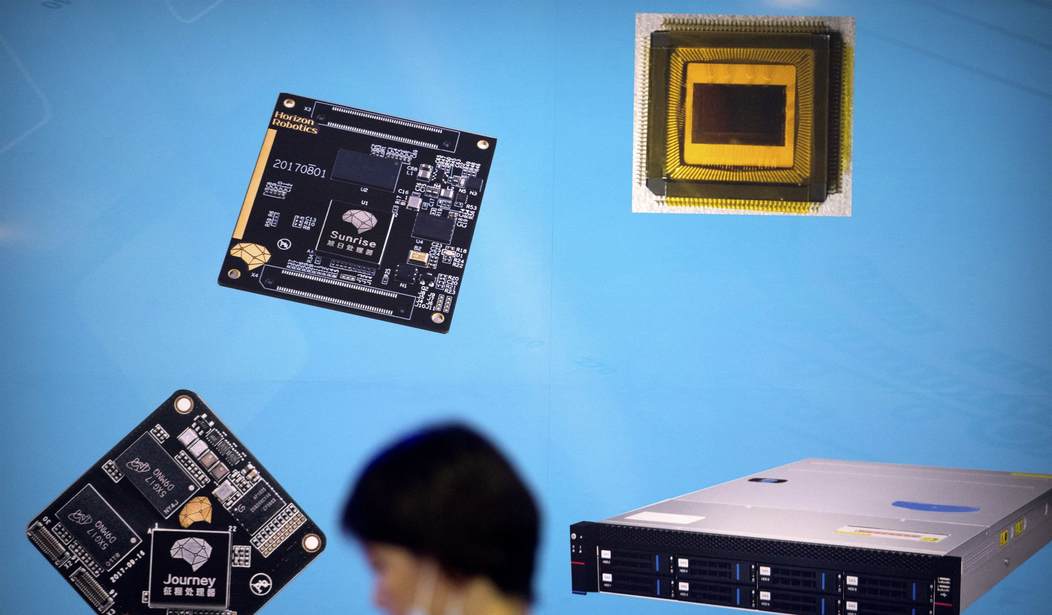
China's planned economy, closed political system, and stifling of freedom of speech do not give it many advantages. But with America tying itself in knots over artificial intelligence, the data centers that power it, and a rejection of battery technology with far more utility than simply putting them in EVs, China has stolen a march on the U.S.
It's a "march to the future" that America cannot lose. Global dominance in these industries will determine the superpower status of both China and America, and give the winner an edge in military superiority.
"America has been napping or distracted by trivialities while China is racing toward the future," reports Axios, writing about Evan Osnos’s New Yorker article, “The Future, Made in China,” which examines the shifting geopolitical and technological landscape as China aggressively competes with the U.S. for global dominance.
China does not have politicians at the local, state, and national level lining up to demonize data centers. Social media hysteria against AI is virtually unknown, when China can squelch unwanted posting. Neither do they have a government that discourages investment in cutting-edge technologies, nor do they have companies worrying about DEI priorities. What China has is an industrial policy that coordinates resources and strategy across several industries, allowing them to race ahead and capture market share and leapfrog the United States in several key areas of technological development.
Decades of targeted industrial policy and massive state investments have given China a strong foothold in future technologies. China now leads in global manufacturing and export of electric vehicles (EVs), lithium-ion batteries, solar cells, and industrial robots. Unlike the U.S., where A.I. development has largely been left to private Silicon Valley firms, China employs an "all-hands-on-deck" national strategy integrating A.I. into every sector — from automotive to policing and public behavioral tracking. Chinese tech companies are developing competitive A.I. models at a fraction of Western costs.
Beijing sees internal political divisions and shifting trade policies in the U.S. as a sign of Western decline, positioning itself to offer autocracies worldwide technological infrastructure via initiatives like "Belt and Road," which had mixed results in Africa and South America.
It's axiomatic: as America retreats, China advances to fill the void.
Despite its high-tech achievements, such as fully automated factories, China faces severe internal economic headwinds, including a collapsing real estate market, high youth unemployment, and declining public economic optimism. Its annual 7% growth rate has been cut nearly in half. China's mania for control has reached a whole new level. High-tech tools, including facial and emotion recognition, are widely integrated into daily life to maintain political stability and enforce social order. State monitoring is routinely accepted as part of the social contract.
But not by all. China's youth are chafing under all the restrictions, especially since youth unemployment (16-24) is 14.9% and is only getting worse as 12 million college graduates enter the job market. As people push back against restrictions, the government is forced to crack down even more.
American consumers have refused to embrace EVs, a sensible decision considering their performance and lack of infrastructure. But China is rushing ahead, innovating and improving EV performance, and is selling EVs to the world.
"China produces 70% of the world's drones, electric vehicles, lithium-ion batteries and solar cells, the New Yorker says, and "deploys more industrial robots than the rest of the world combined, and, in medicine, it has surpassed the United States in the number of registered clinical trials. Its shipbuilding capacity is roughly two hundred times that of the U.S., and some observers in Washington worry that American stockpiles of munitions would not match China’s in a war over Taiwan."
We've been reading scare stories about China's coming dominance for a decade or more. They usually ignore American progress that keeps us ahead of Beijing on several fronts.
But in several respects, either due to government interference, hysterical, uninformed opposition, or just plain stupidity, America is in real danger of falling behind. It would be an economic and security disaster.
Biotech is another critical industry in which the U.S. is falling behind after decades of being far ahead. Biotech is listed alongside artificial intelligence and robotics as part of the critical "next wave of industries". Experts warn that if the U.S. loses its lead in biotech to China — just as it did with solar panels, batteries, and electric vehicles — it would "irreversibly change the balance of power" between the two nations.
It's not just technology that is driving China's biotech rise.
Chinese biotech firms now generate nearly a third of the world’s new drug candidates, almost matching the U.S. “People in Washington are worried that biotech is the next E.V.s,” an American executive told me. “We’ve scared all of this f**king talent back to China. If you look at the guys who are doing this, they used to work for Western pharma giants, or they were running a top university department somewhere.”
A report by researchers at Princeton, Harvard, and M.I.T. identified almost twenty thousand scientists of Chinese descent who left America between 2010 and 2021. The Canadian scholar David Zweig, who has studied the exodus, told me that at Westlake University, a new Chinese research institute, “there are approximately a hundred new labs set up by returnees, and probably eighty per cent of them are from the United States.” He said, “First, it was because they felt alienated. Then the money dried up.”
The "brain drain" in U.S. colleges is critical. It's one thing to halt federal aid to schools for DEI policies or the schools using grant money for stupid, wasteful things. To deny billions of dollars to schools carrying on vital research is shooting ourselves in the foot. It's a policy that needs to be reexamined in light of our growing talent deficit in the sciences.
China is rising while the U.S. is, at the moment, flat-footed. The situation is still reversible by applying intelligence and acting with foresight over the next critical decade.