


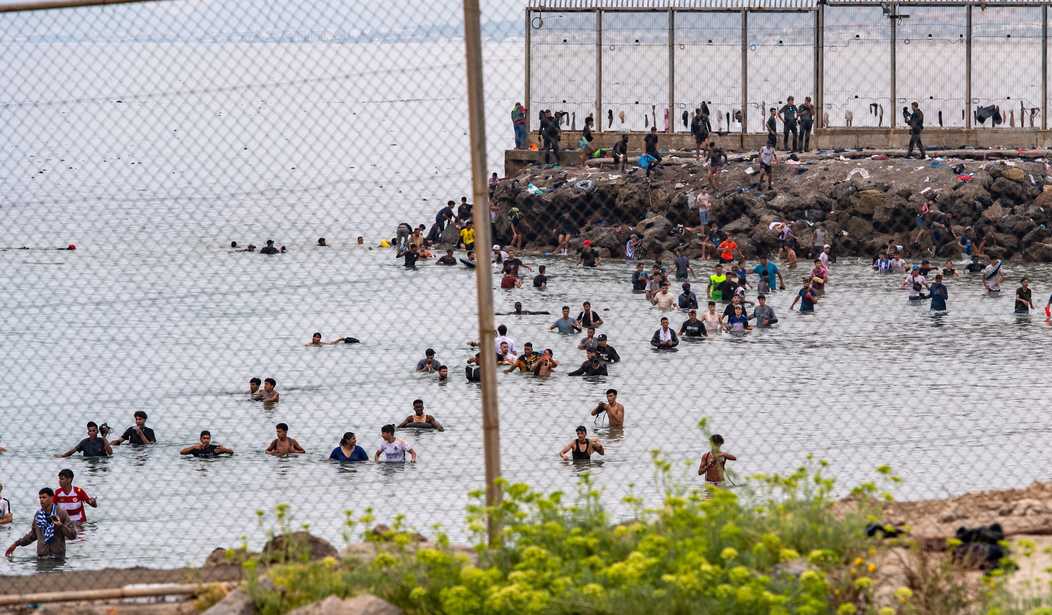
It was one of the most astonishing scenes in modern European history. More than 60,000 people, mostly from Morocco, poured over a breakwater in the Spanish city of Ceuta over a 24-hour period after Moroccan border police deserted their posts.
The lack of border security in Morocco was deliberate. This "migration diplomacy," or "coercively engineered migration," is a geopolitical gambit that Rabat used to bolster its argument in its dispute with Algeria over Western Sahara.
Sovereignty over Western Sahara is Morocco’s top foreign policy goal. Relaxing border security serves as a warning shot when European nations signal support for the pro-independence Polisario Front or normalize relations with Algeria (Morocco's chief regional rival).
By demonstrating how quickly European borders can be overwhelmed without Moroccan border enforcement, Rabat leverages migration control to secure hundreds of millions of euros in development aid and military/border-control funding from Spain and the EU.
Thus, a third-world nation dictates conditions to the mighty EU.
Morocco has a massive youth unemployment problem and inflation. Allowing young Moroccans and sub-Saharan migrants to attempt entry into Europe acts as a political pressure-relief valve for domestic discontent.
A decade ago, more than 2.5 million people poured into Europe in just over a year. The EU politicians breathed a sigh of relief. Their demographic problems of too many old people being supported by not enough young workers seemed solved.
That is, until other problems cropped up. The newcomers were shockingly ungrateful for the chance to live in freedom and prosperity. They refused to cooperate in assimilating to their new surroundings, and many migrants proved to be criminals. What's more, the harsh backlash against governments that allowed the newcomers to waltz right in and receive extremely generous welfare benefits ended up generating a political earthquake. Right-wing and populist parties made huge inroads all across the continent, a political reality that has yet to reach its peak.
Spain and several other EU nations are just now realizing that the course they embarked on 10 years ago isn't sustainable.
Like many other European countries, Spain has a national debt that exceeds its annual gross domestic product. It cannot afford to pay to house illegal migrants. The migrants themselves will never put back in taxes what they take out in welfare. The vast majority of those who arrived illegally in the past decade remain a net drain on the state. And that is before you even begin to address the social and civilizational challenges that such movement brings. But Spain—like the rest of Europe—will continue to try to sustain the unsustainable. Something that I have come to realize can go on for a very long time. It has gone on for more than a decade already. Only four days ago in these pages, I described the spate of terrorist attacks conducted in Europe by Islamist migrants. And just as every week’s news includes stories of the worst effects of Europe’s illegal migration, so each week’s news ignores the long-term unsustainability of the economic migration model Europe has put in place.
England, France, and Germany want to limit new arrivals. England's immigrants were provisionally estimated to be 813,000 for the year ending December 2025. This represents a 20% decline from 1.01 million in 2024 and a substantial decrease from the peak of 1.47 million recorded in March 2023.
In France, the National Institute of Statistics and Economic Studies (INSEE) estimated net migration (total long-term inflows minus outflows) at approximately 150,000 to 160,000 people, serving as the sole driver of French population growth in 2025 due to a negative natural balance of births and deaths.
Germany imported 235,000 people in 2025, representing a 45% decline from the 430,000 net figure recorded in 2024. Because Germany’s natural birth-to-death deficit remained larger than net migration, the overall population contracted slightly by 100,000 to approximately 83.5 million — the first population decline recorded in years.
The big EU nations need these migrants. As much as many center-right voters want to limit or end immigration, the governments are stuck in a demographic death spiral. Not right now, but they are looking ahead 20 years. Without a replacement population, these economies will wither and die. And the demographic bomb is set to go off when the number of workers paying taxes equals the number of oldsters being supported, which will destroy what's left of their stability.
It's not a pretty picture. This is why the EU has no choice but to accept immigrants and why we're likely to see a repeat of Ceuta elsewhere.