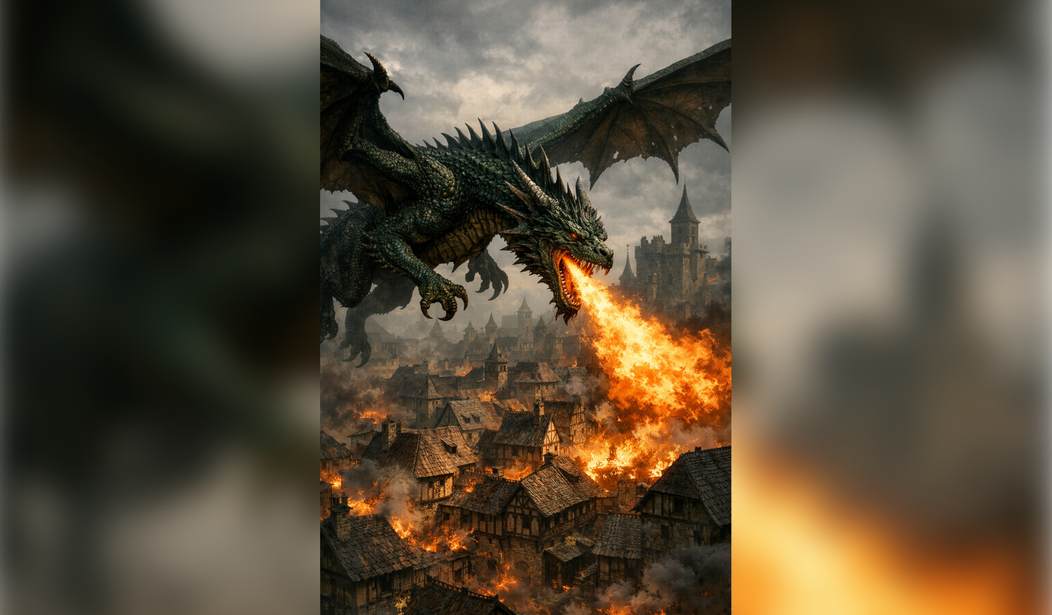
Did dragons ever exist in Earth's history? The bones of several species of flying dinosaurs have been found, but none were contemporaneous with humans. Dragons are a persistent myth across many ancient civilizations, haunting our dreams and animating our stories since humans first sat around campfires.
Amazingly, the artistic depictions of dragons are eerily similar. Long tails, blunt snouts, razor-sharp teeth, and the ability to breathe fire are the way dragons are portrayed from China throughout Asia and into Europe, with the dragon that St. George slew looking a lot like other dragons in Asia and the Middle East.
We're told that dragons never existed. I'm not so sure. The atavistic shudder that is experienced by many when watching the terrifying Dragons of Westeros in the Game of Thrones prequel, House of the Dragon, makes me think that at some point in our distant past, dragons must have been flying overhead, breathing fire, incinerating our ancestors, and causing everyone to gaze skyward when an unfamiliar noise was heard.
The Westeros dragons are the epitome of Hollywood creature creation. They not only fly, albeit awkwardly and with much effort getting off the ground, they also soar like eagles, dive like falcons, swoop like hawks, and attack other predator birds mid-flight like kites.
Sadly, science informs us that they could never get off the ground.
“You don’t have to be an air mechanics specialist like I am to know that if you put the wings on the very front of a Boeing 747, it isn’t going to fly,” Michael Habib, an expert in biology-inspired robotics, tells Popular Science.
Perhaps, but even Habib is forced to admire the creature manufacturers who imagined these marvelous beasts.
Even though the dragons aren’t scientifically capable of flight, an impressive amount of scientific detail and biomaterial consideration went into their design to make it look like they could fly. The fact that most viewers don’t immediately shut off their screens when they see massive dragons soaring through the sky or laying waste to towns is itself a massive win for the art of suspending disbelief, Habib says. That art, ironically, requires a deep knowledge of the science of real large flying creatures.
“You’re trying to minimize how many things [a viewer’s] brain has to accept at that moment,” Habib says. Put another way, “how many impossible things are you asking” each viewer to believe.
"To fly, Habib says, any creature needs to overcome the effect of gravity on its mass, which in the case of dragons would require extreme power," says Popular Science. "Even so, the show is limited in the types of changes it can make to the dragons’ bodies, due to the common image people have come to associate with dragons from centuries of art and lore."
“You can balance that to a certain degree by sweeping the wings forward or back a little bit, but obviously there are limits on how much you can do that,” Habib says. “At some point you get to a stage where you’ve got so much tail, there’s just no way you can balance it.”
In House of the Dragon, the oldest, largest, and most ferocious dragon is Vhagar the Terrible. In Season 2, during a battle between Vhagar and the smaller dragon, Arrax (ridden by Lucerys Velaryon), Vhagar swooped down and bit Arrax in half in midair.
Fantasy creators simply need to make it accurate enough to suspend disbelief. To do that, Habib says, maybe the biggest consideration is accurate scaling. What the viewer actually sees on screen in terms of size is volume. The way the dragon behaves, and how the world around it responds, is what translates to the perception of weight. Humans, even laypeople with no biomechanical background, have an intuitive sense for what seems right in terms of scale.
“If it doesn’t act heavy, then your brain goes, ‘Well, something’s broken here because I see a huge volume, but it’s acting like it’s floating,” Habib says. “And then you’ve broken it. Now your mind is trying to make sense of this and you’ve gotten pulled out of the story.”
In terms of pure scientific accuracy, Habib says the show hits a sweet spot with the dragons in the original series. By introducing many more shapes and sizes of dragons in the newer series, House of the Dragon forces the viewer to accept more impossibilities. But that’s not necessarily an inherent negative.
In An Instinct for Dragons, anthropologist David E. Jones refers to dragons as the “oldest, the first, [and] the most basic monster.” They are a composite of all the horrors that predators faced by early humans: snakes, wings, reptilian scales, and sharp teeth were the stuff of nightmares for humans dealing with raptors and big cats.
Stanford historian Adrienne Mayor argues that dragons were a way for early humans to make sense of massive dinosaur bones that littered the landscape. With no understanding of the archaeological record, they created myths about flying creatures doing battle with heroes like St. George.
Regardless of how they originated, humans have had plenty of time to refine their dragons. It’s high praise, then, that Habib says the HBO dragons, particularly those in the original Game of Thrones series, are among the best he’s seen. Also high up on the list: gold-coveting Smaug from The Hobbit films and a recent redesign to a table-top role playing game Dungeons and Dragons.
I'm hoping that House of the Dragon ends with how the dragons became extinct. By the time Game of Thrones begins, they had been extinct for several hundred years.