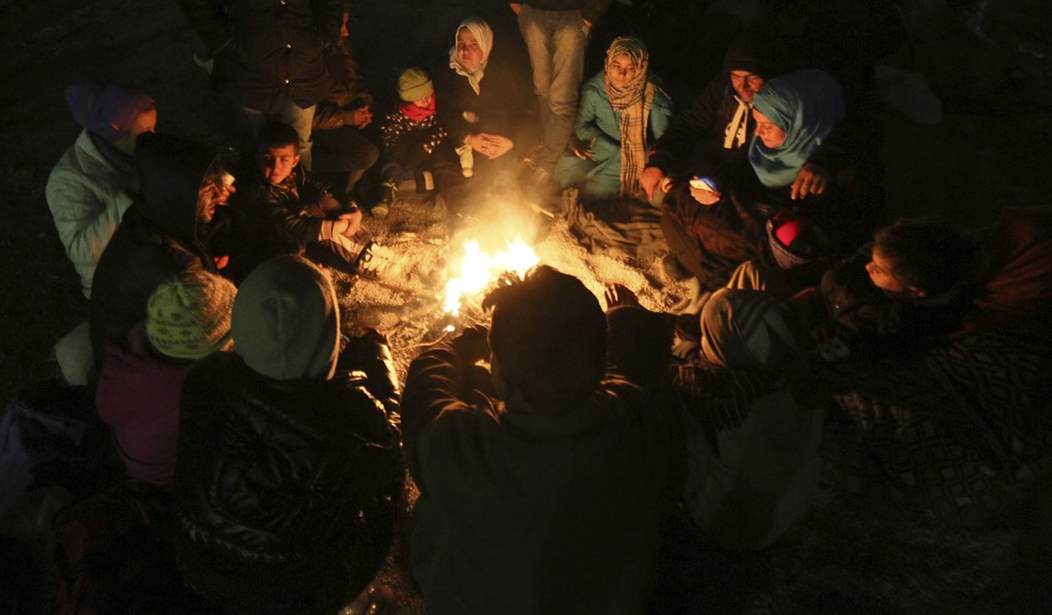
You're out camping with the family, at the roasting-marshmallows stage of the evening, when suddenly everyone gets quiet. The entire family stares into the flickering, crackling fire as if hypnotized, absorbed in their own thoughts. Perhaps you're remembering another family gathering, another time and place.
More likely, your mind is a blank as the fire itself becomes the center of your universe. It's a phenomenon that humans have noticed for as long as fire has mesmerized us. What is the hold that fire has over our imaginations?
Why does Netflix have hours of fireplace footage available for subscribers? You can get two sites with music and one without if you really want to zone out. Roku has a live station of roaring fires.
The fact is, our brains are sending us a message that fire is vitally important and gives us the impetus to master it. It's what evolutionary psychologists call "prepared learning," where "evolution doesn’t always hardwire us with full instructions for things, but gives us a head start on learning the important stuff fast," writes Jennifer Byrne in Popular Science. "Fire is more than just a practicality—it’s closer to a fixation."
Dr. Daniel M.T. Fessler is an evolutionary anthropologist at the University of California, Los Angeles. He and his wife spent three years conducting ethnographic research in Southwestern Sumatra and found that indigenous people who cooked over an open fire lost their fixation with fire at around age 10. Once the kids learned how to make and control fire, it lost its fascination.
“The idea,” Fessler says, “is that if you don’t have the right developmental experiences, that motivation doesn’t shut off, because you never have enough input into the system for it to say, ‘Okay, we’ve done our job. We can step back now.’”
There is evidence to the contrary.
A 2015 study he co-authored tested college students in Anchorage, Alaska, a population with varying levels of fire exposure and mastery, and found something unexpected: People who’d grown up with more fire experience actually reported more enjoyment of it as adults, not less.
Fessler is careful not to overstate the case. “It’s possible that, even in our Anchorage sample, participants did not have sufficiently extensive daily experience with fire as a mundane tool during childhood,” he says. “Or, our hypothesis might just be wrong!”
Related research led by Christopher Lynn, an anthropologist at the University of Alabama, studied what was actually happening in our brains when we stared at fire.
In one study, he tracked blood pressure while volunteers watched fire under different conditions and found a measurable drop, particularly when the fire included its natural crackling sound. The effect grew stronger the longer people watched.
Lynn’s research also touches on dissociation—not in the clinical sense, but the same everyday kind of “zoning out” you’d experience getting lost in a good book or a movie. Fire, his research suggests, might trigger a mild version of that state, where attention narrows, and the mind quiets down.
“It’s not surprising to me that we see these relaxation effects,” Dr. Fessler says. “Part of it is probably due to the stimulus properties of fire itself, part of it is the emotional attraction to it, and part of it is clearly cultural.”
Fessler is amused by the fascination of homeowners with the idea of buying a house with a fireplace.
“If you look at real estate listings, what do they describe? The number of bedrooms, the square footage, the number of bathrooms, whether it has a swimming pool and the number of fireplaces,” he says. “Which is completely absurd.”
I don't know if it's "absurd" to enjoy quiet moments with your loved one staring into a fireplace or making love by a roaring, crackling fire. Sounds pretty nice to me.
Also for our VIPs: The Explosive Growth of 'Death Doulas' and the $100 Billion Business of Dying