


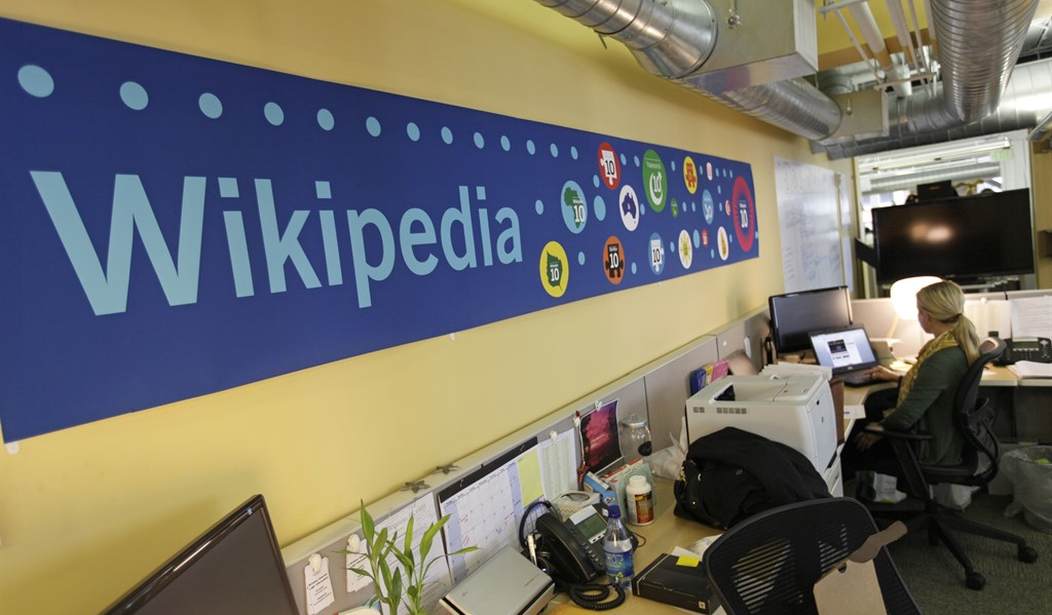
Any writer worth his salt uses Wikipedia as a reference source on key issues, not because it's "the most important encyclopedia in human history," as co-founder Larry Sanger calls it, but in spite of that.
Wikipedia could have been an incredible research tool driven by the free exchange of ideas and opinions if everyone's perspectives had been taken into account. Unfortunately, that's not the case now, and I doubt that it ever really was.
The left hijacked Wikipedia early in its history. Sanger wrote the original guidelines stating that Wikipedia should be a neutral, crowd-sourced publication where anyone can contribute.
"Instead of maintaining strict neutrality when it comes to the most important and contentious topics," Sanger writes in The Free Press, "Wikipedia has, over time, become decidedly globalist, academic, secular, and progressive." He adds, "In other words, it has become the mouthpiece of a relatively narrow liberal establishment, which has left perspectives beyond its borders out in the cold."
Perhaps the project was doomed to fail from the start. In his own way, Sanger was as naive as anyone in the early years of the internet who saw the web as humanity's saving technology. It was widely available, which meant that it was "democratic" and untainted by bias. The problem, Sanger thinks, can be traced back to Wikipedia's founding years.
It goes back to a fundamental problem with the site: Wikipedia has never developed a community charter. Instead, it operates under vague, collaboratively written rules that are interpreted by an all-powerful class of “admin” moderators beholden more to each other than to any constitutional framework. It is rule by an anonymous mob, and not even a large one; of about 800 administrator accounts, only about 400 are active. Because of that, important contributors have been blocked; pages about socialism and communism whitewashed (or turned into hit jobs, or deleted outright); facts censored in the name of “undue weight” and avoiding “fringe views”; and left-leaning outlets overwhelmingly favored. All this transpires with no mechanisms for real accountability.
The lack of transparency and accountability is a major flaw, but Sanger is missing the point. Neutrality itself is a perspective. What is "neutral"? "The Republican Party, for instance, is classified as being on the 'right-wing to far-right' of the political spectrum," Sanger writes. "And the Democratic Party? 'Center to center-left.'”
If you're a Democrat, you'd see those biased statements as true and accurate. There simply is no "objective neutrality," or, at least, a neutrality that everyone can agree on.
Sanger tried his best. He proposed Nine Theses on Wikipedia in September 2025. "The program advocated, among other things, enabling competing articles, abolishing biased source blacklists, and reviving our original policy of neutrality on topics of controversy," says Sanger.
Sanger was hoping to inspire reform on the platform without having to take an active role. "Two-thirds of the commenters on the proposal were opposed, and among those opposed were some of the most influential voices on the platform, including administrators and experienced editors—the kind of voices that naturally intimidated my supporters," he noted.
Failing to generate much enthusiasm for reform using an indirect method, Sanger formed a group named WikiProject Intellectual Diversity (WPID), whose goal was "to guide Wikipedia’s policies toward allowing a more diverse set of views than those currently permitted on the site."
He was shocked at the response.
I am no stranger to online controversy, but what happened next surprised me. Last Friday morning, I woke to dozens of comments from users on my WPID application. For simply advocating for a wider use of sources and a more open decision-making process, some critics accused me of trying to grant an “unearned DEI-type lift to far minority, such as far-right, positions.” One editor called WPID “a barely concealed attempt at a coup d’état via canvassing. It’s a sabotage operation.” Another insisted: “Strongest oppose in existence. Far-right extremism is not welcome on Wikipedia. Trans rights are human rights by the way.” Another wrote simply: “Oppose because Larry Sanger.”
I updated my X followers in bemusement, telling them about the absurd debate occurring over my project. Then some users noticed this, and accused me of “off-wiki canvassing.” “You are using your platform to influence the vote,” they said. Of course, I never called for participation in the debate; I just said it was happening. Even Jimmy Wales agreed it wasn’t canvassing, writing that my post was “unambiguously fine.”
A kangaroo court of Wikipedia bullies put Sanger on trial. "There was no assigned judge, because my accusers were also my judges. And of course there was no presumption of innocence, no jury, and no requirement of decorum that would forbid prejudicial statements," he wrote.
A Soviet show trial of the 1930's would have been fairer.
Shortly after Sanger went on trial, an administrator banned him. "There is general agreement among participants that he has engaged in off-wiki canvassing and is not here to constructively build the encyclopedia.”
The real reason Sanger was banned was that he wanted to include alternative viewpoints on key issues and broaden the base of administrators to include people who pushed back against the fascist left. It was not to be.
"Wikipedia changed the world," Sanger writes. "But its tragedy is that it grew so large that it sucked most of the air out of competing projects and, even as it grew to dominance, it was taken over by ideologues and shills who co-opted it for propaganda purposes."
Not having the intellectual honesty to recognize that there are other legitimate points of view is the greatest tragedy for a platform that showed such promise at its founding.