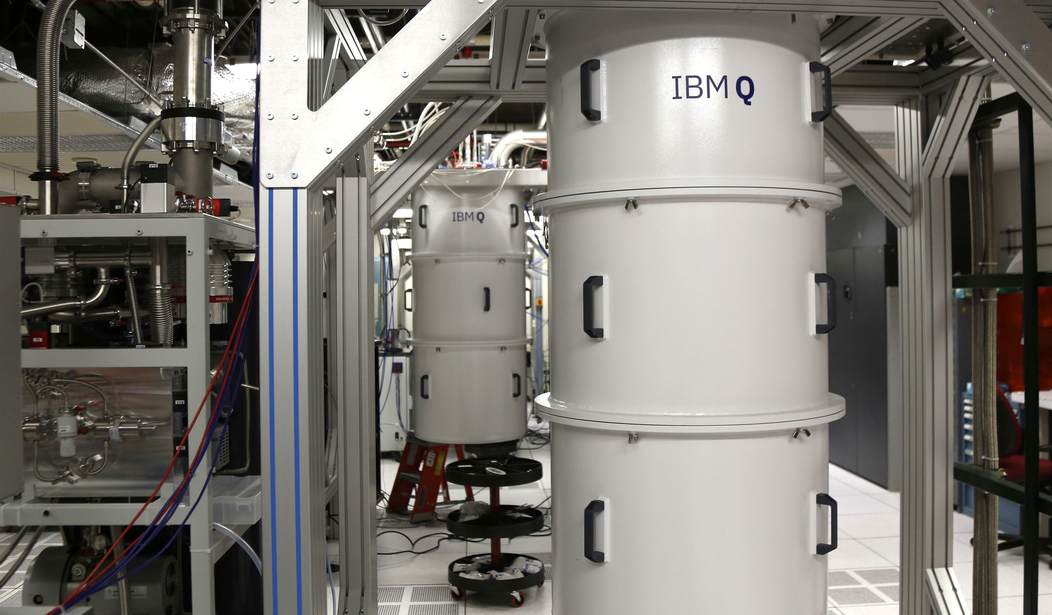
Donald Trump signed a package of executive orders on Monday, committing the government to a high-stakes race with China to develop quantum computing technology to help protect U.S. systems from sophisticated cyberattacks and to create ways to supercharge artificial intelligence.
A quantum computer has been the holy grail of computer scientists for nearly 50 years. The theoretical concept of quantum computing began to take shape in the academic world around 1980, thanks to physicists such as Paul Benioff and Richard Feynman. However, science fiction writers started incorporating the term and the idea into their stories shortly after.
A quantum computer uses the laws of quantum mechanics to solve entirely different classes of complex, massive problems than an ordinary computer. A classical computer handles data sequentially or by brute force — trying one combination at a time. A quantum computer calculates an astronomical number of possibilities simultaneously.
It accomplishes this using concepts called superposition and entanglement. The example most teachers use to illustrate superposition is "Schrödinger's cat," where the cat is in a box with a vial of poison that will only break if an atom in the box decays. There is a 50% chance that the atom decays in one hour. In the quantum world, the vial breaks in some outcomes and doesn't in others. The observer won't know which it is until he opens the box. Until then, the cat is in a state of "superposition," both alive and dead.
"A quantum computer utilizes 'entanglement' and 'quantum interference.' Entanglement links qubits together instantaneously across distances; changing the state of one instantly alters the possibilities of another. This allows a quantum computer to evaluate a massive number of possibilities simultaneously. In the maze analogy, a quantum computer travels down every single path at the exact same time." (Hat Tip: Gemini)
In groundbreaking experiments, researchers successfully distributed entangled photon pairs across distances of thousands of miles using China's Micius quantum satellite. This demonstrated that entanglement could exist across space constraints without degradation.
Einstein called the effect of two particles on opposite sides of the universe being connected "spooky." It is that.
The possibilities for creating unbreakable encryption, as well as the ability to crack any system's encryption, are staggering, as are the implications. No system would be safe unless it were protected by a quantum computer's algorithm.
With the executive orders, Trump has unleashed the power of American capitalism to create quantum systems that would allow the U.S. to dominate this nascent industry.
Trump said the first order would launch an effort to create a quantum computer capable of performing important scientific calculations. White House officials, who briefed reporters on condition of anonymity ahead of the signing, said they believed a computer could be developed by 2028.
The order also calls on agencies to work on plans to deploy quantum-enabled sensors and networks in the next five years, the officials said. The order also supports coordination with allies to protect quantum intellectual property and bolster supply chains.
A second order seeks to accelerate US deployment of algorithms that can resist quantum-powered cyberattacks, with migration to those standards — called post-quantum cryptography — set for 2031 at the latest for high-value assets at agencies. Quantum technologies remain mostly theoretical for now and are unproven at scale, but could one day be powerful enough to break the standard encryption standards used to keep a wide swath of information, such as bank payments, private.
"Technologists and physicists have tried for decades to harness the mind-bending mechanics of quantum physics into making so-called supercomputers that would be exponentially more powerful than conventional machines," reports Bloomberg. "The industry has made some breakthroughs but is still working to overcome the challenges of making the technology work at scale."
Also for our VIPS: Will We Know Alien Life When We See It?
The promise of supercharging artificial intelligence to perform tasks such as molecular and chemical simulations is mind-boggling. Because qubits operate under the same quantum physics laws as actual molecules, they can simulate chemical reactions perfectly. This allows scientists to design life-saving drugs in days rather than decades, invent hyper-efficient solar panels, and discover new materials—like room-temperature superconductors or ultra-strong, lightweight alloys.
So say quantum computer enthusiasts.
The potential is certainly there for revolutionary discoveries. How a quantum computer actually performs in the real world is still unknown.