

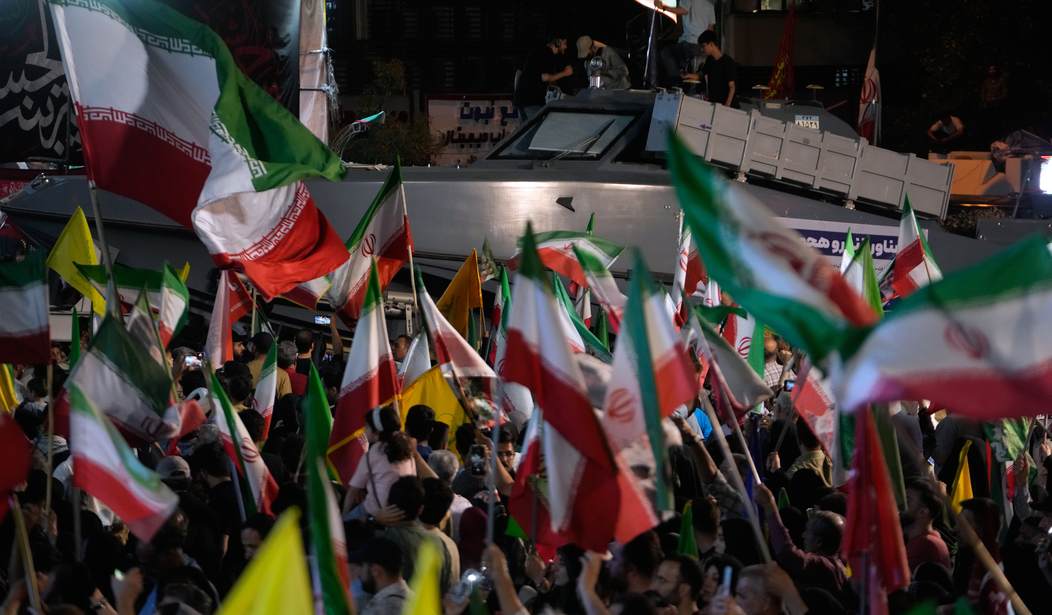
Iran is facing a dilemma. It is about to sign a Memorandum of Understanding (MOU) with the U.S. to end the war, allowing it to continue enriching uranium and building ballistic missiles, but it must be careful about what it says and how it says it.
Donald Trump is likely to call off the deal if the Iranian government takes too triumphant a tone about its success in surviving the U.S.-Israel onslaught and brags about its triumph at the negotiating table.
Iran gets to continue enriching uranium. Its stockpile of highly enriched uranium, to 60%, remains in their hands with a nebulous promise to negotiate a way to "dilute it." They will be allowed to continue to support their terrorist networks in Lebanon (Hezbollah), Yemen (Houthis), and Gaza (Hamas). They will have access to $300 billion to rebuild their defenses and ballistic missile forces.
Surprisingly, hardliners in Tehran don't believe that this deal is good, although not for the same reasons as some in the U.S.
Kayhan, the hardline conservative daily, adopted a tone of open opposition, portraying the agreement as diplomatic capitulation under Western pressure and breaking with the official state narrative of victory.
“Surrendering to the Great Satan under the guise of an ‘antidote’ or regional de-escalation is a betrayal of our long-standing resistance,” Kayhan wrote.
“The historical track record shows that retreating before American demands never guarantees peace; it only invites further exploitation. This administration is repeating past blunders, turning a blind eye to our ultimate red lines.”
Khorasan, a conservative daily close to chief negotiator and parliamentary speaker Mohammad Bagher Ghalibaf, framed the MoU not as a peace settlement but as a tactical pause.
“The emerging agreement only aims to end the current war and does not resolve the underlying issues between Iran and the United States,” it wrote.
Meanwhile, the government-controlled media tried to contain its triumphant tone by modestly thanking the people of Iran for their support.
Tehran's top diplomat, Foreign Minister Abbas Araghchi, stated that the "Iranian nation achieved not only tactical victories during the 12-day imposed war in June last year and the recent war, but also important strategic accomplishments whose impact can be observed in both regional and global equations."
Araghchi said, according to IRNA," that the true image of Iran’s power on the global stage stems not only from its military capabilities but also from national cohesion, resilience, and the active involvement of its people."
Lisa Daftari, the founder and editor-in-chief of The Foreign Desk, told Fox News Digital that "Inside Iran, state media is selling this as a victory, not a compromise. The message on Iranian television is that a ‘strong and proud’ Islamic Republic has forced Washington to recognize its control over the Strait of Hormuz and to ease military pressure, while Tehran supposedly gives up very little in return."
The de facto recognition of Iran's control over the Strait of Hormuz is perhaps the most surprising and worrying aspect of the entire deal. The Strait is in international waters. If Iran is allowed to charge tolls for tankers and other vessels to traverse the Strait, it will create a precedent that will dramatically affect international shipping, not just in the Strait.
Accepting a toll system amounts to recognition of Iran's absolute sovereignty and military control over a crucial international choke point. It grants Tehran significant leverage to dictate terms to global powers, effectively allowing them to decide who gets to pass based on compliance with their demands.
Daftari adds, "The Islamic Republic’s very DNA is built on delay, deceit and deniability. Every agreement it has signed has been treated as a tactical pause on the way to more missiles, more proxies and more leverage, not a real change in behavior. So while it’s important to read the fine print of this new deal, it’s even more important to remember who is signing it. A system that survives by holding deadly weapons over its neighbors and by lying to its own people is not suddenly going to become a trustworthy partner."
She concluded, "The Trump administration should assume from day one that Tehran will test every loophole, hide every capability it can, and resume its nuclear program, amass its drones and missiles, fund its deadly proxies while continuing to torture the Iranian people at home."
Iran is not exactly gloating over its perceived victory. It's too smart for that. But it's clear it thinks that it came out on top.
Editor's Note: The Democrat Party has never been less popular as voters reject its globalist agenda.
Help us continue exposing Democrats' plans to lead America down a dangerous path. Join PJ Media VIP and use promo code FIGHT to receive 60% off your membership.





Join the conversation as a VIP Member