


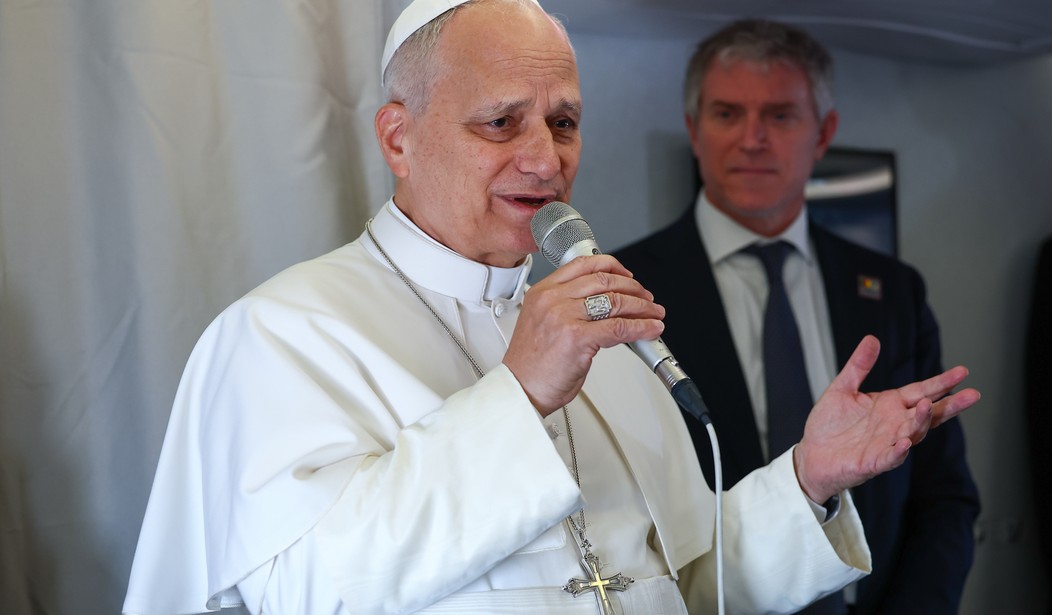
Pope Leo XIV is a thoughtful man. His recently released first encyclical, a 44,000-word document titled Magnifica Humanitas (Magnificent Humanity), shows a surprising depth of understanding of man, technology, and our fraught relationship with modern tech.
It's no accident that Robert Francis Prevost took the name Leo when he was inaugurated as pope. The papal name "Leo" has a long and illustrious history in the Catholic Church. Leo I is the pope who tangled with Attila on the outskirts of Rome, pleading with him to spare the city. Legend has it that Attila turned around and left due to a miracle. The reality is that the bubonic plague had almost certainly decimated Attila's army, which is why he left Italy.
It's the last Pope Leo, dubbed XIII, that Prevost was thinking of when he took the name. Leo XIII and his advisors wrote one of the most important documents in the history of the Church: his 1891 encyclical, Rerum Novarum (“Of New Things”), which decried the excesses of the Industrial Revolution. The document "called for the protection of workers and the need for collaboration between capital and labor," according to The Deep View. The encyclical served as a catalyst for organized labor in Europe and, eventually, the United States.
Leo XIV approached the AI encyclical from the standpoint of Catholic social doctrine. It's intellectually lazy to classify this as "socialism." In fact, Leo and most pontiffs in the past were "gospelists," taking inspiration and direction from what they believed was the word of God. That sacred word taught, as Leo XIII claimed in his critique of the Industrial Revolution, that the wonders of technology should never blind us to the simple fact of our humanity, created in the image and likeness of God, and which carries a responsibility to love our fellow humans.
Leo convened an AI study group and "reportedly consulted with scientists, technologists, theologians, moral philosophers, researchers, and business executives," according to The Deep View. The result of their work and Leo's thinking on AI changes the conversation about AI, shifting it toward its effects, both good and bad, on humanity rather than specifics like lost jobs. Keeping the conversation on this plane is designed to think first of our humanity.
"Technology has the power to heal, connect, educate and protect our common home; but it can also divide, exclude and generate new forms of injustice," writes Pope Leo XIV in the new encyclical. "In the abstract, technology in and of itself is not a solution to humanity's problems, just as it is not inherently evil."
Past Catholic teachings have only railed against "capitalism's excesses," losing sight of our fellow man's needs in the rush for profits. That Catholicism is not exclusively anti-capitalist is evidenced by business associations such as the Catholic Business Network (CBN) and Pope John Paul's Centesimus Annus Pro Pontifice (CAPP), which focus on promoting the knowledge and practical application of Catholic social teaching in the business world, economic policy, and workplace management. These associations recognize a responsibility toward employees, suppliers, and the broader community, rather than prioritizing shareholders exclusively.
Leo's encyclical states, "In practice, however, technology is never neutral, because it takes on the characteristics of those who devise, finance, regulate and use it. Therefore, the primary choice is not between a 'yes' or 'no' to technology, but rather between constructing Babel or rebuilding Jerusalem; between a power that claims to dominate the heavens and a people who work together in the presence of God to rebuild the walls of fraternal coexistence."
The document's five chapters place Catholic social doctrine in the context of history and current events. Chapter 2 argues that new forms of "property" such as patents, algorithms, digital platforms, data, and technological infrastructure must now be subject to the principle of the "universal destination of goods" — meaning they can't be monopolized by the few. That's a direct echo of Leo XIII's Novorum, placing his own document squarely within Catholic theology.
Chapter 3 confronts the "technocratic paradigm" directly. "The main drivers of technological development are now private, often transnational, actors whose resources and capacity to intervene surpass those of many governments — making governance toward the common good harder," according to The Deep View. The encyclical warns against transhumanism and posthumanism as distorted visions of human flourishing, affirming that authentic human "transcendence" comes through grace, not technological enhancement.
Liz Wolf, writing in Reason.com, questions the encyclical's real-world applications. Unlike Leo XIII's critique of unfettered capitalism, Leo XIV's high-mindedness has another purpose entirely.
Leo XIV notes that "the pursuit of greater profits cannot justify choices that systematically sacrifice jobs." (Libertarians might be divided on his contention that "the economic order must remain subordinate to human dignity and the common good" based on their religious beliefs.) He correctly anticipates that "a society that guarantees employment to only a small fraction of the population, despite having a high level of technical development, risks exposing many to forced inactivity, a lack of responsibility and the absence of daily tasks and stimuli, resulting in human and cultural impoverishment," but it's not clear how this ("the Church's Social Doctrine insists that access to work for all must be a high priority for public policies and economic processes") actually plays out in practice. That said, he's not really trying to craft policy: He's trying to provide moral frameworks that can help policymakers clarify what it is they're trying to do.
Leo's take on AI is cautious and intelligent, leaving plenty of room for discussion, which is not always the case with such papal edicts.
I liked Leo XIV from the start because he shows great intelligence in being a Chicago White Sox fan. That he also demonstrates a deep understanding of the modern world is a plus.
Editor's Note: Do you enjoy PJ Media's conservative reporting that takes on the radical Left and woke media? Support our work so that we can continue to bring you the truth.
Join PJ Media VIP and use promo code FIGHT to receive 60% off your membership.






Join the conversation as a VIP Member