


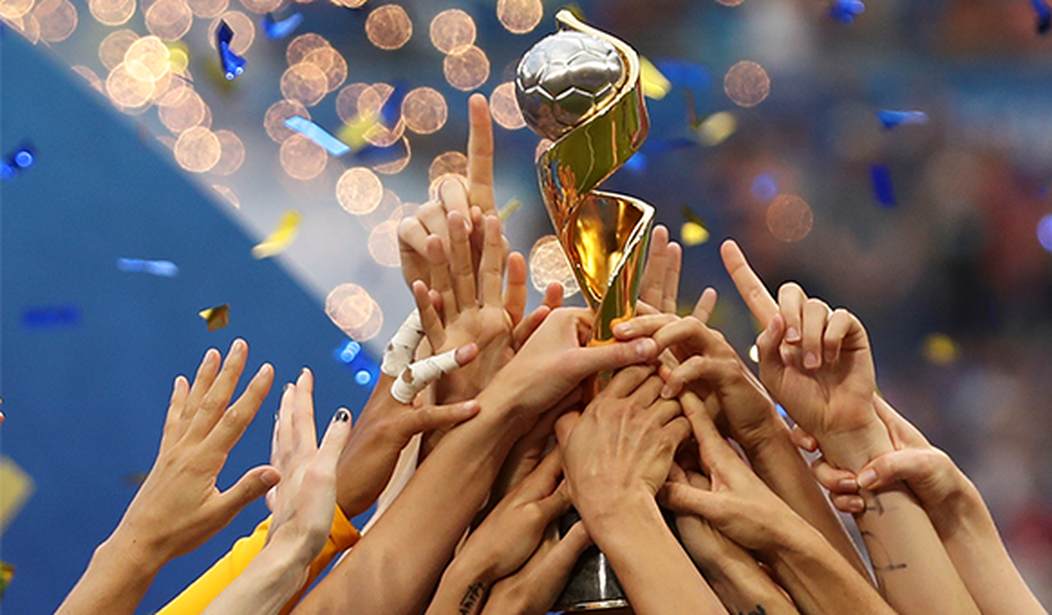
The world is coming to the United States for five weeks in June and July to witness the greatest extravaganza in sports.
That's how the Fédération Internationale de Football Association (FIFA) describes the World Cup Soccer Tournament, anyway. And that's how most of the rest of the soccer-mad world sees it.
FIFA, like the International Olympic Committee (IOC), is a perfect example of internationalism run amok. Mediocre men and women are placed in a position of absolute authority, handling billions of dollars in revenue, with little oversight and less transparency. Payola scandals are common.
The FIFA bribery scandal, widely known as "FIFA-Gate," is one of the most significant corruption cases in sports history. It involved a "systemic, deep-rooted" culture of racketeering, wire fraud, and money laundering that spanned over 24 years, according to the U.S. Department of Justice (DOJ).
While FIFA generates billions in revenue, investigations revealed that high-level officials often used the tournament selection process for personal enrichment. Shocker!
Over 40 individuals and entities have been charged by the U.S. DOJ, with many high-ranking officials arrested in Zurich. Longtime FIFA President Sepp Blatter and Union of European Football Associations (UEFA) President Michel Platini were eventually banned from football due to unethical payments.
The corruption extended to media rights. For example, Televisa, the world's largest Spanish-language content producer and a major Mexican telecommunications operator, paid a $95 million settlement in 2023 following allegations it concealed bribes used to secure rights for the 2018, 2022, 2026, and 2030 World Cups.
The FIFA people have so much money, they don't know what to do with it. The organization is expecting a windfall of $11 billion for the 2026 World Cup.
The largest single expense is the actual cost of running the World Cup. For 2026, this includes:
Logistics and Staffing: Managing 104 matches across 16 host cities.
A record $655 million total prize pool, with the champion slated to receive $50 million.
Every participating nation receives a guaranteed minimum payout (recently increased to $12.5 million) plus preparation funds and travel subsidies.
FIFA also pays roughly $200 million to professional clubs worldwide to compensate them for releasing their players for the tournament.
When FIFA announced that the tournament would be held in North America, with the U.S., Canada, and Mexico sharing the glory, 18 U.S. cities offered bids to host games. Little did they know what they were getting into.
Then-New Jersey Governor Phil Murphy epitomized the enthusiasm among local officials when he said that there was no way to “overestimate” how big a bonanza the games could be for his state. Only a few skeptics voiced concerns, including officials in Chicago who withdrew their bid to be a host city, fearing open-ended costs. Still, FIFA president Gianni Infantino hyperbolically claimed the U.S. economy would derive $30 billion from the games. Eventually, FIFA chose 11 U.S. cities as hosts and designated Jersey’s MetLife stadium as the home of the prestigious final.
The glow quickly started to fade once sales began. The first disquieting signs were unprecedented ticket prices and a decision by FIFA to allow unlimited resale of tickets, from which it would take a cut of the profits. This set off a worldwide effort by scalpers to corner tickets they knew they could hawk for significant profits. As sales proceeded, anger grew over what seemed to be questionable efforts by FIFA to squeeze fans. Early buyers were sold tickets for certain sections in the stadiums, but not with individual seat numbers, only to later receive actual tickets that were farther from the action and less desirable than stadium maps had implied. “It’s just hard to not feel scammed and/or bamboozled,” one fan said.
They should have let the mafia run it. At least then, no one would expect fairness, transparency, and reasonable prices.
Local officials were swindled. Gillette Stadium in Foxborough, Mass., which will host seven matches during the tournament, "suddenly faced a nearly $8 million bill for public safety related to the tournament," according to City Journal. "This included not only the games themselves but also FIFA-mandated fan fests, security for tournament officials, and additional airport security."
Unbelievable.
Perhaps the cities should have read the fine print. Or maybe they got caught up in the buzz.
In 2018, after the North American bid was accepted, then-New Jersey Gov. Phil Murphy said that there was no way to “overestimate” how big a bonanza the games could be for his state. The current governor, Mikie Sherrill, claimed that Murphy, also a Democrat, "had left her with a $48 million bill for World Cup transportation and criticized FIFA, arguing it could earn as much as $11 billion on the tournament while providing no subsidy to host cities," according to City Journal.
The sad fact is that big sporting events like the World Cup end up costing cities a pretty penny.
A 2004 study examining the 1994 FIFA World Cup concluded that the average host city experienced more than $700 million in reduced local income during the tournament. Such losses were linked to a “crowding out” effect in which higher prices for hotels and other venues discouraged regular tourists from visiting host cities.
Subsequent World Cups have inflicted similar adverse economic impacts. While South Africa spent nearly $4 billion to host the 2010 event, it attracted only half the anticipated visitors, and economic output in the country slowed during the event.Brazil’s government invested a sobering $14 billion on new stadiums and infrastructure to host the 2014 World Cup, only to spark protests within the country on rising costs borne by Brazilians to finance the effort.
I love watching soccer, especially national teams like Brazil, Germany, and England. But I would never pay $2,700 to watch the U.S. play. Not when the game is on TV, and I don't have to deal with crowds.
If you're a fan, keep in mind the grasping claws of FIFA hoovering up Americans' dollars with one hand while the other hand is reaching into the city coffers, taking tax revenue that could have and should have been spent on almost anything else.
If the world loves soccer so much, let them host the damn tournament. We'll gladly stream the game on our own time and at our own leisure.
Editor's Note: The Democrat Party has never been less popular as voters reject its globalist agenda.
Help us continue exposing Democrats' plans to lead America down a dangerous path. Join PJ Media VIP and use promo code FIGHT to receive 60% off your membership.