


Iranian President Masoud Pezeshkian, Judiciary Chief Gholam Hossein Mohseni Ejei, and Parliament Speaker Mohammad Bagher Ghalibaf are all in deep trouble and will have to be nimble on their feet if they want to keep their heads on their shoulders.
The trio is being accused of the worst crime imaginable. They are being fingered by the Islamic Revolutionary Guard Corps (IRGC) as "moderates."
The three leaders "issued a series of statements aimed at defending themselves from accusations of 'moderation' in the Islamic Revolutionary context," reports the Institute for the Study of War (ISW).
The three statements were almost identical, probably indicating they were written for them.
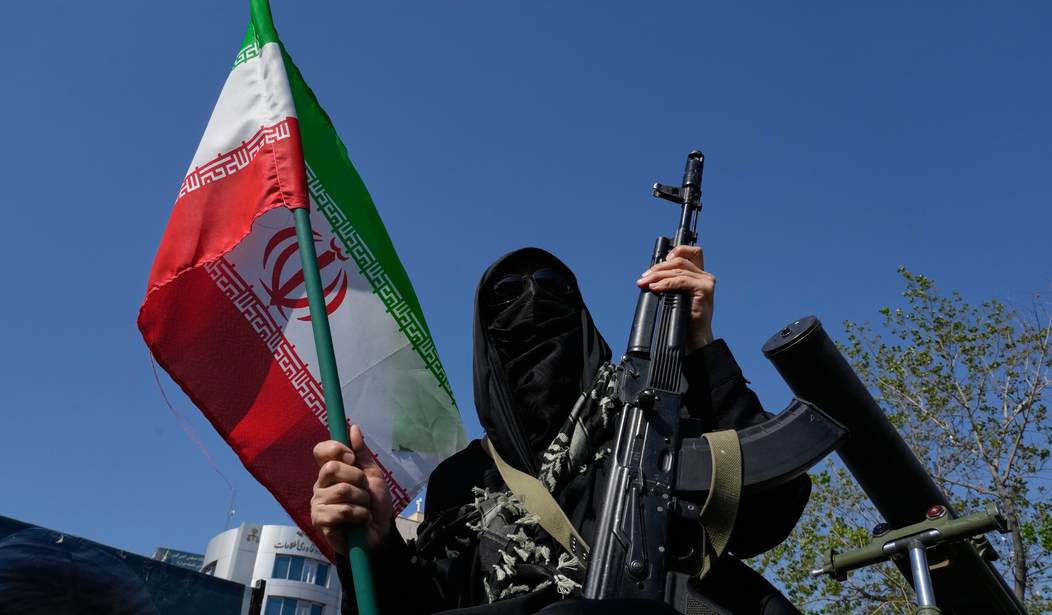
The longer Trump's blockade continues, the more likely it is that the pressure cooker that is Iran will explode, and the regime, even with extreme brutality, will have a hard time maintaining control.
The blockade is an absolute killer. All the braggadocio and bombast coming from Iran is a smokescreen to hide the simple fact that the Iranian economy is down for the count.
"While a conditional ceasefire is in place (extended until talks are concluded), almost no shipping has used the strait, and it remains effectively closed," says a report to the British parliament.
In practical terms, the blockade of the Strait of Hormuz and other Iranian ports is quickly destroying the Iranian economy. Approximately 90% of Iran’s crude oil exports typically sail through the Strait of Hormuz. In 2025, Iran exported roughly 2.41 million barrels per day (crude and products) through this route.
Beyond oil, the Strait handles about 30% of internationally traded fertilizers from the region. For Iran, these industries are major employers and pillars of the national stock exchange. Estimates suggest that a full blockade or closure of the Strait results in losses of roughly $450 million to $500 million in daily economic activity for the country.
And that's just the Strait of Hormuz. Blockading all Iranian ports will quickly bring Tehran to its knees.
The U.S. government estimates the naval blockade alone is costing Iran $500 million daily by halting nearly all sea-based imports and exports. Tehran claims that the overall conflict has caused roughly $270 billion in damage to its infrastructure and economy, which is equivalent to approximately 57% of its GDP. (Author emphasis)
Analysts at the Foundation for Defense of Democracies (FDD) estimate that reconstruction under the weight of sustained sanctions could reach $144 billion, a figure that continues to climb as the blockade persists.
Authorities had to shut down the stock exchange in March or risk a total meltdown. Other measures have been like putting a Band-Aid on a gaping wound.
The war has transformed Iran’s preexisting economic crisis into a systemic breakdown. Official Iranian estimates put direct and indirect damage at up to $270 billion, though independent assessments suggest the true cost could be several times higher. GDP is projected to contract by around 10 percent this year, with the International Monetary Fund forecasting inflation approaching 69 percent. Iran’s Central Bank has warned that full reconstruction could take up to 12 years.
Precision strikes crippled 85 percent of Iran’s petrochemical export capacity, costing tens of billions of dollars in lost revenue. Attacks on the country’s two largest steel plants slashed national steel production by an estimated 70 percent. In addition to being generators of export revenue, these industries are also major employers.
Steel and petrochemical industries are also pillars of the Iranian stock exchange. They function as important vehicles for protecting assets from inflation. Yet since early March 2026, the regime has forcibly shut down the Tehran Stock Exchange entirely. The halt was a desperate measure to prevent an immediate market meltdown, panic selling, and a rush out of the rial into hard assets. By freezing trading, the regime has temporarily hidden the true scale of wartime destruction from the Iranian public.
How long can the government remain in power with this kind of pain being inflicted on the population?
The international publication El País reports that," According to Iran’s Statistical Center, 'year-on-year food inflation, which was just under 43% a year ago, reached nearly 125% before the blockade.” The magical "triple-digit" inflation figure is being keenly felt across the country. Hungry people are unhappy people. Whether Iranian's would brave the guns of their oppressors is doubtful.
But the internal strife is creating a multiplying number of factions within the IRGC and other lesser power centers. If the pressure continues, I think we can expect some kind of civil war to break out if Trump keeps the pressure on.
The "shock and awe" part of the war may be over. But the intensity of the power struggle between factions is only just beginning.
Editor's Note: Do you enjoy PJ Media's conservative reporting that takes on the radical left and woke media? Support our work so that we can continue to bring you the truth.
Join PJ Media VIP and use promo code FIGHT to receive 60% off your membership.