


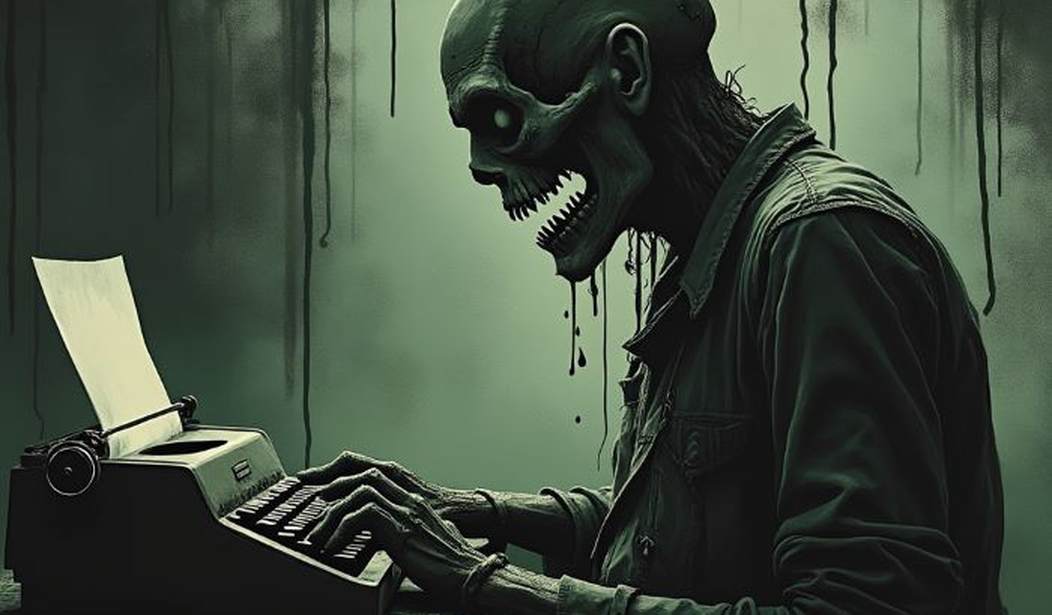
The real "AI apocalypse" isn't a sci-fi scenario of robot uprisings, but rather a degradation of the human "form of life," as philosopher Ludwig Wittgenstein observed in the 1940s. This occurs when we adopt a purely technical or scientific way of thinking that reduces human experience and language to the mechanical processes we find in a calculator.
The threat to humanity is "a way of thinking that lowers human life to the plane of science and technology," writes Alexander Stern in Commonweal. "Wittgenstein’s attempt to draw attention to that way of thinking—and dissuade us from it—is of the utmost importance in an era where the developing AI ideology threatens to further distort our understanding of how we use language and how we live," Stern writes.
Large Language Models (LLMs) can only mimic understanding language. That's because AI cannot participate in the actual living of life (it cannot "hope," "greet," or "be born"); its outputs are a "conversational equivalent of" onanism—a one-player game that mimics interaction without genuine connection.
And yet, we treat AI like "cut-rate doctors and therapists, our robot teachers and rent-a-friends," observes Stern. "In the midst of an already quite advanced crisis of meaning—and related crises in politics, mental health, and education—this proposal must be regarded as a piece of sheer insanity, like treating lung cancer with cigarettes."
AI is accelerating the crisis by elevating machines to equal status with humans. Instead of our servants, the machines are being embraced as our friends. Chatbot addiction in young people has already resulted in suicides and serious mental health issues.
Wittgenstein believed he had a way to address this crisis, outlined in his last book, Philosophical Investigations.
The stated goal of the posthumously published Philosophical Investigations, the most complete statement of his later philosophy, is to “struggle against the bewitchment of our understanding by the resources of our language.” He sought, in other words, to “bring words back from their metaphysical to their everyday use” and in so doing to “show the fly out of the fly bottle.” Wittgenstein wrote that philosophers shouldn’t just answer questions but instead “treat” them, “like an illness.”
"If we’re looking for understanding and meaning, Wittgenstein thinks, we will find them in the various things we do with language and not in some internal process that accompanies our use of language," says Stern.
Those internal processes are taking over language. "We are primed to pay homage to the machines because we already think of ourselves—and of our minds, in particular—as machines, albeit ones hopelessly outgunned by digital technology," Stern notes.
This homage has real-world consequences.
Long before the latest version of AI burst on the scene, this view of the mind as a meaning machine had become entrenched as a central premise of tech and the broader neoliberal economic environment in which the industry has thrived. The consequences for this misunderstanding have not been only philosophical. Misguided assumptions about the nature of human beings and human understanding have been used to restructure work, social life, and even the built environment.
Big Tech treats us "as gratification machines, economic calculators, and attentional resources," notes Styern bitterly. Humans "have been atomized, manipulated, and strip-mined."
"The devastating consequences for cultural and political life, sociality, and individual well-being are by now overwhelmingly obvious," notes Stern. Resisting these consequences rests "on our ability to articulate the difference between AI’s linguistic capacity and that of human beings," says Stern.
It's a quaint notion when you consider that even intelligent, tech-savvy adults can't articulate the difference and see chatbots as a lifeform.
Computer scientist Geoffrey Hinton, whose work helped spur the early development of LLMs, has claimed that they are the “best model we have of how people understand language.” The extraordinary stupidity of this statement becomes clear as soon as one learns anything about how LLMs “understand.” They are trained on enormous datasets to make complicated statistical calculations about what words are most suitable to output in response to a user’s prompt. Based on this “pre-training” and on vast amounts of correction by human beings providing “reinforcement learning,” LLMs encode “meaning” in complicated mathematical operations, essentially mapping words and the relationships between them in terms of numbers.
These models are technologically impressive, as is their ability to imitate human textual responses. But what does their mathematical version of meaning have to do with how we come to understand and use language? As Wittgenstein makes clear in the Investigations, a child doesn’t learn language the way we might later in life learn the piano, integral calculus, or even a second language. Primary language acquisition is inseparable from the rest of a child’s dawning world. Language is, in the vocabulary of the philosopher Charles Taylor, “constitutive” of the child’s experience. Learning the words for things is learning the things themselves. It makes them available for the first time and begins to separate the child’s amorphous, bewildering experience into discrete units of meaning: mom, dad, food, eat, ball, etc. Learning language is thus intimately connected with learning to do anything at all, and this, as Wittgenstein insists, doesn’t change with adult language use. Once meaning is separated from the practices in which it is rooted, it soon breaks down into nonsense.
"LLMs, then, can’t understand meanings in the way human beings do because they don’t and can never participate in our form of life," notes Stern. "To really understand language, LLMs would have to be capable of being born." Instead, they are only capable of "mimicking" being alive.
Is this our ultimate fate as we rely on AI not just for problem-solving but as substitutes for humans in our lives? I don't think it's a stretch to see it. AI could easily destroy our sense of humanity if we let it, render "meaning" in our language irrelevant, and push us farther apart by making interaction with other humans optional.
Meanwhile, AI development continues at breakneck speed. Perhaps it's up to conservatives to "stand athwart history and yell 'Stop!'" before we reach a point of no return in the AI Apocalypse.