



In 15 years, private companies will have established permanent bases on the Moon. In 25 years, it's likely that we will have created a permanent human presence on Mars.
These first stirrings of human colonization of the cosmos come with immense problems that must be overcome if our species is to successfully live and work in the hostile environments beyond Earth's atmosphere.
Our body, creation's most perfect machine, doesn't work very well in zero gravity (micro-gravity). In a relatively short time, our bones grow brittle from being weightless, our muscles atrophy, and our blood becomes anemic. Our entire lymphatic system goes haywire. Our heart weakens, and without constant exercise in space, it would be unable to pump effectively after returning to Earth.
How well do we function in the 1/6 gravity of the Moon compared to Earth's gravity? If you weigh 100 pounds on Earth, you would weigh only about 16.6 pounds on the Moon. That has some advantages, but again, the moon's lower gravity would still cause the same physical problems we experience in microgravity, perhaps to a lesser degree.
Eventually, we will be able to overcome these problems. After all, we are a clever species and have overcome far more difficult problems in our history.
One problem we may not be able to solve concerns replenishing the human population in our colonies. We could always just send more people from Earth, but that would be far more expensive than simply growing more earthlings on the colony.
That may not be possible. A study conducted by researchers at the University of Adelaide in Australia adds to the growing body of evidence that suggests "mammalian reproduction in space might be quite complicated, if not impossible," according to Space.com's Tereza Pultarova.
"When you think about the future of space exploration and space settlements, it's happening. It's happening now," Nicole McPherson, a reproductive biologist at the University of Adelaide, Australia, and lead author of the paper, told Space.com. "I think people forget that for us to maintain these settlements without having to continually colonize them from Earth, we need to be able to reproduce in space."
Scientists know sperm relies on a complex set of signals to find its way to an egg. Part of that navigation is driven by chemical cues, such as concentrations of the female hormone progesterone, but gravity seems to play a significant role too, McPherson said.
"We know that sperm responds to chemical cues, but we also know that they like to swim near surfaces," she said. "Obviously, to know where surfaces are, you need to understand your position in time and for that you need gravity."
The struggle of sperm to make it to the egg was only one part of the findings. When sperms managed to reach the eggs, the ensuing early-stage embryos, called blastocysts, initially appeared stronger than their counterparts conceived in gravity. However, when microgravity exposure continued, the superior quality of microgravity-conceived blastocysts deteriorated and the embryos started to lag behind their normal counterparts.
The more we learn about the unforgiving environment beyond Earth's atmosphere, the more we realize just how finely tuned our bodies are to living on our one-G planet and how much of a role gravity plays in staying healthy.
"There are so many changes that happen in those first 24 hours of embryo development," McPherson said. "You have the maternal and the paternal DNA coming together. You have lots of epigenetic remodeling that goes on to drive early foetal development. And that being exposed to zero gravity is actually really detrimental."
McPherson said the researchers would, in the future, want to conduct similar experiments in reduced gravity, such as that of the moon or Mars, to see whether partial gravity might mitigate the problem. She thinks the findings have implications not just for the visions of space settlements, but also for commercial space tourism and babies potentially conceived on lunar and orbital honeymoons. The natural selection leading to the formation of stronger embryos after short microgravity exposures, on the other hand, could lead to advances in human IVF technologies that help treat infertility on Earth.
We already know, in theory, how to create artificial gravity in spacecraft. Spinning at least part of the spacecraft at about two revolutions per minute would create centripetal force. But that comes with its own set of problems.
In a rotating structure, "gravity" is created by centripetal force pushing you against the floor. Because the station is spinning, any movement you make—like walking, throwing a ball, or even turning your head—triggers the "Coriolis Effect." Your inner ear goes haywire. When you move within a rotating frame, the fluid in your inner ear (vestibular system) moves in ways your brain isn't used to. This causes severe nausea, dizziness, and "cross-coupled" illusions where turning your head feels like the room is tumbling.
Also, if the ship's radius is small, the gravity at your feet will be significantly stronger than at your head. This constant "pull" difference can lead to blood pooling and general discomfort.
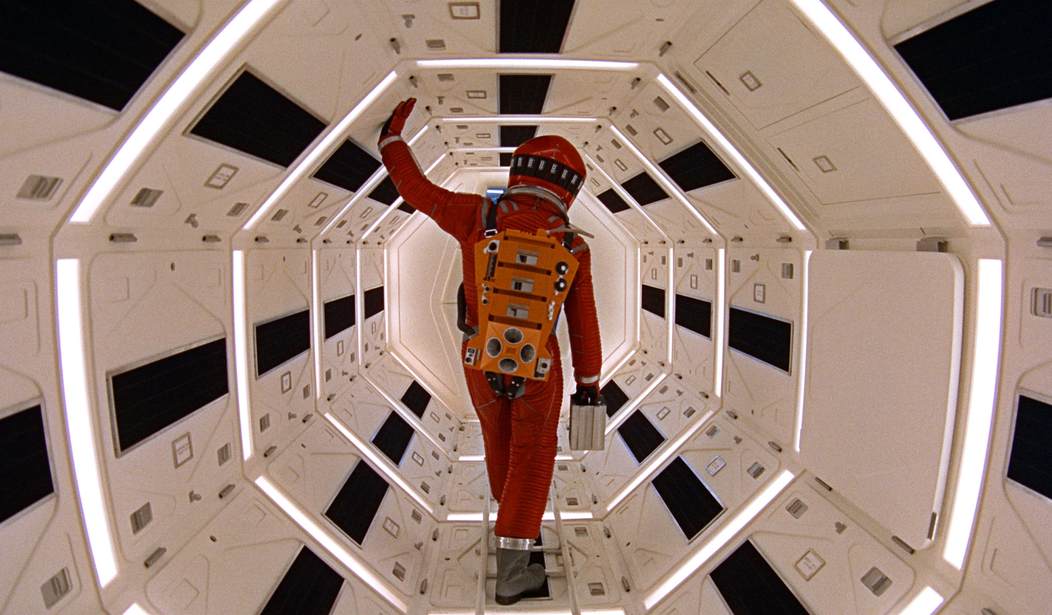
The problem can be solved by building a massive spacecraft like Discovery One in 2001: A Space Odyssey. The ship features a rotating circular deck, which creates a simulated gravity environment for the astronauts to exercise and eat in.
Cost estimates (according to my pal, Gemini) would be between $500 billion and $1 trillion for R&D plus another $100 billion just to put all the pieces in orbit where they would need to be assembled.
Suffice it to say, we're not building Discovery One any time soon.
We'll get there. Some day. As long as there is the desire to tap into the unlimited wealth sitting out there, commercial enterprises will find a way.