


The legendary Western personality Judge Roy Bean was fond of quoting the adage: "There's no law west of the Pecos and no God west of El Paso."
In Chisum, one of John Wayne's best films, he responds to that adage with one of his best quips.
"Wrong, Mr. Pepper. Because no matter where people go, sooner or later, there's the law. And sooner or later, they find God's already been there."
It's inevitable that the law (and rules, regulations, and ultimately bureaucrats) will follow humans wherever they go. This includes outer space.
In the next several decades, mankind will overcome the numerous challenges of living and working beyond Earth's atmosphere and settle on moons, planets, and asteroids, forming new societies and copying old ones.
The human urge to organize and create rules to live by is primal. They are a huge part of our evolutionary success as a species. The question we should be asking is simple: Will we repeat the mistakes of Earth-bound societies and tie the happiness of our people and success of our commerce to the capricious whims of the rule-makers? Or will these new governments trust citizens to truly govern themselves?
Certainly, there need to be some laws and rules to live by. But do we really need laws governing Moon pollution? Or asteroid maintenance?
"Despite evolving technical capabilities, the international legal framework governing exploitation of the Moon is both very limited and frozen in the Cold War era," claim Adam Urwick and Jesse Osborne of the RAND Corporation in a recent paper.
"The pursuit of profit raises paramount scientific and environmental concerns. Astronomers caution that large-scale mining activities could disrupt ongoing research and preservation of the lunar environment, leading to calls for development of comprehensive lunar laws and regulations to manage these activities responsibly."
What could possibly go wrong?
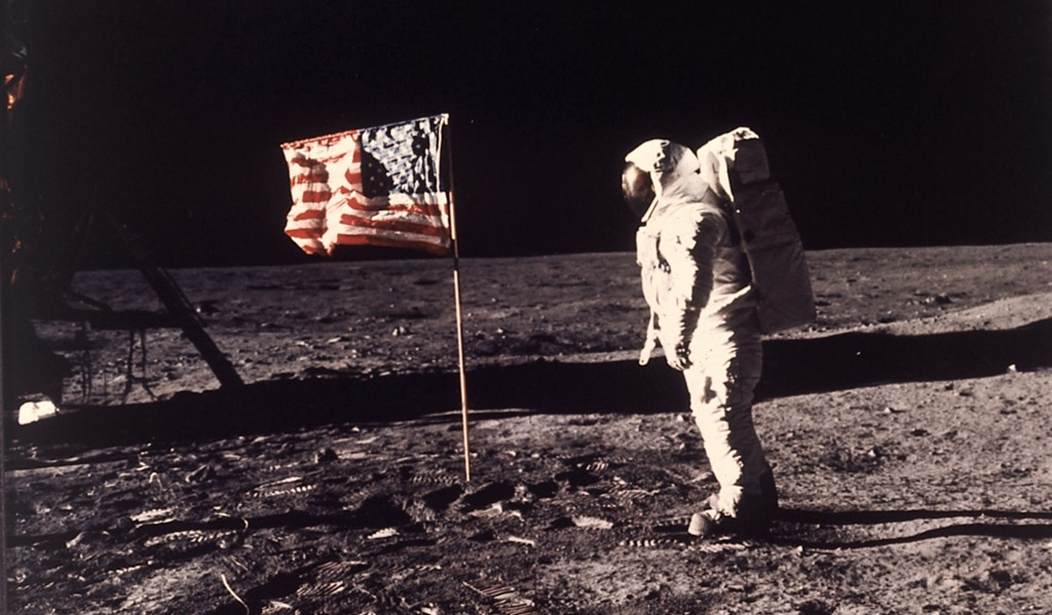
Earth's moon is a dead place where nobody currently does anything. There is nothing to disrupt, let alone an environment to worry about unless you want to elevate the occasional boot print or tire tread in lunar dust to the status of a problem. The pursuit of profit there should raise no concerns beyond those of investors seeking returns—and investors and space ventures are looking for opportunity, assuming it's not strangled by red tape.
Last year, Interlune and Vermeer Corporation revealed they've developed a full-scape prototype of an excavator "designed to ingest 100 metric tons of Moon dirt, or regolith, per hour and return it to the surface in a continuous motion. Interlune's immediate focus is harvesting helium-3 from the Moon." Interlune has since signed a contract with the Air Force to deliver lunar helium-3.
The partnership between Interlune, a space technology startup, and Vermeer, an established manufacturing company, illustrates the seriousness with which industry views the prospect of tapping into space resources. Rio Tinto, an Anglo–Australian mining giant, sees its expertise in automated mining as an advantage when it comes to extracting resources in space. The company joined an industry consortium to take its abilities off-planet. It's well-positioned to succeed in a new environment.
This isn't pie-in-the-sky sci-fi TV. Real companies are putting real money into the venture to mine the Moon's riches. The fact that we haven't set foot on the Moon since 1972 is immaterial to the raw potential of exploiting the Moon's resources for profit.
There's already a market for helium-3, rare as hen's teeth on Earth but plentiful on the Moon, as it's used in neutron detection at the border in sniffing out radioactive material, in medical imaging, and in the near future, as fuel for fusion reactors. The discovery of water ice on the Moon in 2009 is what's really driving the effort to go back to the Moon. Water doesn't only mean that human life can be sustained indefinitely on the Moon; the hydrogen can be separated to make rocket fuel and oxygen can be used for breathable air. Rare earth minerals are abundant on the Moon, as are titanium, aluminum, iron, and silicon.
One can imagine bureaucrats on Earth writing rules governing everything from the safety of miners to the prevention of environmental degradation on the surface.
The 2015 U.S. Commercial Space Launch Competitiveness Act established grounds for recognizing private property rights in space so that private firms would have reason to take risks and make investments. The law was intended to end-run the 1967 space treaty's requirement that space exploration "be carried out for the benefit and in the interests of all countries." We won't have national territory in space, but the U.S. will recognize and enforce property claims.
But, as RAND's Urwick and Osborne make clear, natural-born bureaucrats are ready to assert their will even before the first commercial operation has extracted an ounce of resources in space. They want "binding international agreements…which emphasise principles of stewardship, clarify access rights and support common benefits from lunar development." To their voices you can add University of Bristol law lecturer Dr. Charles Ho Wang Mak's worries that "unregulated mining could contaminate lunar regolith or generate debris" and other early calls for red tape in space.
The Artemis Accords, signed by multiple countries since 2020, represent an early effort to encourage "space-based exploration, scientific discovery, and commercial utilization" that at least acknowledges the interests of private enterprise. Then again, the European Space Agency's Zero Debris Charter would export a sort of zero-gravity environmentalism to outer space.
Unfortunately, once bureaucrats are tapped to write regulations, they can't help themselves. They must continuously justify their existence by finding new avenues to regulate and to leave their imprint. It's in the job description.
"Would-be regulators seem determined to insert themselves into the final frontier," writes Reason's J.D. Tuccille. "The only saving grace is that if they want to assert their presence, they'll have to hitch a ride from a private space company."
Let's hope that's true.