



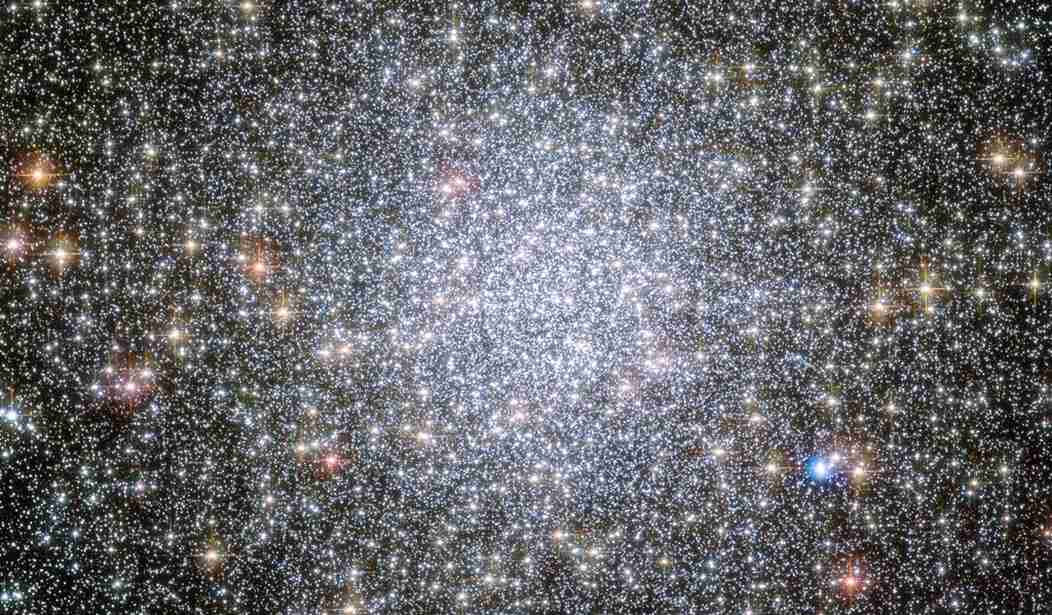
Where is heaven? Any child can tell you by simply pointing "up." Vague, but perhaps as accurate as we're going to be able to discover.
What if the child is right in a physical sense? What if heaven is an actual place?
A former Harvard physics lecturer and science communicator has said that heaven might actually exist in our universe. And he thinks he knows where it might be.
Michael Guillén, PhD, draws on basic proven science like Hubble’s law, which holds that distant galaxies recede faster than nearby ones as space expands, and the cosmic horizon, which is the theoretical limit of what we can observe.
"Pushing that reasoning outward, he wrote that what many religious traditions call 'heaven' could lie roughly 273 billion trillion miles away (about 439 billion trillion kilometers), beyond the cosmic horizon, writes Stav Dimitropoulos in Popular Mechanics.
The "cosmic horizon' is limited by our technological ability to view the observable universe. Better instruments theoretically mean we should be able to view more of what's out there. Most scientists scoff at the idea that there's anything beyond the "observable" universe other than what we can already observe: more stars, planets, and gas clouds.
But what if (and here's where it gets weird) there's a "hyperdimension" beyond what we can observe?
University of Nevada physicist Michael Pravica, PhD, said heaven or hell are potentially hyperdimensional or liminal ("of, relating to, or situated at a sensory threshold: barely perceptible or capable of eliciting a response," according to Webster).
Imagine a two-dimensional circle representing our universe. Guillén’s claim, Pravica says, places “the hereafter” outside the horizon of that circle. But the universe is expanding, which already complicates the geometry. And once you start treating heaven as something spatially “outside,” he adds, the logic quickly breaks down. “If the universe is expanding, does that mean heaven is expanding? Or is heaven being pushed out of that circle?” Still, that doesn’t mean paradise has to be “out there.” If reality includes additional dimensions beyond the familiar three, it could just as easily exist “inside the circle, in a different dimension.”
Pravica is explicit that ideas about hyperdimensional spiritual realms belong not to physics but to metaphysics, a philosophical branch that deals with concepts so abstract they may have no foundation in reality, such as identity and the nature of being. “In the future, perhaps, if we develop techniques for accessing hyperdimensional tunnels or connections—absolutely, perhaps [we could measure heaven], " he says.
Heaven, then, could exist in both the hyperdimensional state and our reality as well.
“I cannot measure an energy that exists outside our spacetime bubble. We live inside the bubble. We’re talking about what’s outside it," Pravica says.
It should be noted that this isn't meant to impinge on anyone's faith. In fact, it's an effort that mixes physics with metaphysics in a way rarely theorized.
“Extraordinary claims require extraordinary proof,” Gianninas says.
Others, however, believe inspiration comes first—Pravica is one of them. Proof, if it comes at all, follows later. For this camp, many of science’s biggest breakthroughs began as unprovable ideas, born in an “aha” moment. Newton was once called a heretic for proposing gravity—an invisible field no one could see. String theory imagines extra dimensions without experimental proof.
“Why is hyperdimensionality unacceptable as a starting point?” Pravica asks. Even quantum entanglement—Einstein’s “spooky action at a distance”—becomes easier to imagine, he argues, if particles remain connected through unseen dimensions, like folding a sheet of paper so distant points suddenly touch.
Einstein's "quantum entanglement" is the revolutionary idea that two particles, even if separated by thousands of light-years, can become so deeply linked that they share a single, unified quantum state. Measuring the state of one particle instantly determines the state of the other—a "spooky" connection, as Einstein described it.
“I’m a physicist, but I’m also a human being,” Pravica says. “I have the right to imagine what’s beyond the bubble.” Alex Gianninas, PhD, an associate teaching professor of astronomy at Connecticut College, disagrees.
“As scientists, personal or religious beliefs have to be kept separate from science itself,” he says.
Pravica answers that, “When you just study physics, it’s kind of cold,” he says. "It can describe particles and forces with extraordinary precision—but not the reason we are here."
There's more and more of this mixing of scientific facts with metaphysical ideas as the conceptualization of the universe demands more imagination to visualize. It won't necessarily lead to "answers" in the scientific sense. But it certainly broadens our understanding of the universe and our place in it.