


What would the Golden Gate Bridge or Hoover Dam look like in 500 years? A thousand? Would they still be able to carry traffic or supply electricity?
How strong an earthquake could damage them? How would weathering affect their operation 500 years from now?
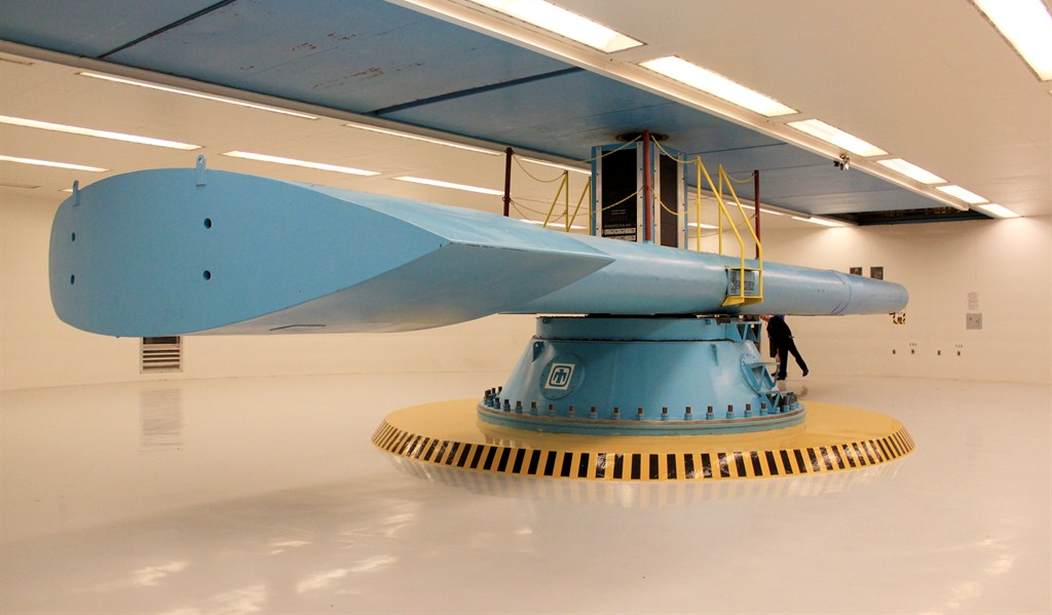
These and other questions about dams, bridges, and even stars and galaxies are being answered by a new hypergravity centrifuge, 50 feet below Zhejiang University in Hangzhou, China. The CHIEF1900 (Centrifugal Hypergravity and Interdisciplinary Experiment Facility) joins the CHIEF1500 and CHIEF1300 in working to unlock mysteries of the universe by being able to spin at unbelievable speeds, achieving "levels of gravity from hundreds to thousands of times more than the single G-force Earth experiences," according to Elizabeth Rayne in Popular Mechanics.
The CHIEF1900 was built by Shanghai Electric Nuclear Power Group and assembled at the university.
Those massive G-forces allow us to compress time and space so that the effects of earthquakes and other natural disasters can be accurately measured, improving the chances for more people to survive. It may also give us a better understanding of the effects of extreme gravity on large planets and stars.
Dan Wilson, the Associate Director at the Center for Geotechnical Modeling (CGM), a National Science Foundation-funded lab at the University of California, "specializes in centrifuge modeling and geotechnical earthquake engineering at the CGM, whose world-class facility houses two centrifuges that simulate how earthquakes, waves, winds and storms affect soil systems," according to Rayne.
"CHIEF 1900 will be one of the four largest dynamic centrifuges in the world, meaning centrifuges with shakers for seismic testing,” Wilson said.
The better we simulate earthquakes, the better we can design houses and other buildings to withstand them.
“We aim to create experimental environments that span milliseconds to tens of thousands of years, and atomic to [kilometre] scales – under normal or extreme conditions of temperature and pressure,” said Chen Yunmin, CHIEF’s chief scientist and a professor at Zhejiang University.
“It gives us the chance to discover entirely new phenomena or theories,” Chen added.
Simulating potentially catastrophic natural phenomena is only one advantage. Hypergravity centrifuges can gauge pressure levels in the deep ocean and deep earth. This can factor into plans to build new underground spaces. And developing new alloys in intense gravity allows the filling of every part of the mold in their liquid state for a flawless solid cast.
At a time when there is more concern about climate change than ever, they can be a good model of how pollutants will seep through the environment if left unchecked. These machines can also replicate other geological processes and create materials that are beyond the capabilities of most labs.
"This centrifuge can accommodate models of structures such as bridges and dams that are already built to scale so they can be spun at intense G-forces to predict potential stress damage," says Rayne.
The machine's enormous arms generate centrifugal force when in rotation. It's like the old amusement park ride, The Rotor, where you stand against a wall in a circular space and are thrilled when the machine starts to spin, and the floor drops from beneath your feet. You're kept from falling by the G-forces pressing against your body.
This is the same principle but magnified several thousand times.
All objects on Earth are subject to gravity and the centrifugal force induced when spinning. By generating forces hundreds or thousands of times stronger than Earth’s gravity, machines such as CHIEF can compress time and distance, making it possible to study phenomena that would otherwise take decades or span kilometres, all within a lab.
For example, to assess the structural stability of a dam 300 metres (984 feet) tall, scientists can build a three-metre model and spin it at 100g. This replicates the same stress levels the full-scale dam would experience in the real world.
Hypergravity experiments also offer insights into how high-speed rail tracks might resonate with the ground or how pollutants migrate through soil over millennia – scenarios that are nearly impossible to study in real time.
We're not exactly sure what benefits will accrue from this kind of basic research. All we know is that, in the past, basic research has always paid off, usually in ways that are hard to predict.