



Evolutionary biologists are the best storytellers in science. They can take a fossil and weave a tale that spans millions of years to posit a theory of how it developed.
The late Stephen J. Gould was among the best of the storytellers. He was a thorn in the side of the noted atheist Richard Dawkins for his challenging concepts of strict selectionism and evolutionary psychology. He's credited with reinvigorating the study of how an organism's development (ontogeny) relates to its evolutionary history (phylogeny).
“The chin evolved largely by accident and not through direct selection, but as an evolutionary by-product resulting from direct selection on other parts of the skull,” said author Noreen von Cramon-Taubadel in a new study published in PLOS One.
Absent from other primates—and even Denisovans and Neanderthals—the bony, protruding chin is a uniquely human characteristic and often used to identify members of our species in the fossil record. As such, it’s tempting to indulge in another uniquely human trait (storytelling) and come up with a reason it was honed by natural selection. Among others, supporting the lower jaw to facilitate chewing or acting as a secondary sexual characteristic to advertise maturity to mates, are two such stories.
To investigate theories of the evolution of the chin, researchers from the University of Buffalo examined gene sequences involved in the development of the head and jaw for evidence of evolution. Specifically, the team looked at whether sequences involved in producing the chin itself were subject to direct selection, whether they arose neutrally due to genetic drift, or whether they were merely a byproduct of evolution acting upon other traits (a spandrel). They found that the evidence pointed toward the chin being a spandrel.
“Just because we have a unique feature, like the chin, does not mean that it was shaped by natural selection to enhance an animal’s survivability, for example a buttress for the lower jaw to help dissipate the forces of chewing,” says von Cramon-Taubadel. “The chin is likely a byproduct, not an adaptation.
“While we do find some evidence of direct selection on parts of the human skull, we find that traits specific to the chin region better fit the spandrel model,” von Cramon-Taubadel explained. “The changes since our last common ancestor with chimpanzee are not because of natural selection on the chin itself but on selection of other parts of the jaw and skull.”
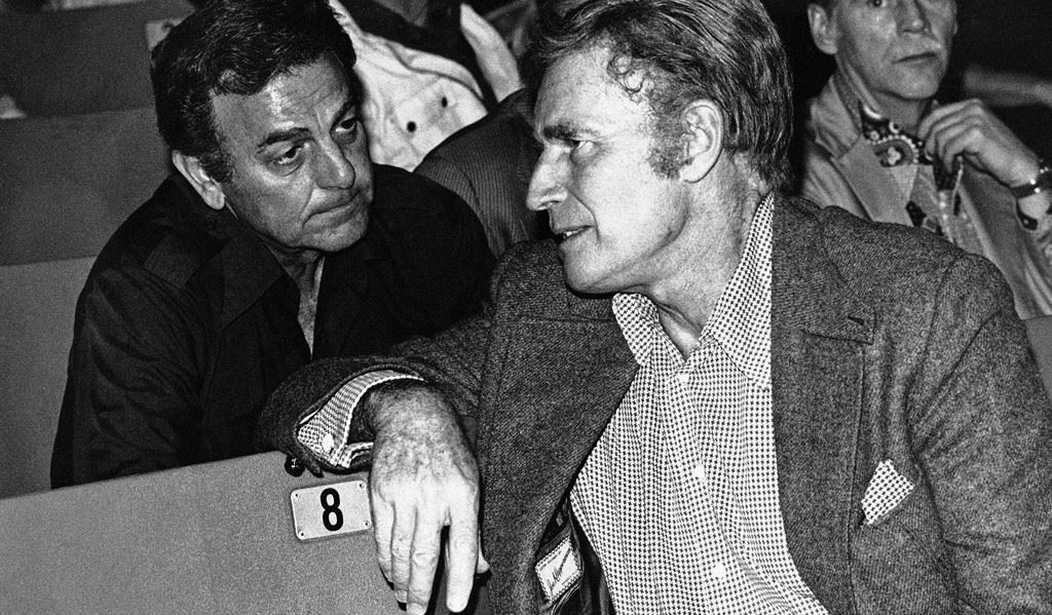
The chin kind of just "happened" as a result of other evolutionary selections on the face and jaw. Take a jaw like that of Charlton Heston. Some reviewers refered to Heston's "jut-jawed portrayals" of historical figures. Would we have accepted a Moses, a Michelangelo, or an Andrew Jackson with a weak jaw? I doubt it.
The spandrel debate raises a significant scientific question. In 1931, mathematician Kurt Gödel shook the foundations of logic. He proved that in any consistent mathematical system (like basic arithmetic), there are statements that are true but cannot be proven within that system. Some philosophers argue that science, which relies on objective observation, may never be able to bridge the gap to purely subjective experience.
There are probably some scientific questions that can't be answered. That doesn't mean we shouldn't strive to answer them, only that it's beyond the ken of humans' understanding.
Thus it may be with the human chin.
Also for our VIPs: Did the Viking Landers of the 1970s Discover Life on Mars After All?