


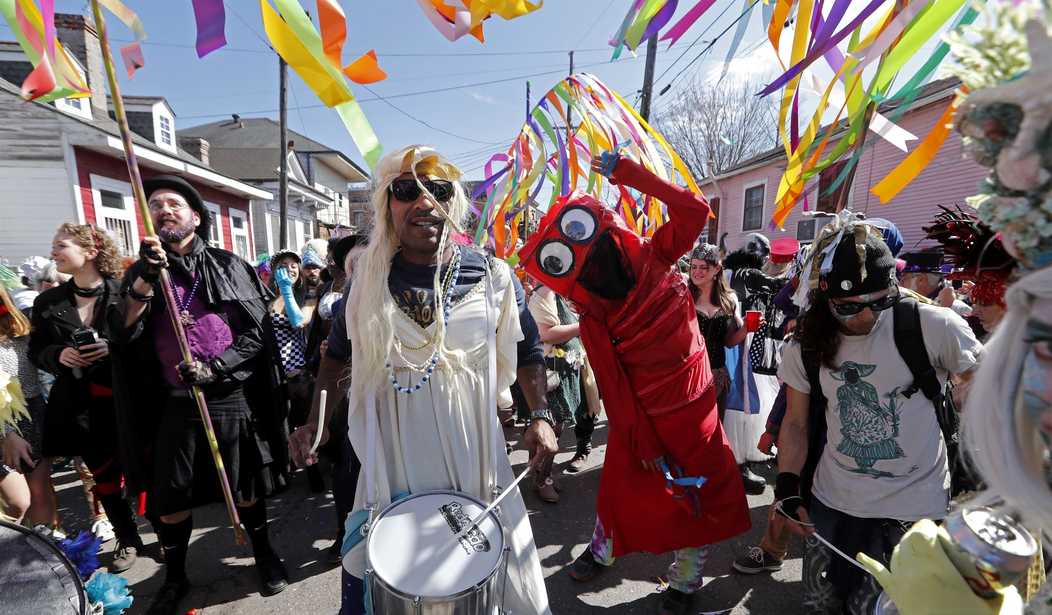
It's a legal holiday in the state of Louisiana today. School kids have a day off, and some businesses are closed, but it's not in recognition of any famous person or event. Louisiana is celebrating Fat Tuesday, and as they say in New Orleans, "Laissez les bons temps rouler" (Let the Good Times Roll!).
Fat Tuesday, or "Mardi Gras," ("Mardi" is Tuesday in French and "gras" means "fat"), is a tradition that marks the last day before the Catholic Lenten season begins on Ash Wednesday, with its fasting and its buildup to Holy Week.
Mardi Gras is an ancient holiday, celebrated in Europe, that goes all the way back to the Romans, and was then adopted by early Christians. It's actually much more than a single day. The "Carnival" season kicks off on the Feast of the Epiphany (January 6) and runs through Fat Tuesday. In Brazil, Carnival is a 24-hour-a-day, balls-to-the-wall bacchanal that will either kill you or cure you. On the other hand, most American cities only celebrate Fat Tuesday.
Food is a big part of Fat Tuesday. King cake is a staple at Mardi Gras in Louisiana. The dough is similar to that of a Danish and can be stuffed with fruit, cream cheese, or cinnamon sugar. It dates back to early Christians who celebrated and honored the three wise men by eating a cake in the shape of a crown.
In Chicago, every bakery worth its salt will make Pączkis, which resemble jelly-filled Bismarcks but can also be filled with fruit and whipped sweet cream.
Customers were lined before 4 a.m. on Tuesday at one of the oldest bakeries in Chicago, Weber's Bakery.
Having worked at the family-owned bakery since he was a child, Michael Weber says popularity for the big event continues to grow each year.
With a large Polish community in Chicago, it's now evolved to a beloved tradition for all Chicagoans.
"When I started 45 years ago, it was not even anything to ride home about. And I was off on Mondays. My dad was off on Tuesdays. He didn't even come in for his day off. Now we are around the clock, pulling all nighters and it's just become such a Chicago tradition. It's one of the 'funnest' times of the year," Weber said.
Weber says they tend to add or change flavors, depending on what customers like year to year.
Generous helpings of gumbo, jambalaya, étouffée, and other traditional Cajun dishes are also rolled out for the feasting in New Orleans. What makes the holiday unique in the Crescent City is the mix of cultures that come together for an experience like no other.
The French influence dominates, largely because Catholicism is the reason for the holiday in the first place. But also in the mix are Haitian voodoo and African animism. This is evident in many of the colorful costumes and figures in the parades. The New Orleans black community has been an important participant in the festivities since the early 19th century.
Certain colors are important to Carnival as well.
Purple, green and gold are synonymous with Mardi Gras. The trio of colors dates back to the 1892 Rex Parade.
Historians believe purple was chosen because it was one of the rarest and most prestigious dye colors at the time. In heraldry, prestige required both metal and nonmetal colors. Gold, representing a king’s status, fulfilled the metal requirement, while green symbolized wealth.
It is also widely accepted that the colors carry symbolic meaning: purple stands for justice, gold represents power and green signifies faith.
These colors fill the streets during Carnival, decorating floats, beads and costumes.
Having spent some time in New Orleans, I can say with certainty that this is a city that knows how to have a good time. Bourbon Street is recognized globally for its 13-block stretch of high-energy nightlife, historic charm, and 24/7, 365-day-a-year atmosphere. It is essentially a bustling, pedestrian-friendly entertainment district featuring open-container laws, live music, and numerous bars.
And everyone — everyone — is friendly.
Put "visit New Orleans at Mardi Gras" on your bucket list. You won't regret it.
Recommended: We Will Be Paying the Cost of 'The Great Awokening' for Generations
The new year promises to be one of the most pivotal in recent history. Midterm elections will determine if we continue to move forward or slide back into lawfare, impeachments, and the toleration of fraud.
PJ Media will give you all the information you need to understand the decisions that will be made this year. Insightful commentary and straight-on, no-BS news reporting have been our hallmarks since 2005.
Get 60% off your new VIP membership by using the code FIGHT. You won't regret it.






Join the conversation as a VIP Member