





I made a classic mistake in college by taking a course in "Icelandic and Scandinavian Sagas." The mistake was that I was told it was an easy "A" and the professor was a soft touch.
Instead, I got a Viking of a professor with the temperment of "Ivar the Boneless." What's worse, the course was a real gonad-buster.
Nevertheless, it was one of the most interesting classes I took in college. "Sagas" aren't like folk tales or legends. They're more like prose narratives with a rhythm and meter all their own. Unlike many medieval legends filled with dragons and magic, sagas often read like historical novels. They focus on real people, genealogy, and the legal or social disputes of the time. As I found to my chagrin, the sagas are also endless tellings of unremarkable stories and violent people.
What I took away from that course was that the last person you want to run into in your travels is a 10th-century Viking raider. Steer clear if at all possible.
I have been following the "saga" of the search for the cause of the affliction known as Havana syndrome, which the U.S. government refers to as an "Anomalous Health Incident " (AHI), for much of the last decade. The number of theories about the syndrome nearly matches the number of victims.
Bureaucratic infighting, State Department politics, and intelligence agency rivalries have all contributed to confusion and a lack of consensus about the real, serious symptoms our diplomats suffer.
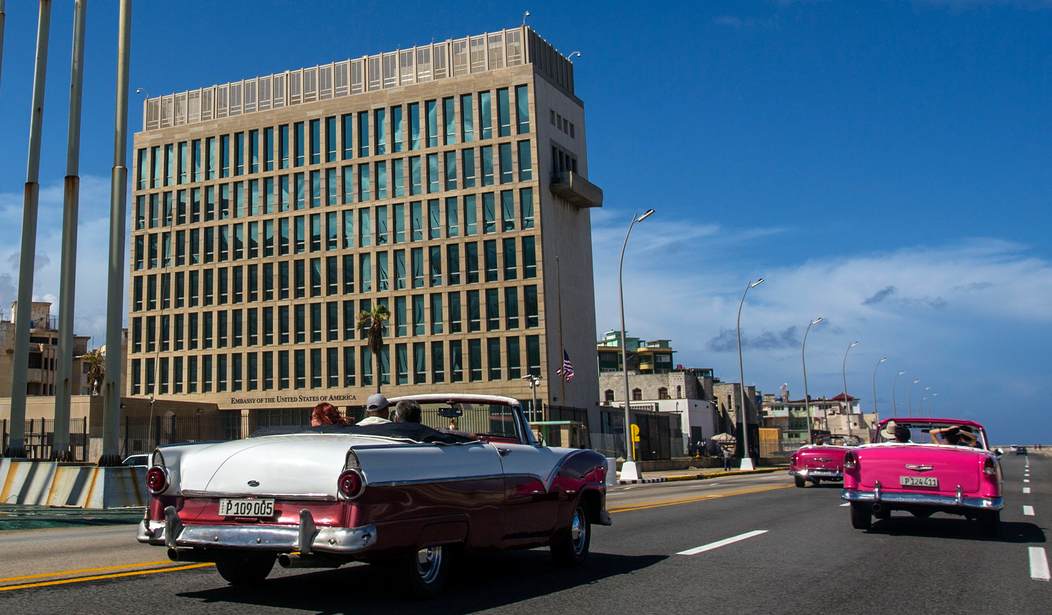
Havana syndrome first appeared in 2016, when several diplomats at the U.S. interests section in Havana began to complain of a host of symptoms, including headaches, nausea, vertigo, and lethargy. Some patients reported severe symptoms that prevented them from performing their jobs. Some were even forced to retire.
Not all personnel suffered the same symptoms to the same degree. Therein lies the mystery. Some patients suffered from some of the symptoms, but not all of them. Others reported only mild discomfort.
In 2020, the National Academy of Sciences, Engineering, and Medicine (NAS) released a report on Havana syndrome that concluded: "directed, pulsed radio frequency energy appears to be the most plausible mechanism in explaining these cases."
“It is just a totally incredible explanation for what happened to these diplomats," said University of Pennsylvania bioengineer Kenneth Foster. "It’s just not possible. The idea that someone could beam huge amounts of microwave energy at people and not have it be obvious defies credibility."
What if, instead of continuous microwaves beamed at people, it were a "pulsed" energy weapon? Such a weapon would be impossible to test on people, right? Who'd volunteer?
Enter an unnamed Norwegian scientist who was so skeptical that any device could cause Havana syndrome symptoms that he actually built his own "directed pulse energy" machine and tried it out on himself.
Working in strict secrecy, a government scientist in Norway built a machine capable of emitting powerful pulses of microwave energy and, in an effort to prove such devices are harmless to humans, in 2024 tested it on himself. He suffered neurological symptoms similar to those of “Havana syndrome,” the unexplained malady that has struck hundreds of U.S. spies and diplomats around the world.
The bizarre story, described by four people familiar with the events, is the latest wrinkle in the decade-long quest to find the causes of Havana syndrome, whose sufferers experience long-lasting effects including cognitive challenges, dizziness and nausea. The U.S. government calls the events Anomalous Health Incidents (AHIs).
The secret test in Norway has not been previously reported. The Norwegian government told the CIA about the results, two of the people said, prompting at least two visits in 2024 to Norway by Pentagon and White House officials.
The German daily Der Spiegel and 60 Minutes and conducted their own investigation and concluded that it was possible that a directed energy weapon was being used by the shadowy Russian GRU intelligence outfit known as Unit 29155. That group is responsible for sabotage and assassinations. They were in the vicinity of many reported Havana syndrome attacks, according to the investigation.
Hardly a smoking gun. But U.S. intelligence did acquire a pulse-directed energy weapon in 2024 for a few million dollars, according to the Post. Tests are continuing on the device with no definitive answers. The Post reports that the device acquired by the U.S. government is different than the device built by the Norwegian scientist.
The story continues. Since it's not likely that Russia or any other nation is going to fess up and admit they're targeting our diplomats, the mystery will remain, and our diplomats will continue to be at risk.
The new year promises to be one of the most pivotal in recent history. Midterm elections will determine if we continue to move forward or slide back into lawfare, impeachments, and the toleration of fraud.
PJ Media will give you all the information you need to understand the decisions that will be made this year. Insightful commentary and straight-on, no-BS news reporting have been our hallmarks since 2005.
Get 60% off your new VIP membership by using the code FIGHT. You won't regret it.



Join the Conversation
VIP members get the ability to comment on articles.