
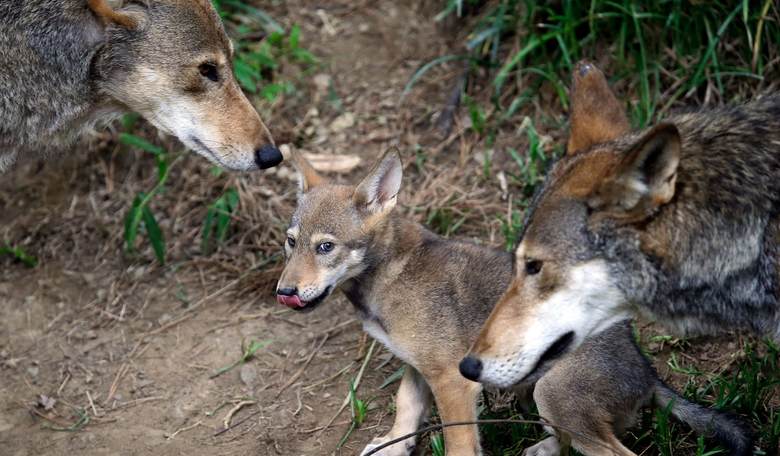
A wolf came within 20 yards of a man working on his tractor in Price County. Another appeared within 6 to 8 feet of a house on two nights. A juvenile wolf watched a man from about 45 feet while he traveled by UTV near a bear-bait site.
Nobody was injured, yet residents had reason to wonder what would happen if the animals lost what little fear of people remained.
By early September, nine wolves in the town of Flambeau were dead. USDA Wildlife Services trapped and euthanized four pups, three yearlings, and two adults at the Wisconsin DNR’s request after a series of six verified human-safety conflicts stretching from July 2025 through August 2026.
The DNR says the wolves had become increasingly comfortable near people.
From WSAW:
According to the DNR, residents tried several nonlethal measures, including hazing, increased lighting, removing potential attractants and modifying fencing. The agency says those efforts failed to stop the concerning behavior.
Although gray wolves remain federally protected, limited exceptions allow lethal removal under certain circumstances involving threats to human safety.
The DNR says it consulted with federal wildlife officials and determined relocation was not feasible because of limited suitable habitat, the size of the pack and potential risks to other wolves.
Wisconsin’s public record adds important perspective. Investigators confirmed three of the August encounters. One was designated Level 3, generally not considered threatening. Two were Level 2, indicating habituation without aggressive behavior.
None was classified as Level 1, the category for aggression toward humans. Those classifications help establish how much danger officials believed was developing.
Still, public safety decisions don’t require an injury report. Wolves ordinarily avoid people. When a wild pack repeatedly visits homes, shows little fear of people, and increasingly resists efforts to scare it away, officials can’t dismiss the pattern as harmless curiosity.
People living there deserve to feel safe in their yards.
Before ordering the removals, wildlife officials urged residents to eliminate attractants, increase lighting and human activity, and use noise and other hazing tactics.
The DNR says the measures failed. Federal wildlife personnel then carried out the removals after the state consulted the U.S. Fish and Wildlife Service. Gray wolves remain federally protected in Wisconsin, so this was a human-safety intervention, not a hunting season or routine livestock control.
Recommended: Wisconsin’s Wolf Debate Has No Easy Villain
Adrian Wydeven, who directed Wisconsin's wolf management program for more than 20 years, defended the decision with sound reasoning. Younger wolves learn dangerous familiarity with humans from adults, and removing only the adults could leave pups vulnerable to starvation or further nuisance behavior. He considered removing the full pack a reasonable way to prevent escalation.
Reasonable, however, isn’t the same as unquestionable. No resident suffered an attack, and the available reports describe approaches and proximity rather than assaults. People deserve to see the specific record explaining why all nine animals had to die, particularly when four were pups.
Transparency helps communities understand when a serious intervention crosses from precaution into necessity.
A second problem has little to do with whether the wolves presented danger. The Great Lakes Indian Fish and Wildlife Commission says Wisconsin failed to consult member tribes before ordering the killings in ceded territory where wolves hold deep cultural significance. DNR Secretary Karen Hyun apologized for inadequate communication and promised to improve coordination.
From WPR:
Conrad St. John, chair of the St. Croix Chippewa Indians of Wisconsin, said that decision showed a lack of respect for tribes and their authority to cooperatively manage natural resources with the DNR in ceded territory.
“There was no consultation with the tribes about the planning of the euthanization … and we weren’t notified until after the euthanizations had occurred,” St. John told WPR. “There were never any reports given to the tribe on threatening behaviors to any humans or livestock in that area.”
The DNR says it publicly posted conflict notices and sent them to an email list that includes tribal biologists. Receiving notices, however, isn’t necessarily involvement in decisions. GLIFWC wanted a chance to examine the evidence and discuss alternatives before officials acted. Federal protections limit the killing of endangered animals. The DNR says relocation wasn’t feasible because of limited suitable habitat, pack size, and potential harm to other wolves.
From WSAW:
The DNR says it sent electronic notices about the wolf conflicts to GLIFWC and tribal biologists but received no requests for additional information.
The agency also said its existing policy did not require further consultation in this case, noting the incidents occurred 20 to 40 miles from the nearest reservation.
Schlender disputed that explanation, noting that GLIFWC’s responsibilities extend throughout ceded territories, not just reservation boundaries.
“We’re not your common citizen, you know, we are partners in this whole thing,” Schlender said.
While DNR Secretary Karen Hyun has apologized and pledged to improve collaboration with tribal nations, the agency has not outlined specific changes to its consultation policy.
Schlender said an apology cannot undo what happened.
“And then even issuing apologies and condolences, that’s already too late,” he said. “Those things have already happened. Those actions have already been taken.”
Northwoods families shouldn’t have to risk injury to protect wolves, and wildlife managers shouldn’t be afraid to act when credible evidence shows escalating threats. At the same time, those agencies owe the public a defensible explanation for lethal decisions, especially when viable alternatives are disputed.
Wisconsin can honor both duties. Protect people first, investigate behavior thoroughly, consult affected tribes early, and publish the reasons for the final decision.
The nine Price County wolves can’t be brought back, but the state can use this case to make its next difficult call more transparent and accountable.