
It's been quite a year for earthquakes, hasn't it? In Latin America specifically, there were two major earthquakes in Venezuela in late June that killed thousands, and a big one in Colombia in August that did quite a bit of damage. There have also been several smaller ones throughout the region in between.
On Friday, October 9, a major 7.7 magnitude earthquake struck Panama, just before 1:00 p.m. local time. It hit just southwest of Pitaloza Arriba in Herrera province. A second 6.6 magnitude earthquake struck just after, and according to the University of Panama, there were at least 45 aftershocks.
As I'm writing this around 8 p.m. Eastern on Friday, and while there are reports of several injuries, no deaths have been confirmed, but the United States Geological Survey predicts that casualties could range from "dozens to hundreds." I will add that we won't see numbers anything like what we did in Venezuela, given that Panama has far better infrastructure built to much higher standards. That said, economic damage is predicted to be up to hundreds of millions of dollars, or roughly 1-10% of the country's GDP. From what I've seen so far, those may be liberal estimates, thank goodness.
To give you an idea of the strength of the earthquake, a Pacific Ocean tsunami threat was issued for Panama and parts of Costa Rica, Colombia, Ecuador, Peru, Nicaragua, Guatemala, El Salvador, and Mexico. It has since been called off.
The shaking could be felt as far away as San José, Costa Rica. I actually contacted a friend of mine who lives in Costa Rica near the Panama border to make sure he was okay. He told me that he didn't think there was any damage to his town, but it was one of the strongest earthquakes he'd ever felt, and he was already seeing videos of damage from people he knows on social media.
According to my research, some of the damage documented so far includes:
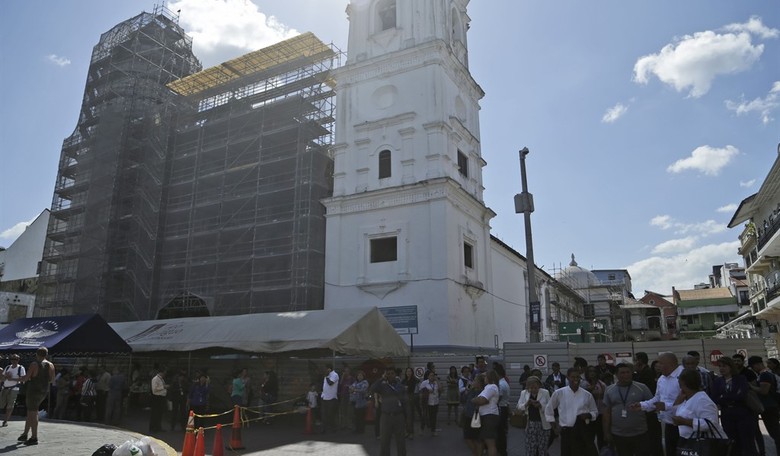
- A partial collapse of a church tower or cathedral, cracks at the governor’s office, damage at the Dos Continentes hotel, and fallen balconies on a residential building in Penonomé.
- The colonial Church of San Atanasio, a national historic site, collapsed in Los Santos.
- A multi-story building in Playa Venao collapsed onto many cars.
- Several homes damaged in Las Minas.
- Unspecific damage in Chitré, Aguadulce, and Soná (including a fire station).
- At least six provinces have businesses and residents without power, and some water treatment plants have been disrupted.
Tocumen International Airport suspended flights for a few hours, but it has since resumed normal activity. Panama City Metro stopped two lines and evacuated stations, while the entire nation canceled school for the day. While there is video online of the Centennial Bridge cables swaying, traffic across the Panama Canal is flowing normally.
Secretary of State Marco Rubio has offered the support of the United States. "I am closely monitoring reports of the earthquake in southern Panama. The United States stands with the people of Panama," he posted on X on Friday evening, adding, "At the request of the Panamanian government, the State Department is rapidly mobilizing resources and personnel to assist."
President José Raúl Mulino, who has been touring the devastated areas, thanked him.
@SecRubio @FelipeChapman Muchas gracias Sr. Secretario. Valoramos mucho su mensaje y colaboración
— José Raúl Mulino (@JoseRaulMulino) October 9, 2026
I'll leave you with a few pictures and videos of the damage and the moment it happened, and if there is more news to report in the days ahead, I'll be on top of it as best I can, assuming Hurricane Isaias doesn't take out my ability to get online this weekend.
Agradecemos a Dios por proteger al pueblo panameño. Vamos a activar de inmediato un plan de evaluación estructural y de apoyo a todas las personas damnificadas. https://t.co/14QSH5vlqN
— José Raúl Mulino (@JoseRaulMulino) October 9, 2026
#PANAMÁ: Terremoto de magnitud preliminar 7.7 interrumpe -en vivo- un programa deportivo en la ciudad de #Santiago 🇵🇦, a 60 km de distancia del epicentro.📍 Fuente: USGS. Video: Deportes RPC. https://t.co/Q8vkPwvQ7p
— 𝗔𝗦𝗜𝗦𝗠𝗘𝗧 (@Asismet_IF) October 9, 2026
🇵🇦#AHORA - Terremoto en Panama Hotel colapsado, en Playa Venao. https://t.co/mdQwqpdOaV
— DatoWorld (@DatosAme24) October 9, 2026
Afectación en la vía de Torio en Mariato, provincia de Veraguas tras fuerte movimiento sísmico en diversos puntos del país. https://t.co/tWHJMeVAAh
— Tráfico Panamá (@traficocpanama) October 9, 2026
🚨 La vivienda del expresidente de Panamá, Ricardo Martinelli, colapsó tras el fuerte sismo de magnitud 7,7 registrado este viernes 9 de octubre. “Solo son pérdidas materiales”, expresó el exmandatario al referirse a los daños. Los detalles ⬇️ https://t.co/Hby5Mveslo https://t.co/QOv47AotO2
— EL TIEMPO (@ELTIEMPO) October 9, 2026
🚨 La vivienda del expresidente de Panamá, Ricardo Martinelli, colapsó tras el fuerte sismo de magnitud 7,7 registrado este viernes 9 de octubre. “Solo son pérdidas materiales”, expresó el exmandatario al referirse a los daños. Los detalles ⬇️ https://t.co/Hby5Mveslo https://t.co/QOv47AotO2
— EL TIEMPO (@ELTIEMPO) October 9, 2026
Panama’s Centennial Bridge cables shake VIOLENTLY but HOLD as it’s battered by earthquake Cars carry on driving across https://t.co/RmdObgODuT
— RTVisual (@RT_Visual_on_X) October 9, 2026