
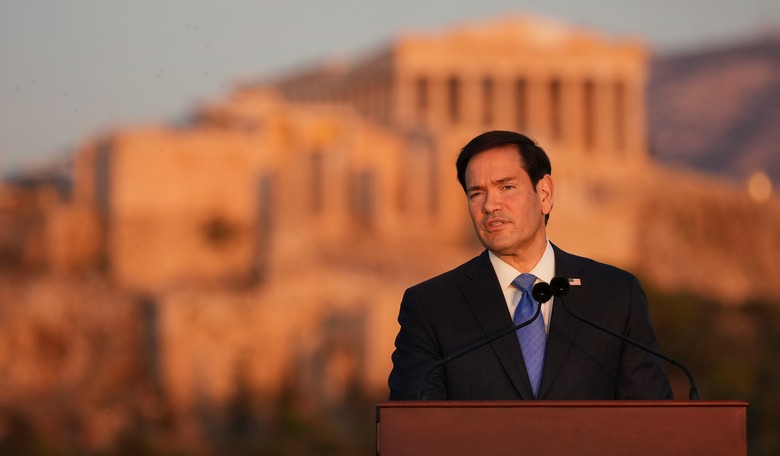
As the sun set in Athens, Greece, on Wednesday evening, a crowd gathered to watch one of the most important and influential men in the world stand at the Acropolis and, once again, make the case for Western Civilization in a way that no one else can.
Secretary of State Marco Rubio, who is currently traveling to Iceland, Greece, and Portugal, stood where the West was born and urged our allies to reject its decline. The imagery was stunning, but the message was more important — it's something that's been a theme throughout Rubio's time at the State Department over the last 20 months: We must maintain the values that make us great.
And on that note, I'm going to shut up and let the secretary do the talking.
He began with a bit of a history lesson.
"For thousands of years, the civilization that built what stands behind me has captivated the imagination of the Western World. Generations of statesmen, artists, and philosophers have looked to it — they've looked to it wonder. They've looked to it with awe," he said. "Now, time has a tendency to dull the senses. Great victories and catastrophic defeats — they seem to shrink to becoming like a footnote in a textbook, another fact for our school children to memorize and forget."
"But the Greeks of antiquity, they seem to have an almost mystical hold on our memory," he continued. "They call us back to them again and again."
Here's more:
For 25 centuries since, the Parthenon has stood. Empires have risen and fallen beneath its shadow.
And the progeny of the men who built it — the sons of Athens and Rome — have carried their civilization with them to the ends of the Earth.
Two and a half centuries after the founding of the American republic halfway across the world from where I stand now, I stand here today — as the Secretary of State of that republic, and as the great-grandson of settlers who arrived in the new world from Spain — I stand here to testify to a debt that no lapse of time, no distance of space, can ever extinguish.
Rubio explained how Greek history is carved into the government, architecture, and city names in the United States.
He went on to point out, as he has so many times before, that the West is at a crossroads, something I think we can all look at the images coming out of Europe right now and understand what he means. But he made it clear that under Donald Trump, the U.S. will act:
Today, we find ourselves at a crossroads because the next decade and the decisions we make will write the story of the next century. The course we take will determine whether the West maintains its place at the head of the world, or resigns itself to a future of atrophy, servitude, and decline. We will either choose to act now, or lose the choice to act at all. Under President Trump, the United States has made its choice.
He also made it clear that across Europe, "we are witnessing what we hope will be the beginnings of a generational shift" and while "passions may, at times, have strained the bonds of affection between the United States and Europe, it must not be allowed to break them."
"Together, we must strengthen an alliance capable of confronting the threats of our age," he said, explaining that we are stronger when we work together.
He then returned to ancient Greece and the "influence on the ideas of the American Founders" and how much the United States and the West as a whole owe to the place where he is standing.
"Here, in Athens, we found the first full realization of all the essential traits that would come to define the West: fierce individuality and relentless ambition; daring exploration and invention; a yearning for discovery, for adventure, risk, and glory; an insatiable curiosity about the world and the principles by which it operates; a hunger to know the mysteries of nature and grasp the secrets of the cosmos; an impatience with the notion of impossibility chafing at all boundaries, at all limits, straining to peer into the depths of the unknown," he explained.
I'll share a clip of that part of the speech, so you can catch the whole thing.
SECRETARY RUBIO: In Athens, we found the first full realization of all the essential traits that would come to define the West. https://t.co/btgVpYC12A
— Department of State (@StateDept) October 7, 2026
Rubio then moved on from history to exceptionalism and pointed out just how unique and special our culture is, how from the Greeks, "the West inherited its sense of duty, an unbreakable loyalty to one's code, one's cause, one's country." He added that Western heroes are the ones who remain loyal when it's most difficult and painful to do so. He also spoke on how we value life over death, comparing that to cultures like the radical mullahs in Iran that do worship death.
He continued:
We take the West’s conception of these things heroism, honor, duty – we take these things for granted. We assume that these somehow are universal to all people in all times and in all places. They are not.
They are the product of a distinct character, a distinct character which arose here – and shaped the whole story of the civilization that came after it.
Rubio went on to reject globalism and praise defending your own nation and fighting for its interests. He said the ancient Greeks would approve: "They believed fiercely in the idea of the great man — the exceptional individual who obtains immortality through his own deeds. But they believed that glory and fame, those things were won through striving, sacrificing, and achieving greatly for something larger than yourself. The recurring hero of the ancient Greek world was the man who was willing to pay any cost for a cause worthy of his loyalty."
After naming Greek heroes, he continued:
These are qualities that would shape the Western moral imagination. From the Christian martyr who refused to betray his faith to the patriot who gave his life for his country; from Saint Thomas More to the Battle of the Alamo, running through the immortal closing words of the Declaration of Independence: 'We mutually pledge to each other our Lives, our Fortunes and our sacred Honor.'
He concluded that we should be "intensely proud of where we come from."
"We should marvel at what our forefathers carved out of this countryside," he proclaimed. "The story of our civilization is the greatest story ever known to man. And it began here, with the first men and women of the West. From them, from them we can rediscover the virtues, the courage, and the strength to confront the dangers that we face in our time."
And he gave one last warning to our neighbors across the Atlantic: "We believe that Europe can awaken from its long slumber – and rekindle the fire that was lit here millennia ago."
You can watch the entire speech here (I highly recommend it) — it starts just after the 32-minute mark. You can also view more clips on the State Department's X account here.