
President Donald Trump's war with Iran has already scrambled the Middle East’s oil routes. Now one of Tehran’s most useful proxies is learning what happens when it grabs a chokepoint too important for everyone else to ignore.
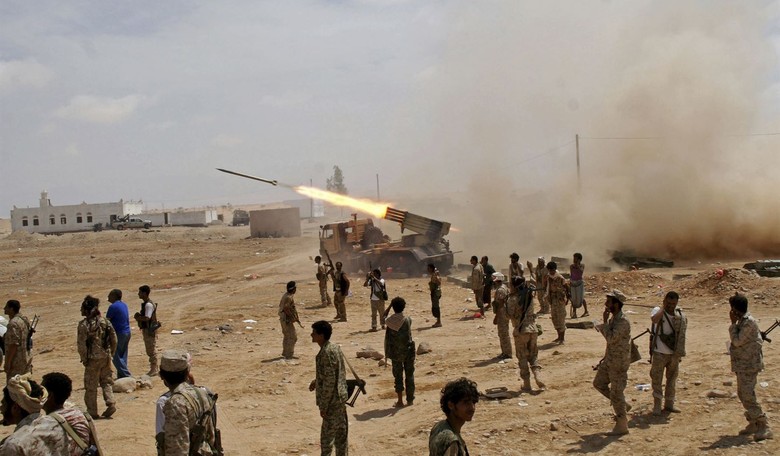
Saudi-backed Yemeni government forces launched a major counteroffensive Monday around the Bab el-Mandeb Strait, retaking the Dhubab district and pushing north toward the port city of Mocha. Yemen’s government says Mocha has also fallen back into its hands after the Houthis seized it last month. Saudi airpower is providing heavy cover, with the coalition saying about 100 fighter jets are supporting the operation.
From Reuters:
The advance, if confirmed, would loosen the Houthis' grip on a vital Red Sea oil route already roiling energy markets alongside Iran's closure of the Strait of Hormuz, though the group could still strike vessels with drones from other positions.
Fighting has raged along several front lines in Yemen for weeks since a dormant civil ?war erupted in a spillover from the US-Iran conflict, with the Houthis seeking to control the Bab el-Mandeb Strait and firing missiles and drones at Saudi cities and infrastructure.
The Saudi-led coalition fighting the Houthis also said late on Monday that naval forces carried out a military operation in Yemen's Red Sea governorate of Hodeidah. The government forces had already taken key positions including an airstrip in the Dhubab district at the mouth of the strait whose seizure by the Houthis last month sent shock waves through energy markets.
Bab el-Mandeb is one of the world’s critical maritime passages, linking the Red Sea to the Gulf of Aden and the Indian Ocean. In the second quarter of 2026, about 8.1 million barrels per day of crude oil and petroleum liquids moved through it, up from 5.4 million barrels per day late last year.
Its importance has grown because the Strait of Hormuz has been badly disrupted because of the Iran conflict. EIA figures show Hormuz oil flows plunged from 21.6 million barrels per day in the fourth quarter of 2025 to just 4.9 million in the second quarter of this year. Bab el-Mandeb moved more oil during that quarter than Hormuz, an extraordinary reversal for two of the world’s most important energy chokepoints.
Tehran and its Houthi allies suddenly had leverage near both ends of a vital Middle Eastern energy route. The Houthis pushed south in September, seized Mocha and nearby territory, and threatened to tighten their grip on the Yemeni side of Bab el-Mandeb.
Saudi Arabia clearly decided enough was enough. Coalition forces are backing Yemeni ground units with a large air campaign while striking Houthi weapons stores, explosive boats, mines, and other targets tied to attacks on Red Sea shipping. Saudi officials say protecting navigation through Bab el-Mandeb is one of the operation’s goals.
The Houthis aren’t finished, and nobody should pretend they are. They dispute the government’s account of how much territory has changed hands, and they have made gains elsewhere near Taiz. They also continue threatening Saudi airports, oil facilities, ships, and cities with missiles and drones.
Still, losing Dhubab and potentially Mocha this quickly is a serious setback. Only weeks ago the Houthis were expanding south and putting themselves in position to squeeze one of the world’s most important shipping lanes. Now Saudi-backed troops are cutting supply routes and forcing them away from positions overlooking the strait.
Iran built much of its regional strategy around armed proxies that could threaten enemies without Tehran paying the full price. Hezbollah pressured Israel from Lebanon, militias pressured American forces in Iraq and Syria, while the Houthis turned cheap missiles and drones into a multibillion-dollar problem for commercial shipping and Western navies.
Bab el-Mandeb shows the limit of that strategy. A militia can terrorize merchant ships, fire missiles, and grab territory while opponents hesitate. Holding a strategic coastline becomes harder when organized ground forces move in under the protection of 100 combat aircraft.
The timing could hardly be worse for Tehran. Iran is already dealing with the economic and military consequences of its confrontation with the United States and Israel. A Houthi retreat from the Bab el-Mandeb approaches would weaken one of the pressure points Tehran hoped could complicate global energy flows and raise the cost of confronting it.
Obviously, the battle isn’t finished, and we need to continue watching Mocha’s final status, but the direction changed Monday. Iran’s proxy grabbed for one of the world’s economic arteries, and Saudi-backed forces answered with something the Houthis understand very well:
Force.