
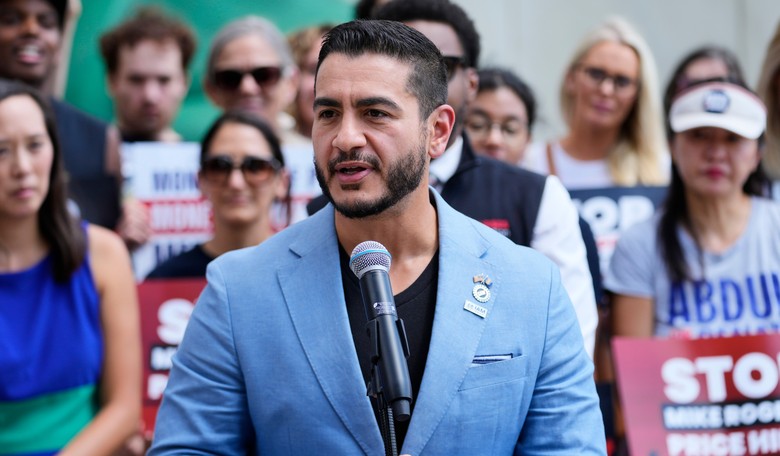
Abdulrahman Mohamed El-Sayed officially launched his U.S. Senate campaign on April 17, 2025, promising Michigan voters a government that works for ordinary people. Six days later, Wayne County approved a consulting agreement with his company, worth as much as $72,000.
The contract paid AME Higher LLC $9,000 a month for 30 hours of work, roughly $300 per hour. The stated purpose was to provide strategic assistance during a leadership transition and help align operational priorities in the county department Abdulrahman Mohamed El-Sayed had recently led.
From the Washington Free Beacon:
The contract, which extended through the end of the calendar year, stipulated that El-Sayed would be paid at a monthly rate of $9,000 for 30 hours of work—which amounts to around $ 300 per hour. Wayne County is run by county executive Warren Evans, a Democrat.
Under the agreement, El-Sayed was approved to receive up to $72,000 for eight months of consulting work, in which he would "provide strategic support to the County in efforts to ensure smooth and effective leadership transition and aligning operational priorities with the County's broader vision for public health and human services."
The payments were routed through "AME Higher LLC," an entity created by El-Sayed as a pass-through for his consulting and speaking fees, according to the contract.
El-Sayed’s own campaign confirms he entered the Senate race on April 17, 2025, presenting himself as a public servant who had rebuilt government agencies, and saying that Michigan needed leaders willing to fight concentrated wealth and make government work for everyone else.
Recommended: Nessel Endorsed Abdulrahman Mohamed El-Sayed, Then Asked Him a Remarkable Question
Then came the Wayne County arrangement.
Public records show the consulting agreement was approved on April 23, 2025, and could run through the end of that year. For eight months of potential work, El-Sayed’s company could collect as much as $72,000 from the county he had previously served as director of Health, Human and Veterans Services.
His financial disclosure also identifies Wayne County consulting income through AME Higher beginning in April 2025, providing another documented link between the county work and his private company.
No evidence in the records I’ve read showed that the contract itself violated a law or ethics rule. El-Sayed’s campaign says his work helped improve county services and make government more efficient, which is seemingly a fair defense.
Still, the timeline is difficult to ignore.
A candidate launches a Senate campaign built partly around fighting powerful financial interests and making government work better for working people. Less than a week later, his former government employer approves a deal paying his private company $9,000 a month for 30 hours of consulting work.
El-Sayed has also made money and political influence central themes of his campaign. On the first anniversary of his Senate run, his campaign celebrated raising $7.7 million, while emphasizing that he hadn’t accepted corporate money and promising to “get money out of politics.”
None of those positions automatically conflict with performing legitimate consulting work for a county. Government agencies routinely keep former officials because they understand departments, personnel, programs, and unfinished projects better than an outsider would.
What exactly did El-Sayed produce during those 30 monthly hours? Were there written reports, meetings, recommendations, transition plans, or measurable results? Was anyone else considered for the contract, and how was the $9,000 monthly rate established?
Those questions don’t require corruption accusations; they need receipts.
Abdulrahman Mohamed El-Sayed wants Michigan voters to trust him with a seat in the United States Senate. A $72,000 public consulting agreement approved six days after his campaign began is exactly the sort of government transaction a candidate preaching transparency should have no problem explaining in full.