
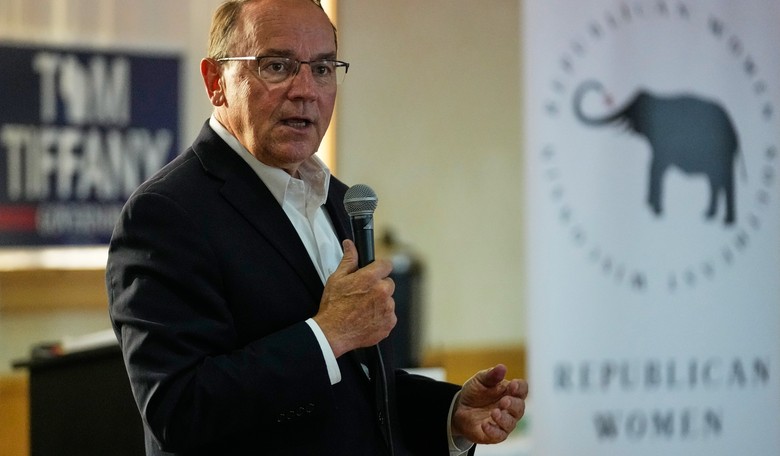
David Crowley leads Tom Tiffany 49% to 46% in the newest Marquette Law School poll, which sounds straightforward until you start opening the hood. Five percent remain undecided, the three-point difference is inside the likely-voter margin of error of ±4.8 points, and Tiffany has gained two points since August while Crowley hasn't gained one.
The September survey interviewed 843 Wisconsin voters from September 16 through September 23. Marquette classified 692 as likely voters. Its August survey had Crowley at the same 49%, Tiffany at 44%, and 7% undecided.
In other words, Crowley's number hasn't moved, but Tiffany's has.
Also, after a summer of polls running amok, showing tremendous leads by Democratic candidates, all polls are now tightening up, providing the polls some cover.
Marquette's definition of "likely voter" deserves attention. It isn't counting everyone who says he or she is "very likely" to vote. Traditionally, Marquette puts only registered voters who say they are absolutely certain to vote into that group. In August, 84% of Democrats, 82% of Republicans, and only 59% of independents cleared that bar.
The August registered-voter sample also wasn't stacked with Democrats. It was 36% Republican, 32% Democratic, and 32% independent. When partisan-leaning independents were reassigned, it became 46% Republican, 42% Democratic, and 13% independent. Marquette said its combined 2025-26 samples showed the same basic partisan distribution.
Then there's Crowley himself. Two months ago, Marquette's final Democratic primary poll had Francesca Hong at 38%, Mandela Barnes at 16%, and Crowley a distant third at 7%. Even adding voters who leaned toward a candidate left Hong at 46% and Crowley at 11%.
Eleven days later, Crowley won the primary. He and Hong each finished near 40%, separated by less than half a percentage point. Hong's support wasn't wildly different from what Marquette had measured. Crowley's was. A huge pool of undecided and late-deciding Democratic voters broke in a direction the topline hadn't captured.
Crowley's statewide familiarity has also been a genuine issue. Last fall, Marquette measured his name identification at 42% in the Milwaukee media market but only 20% around Madison, 12% in Green Bay, and 17% across northern and western Wisconsin. By August, his statewide recognition had improved considerably, yet 38% of registered voters still said they hadn't heard enough about him to form an opinion.
His elected record has likewise been concentrated around Milwaukee. Crowley represented a Milwaukee Assembly district beginning in 2017 and has served as Milwaukee County executive since 2020.
Something else dramatically changed this month. Crowley's favorable rating dropped from 33% in August to 31%, while his unfavorable rating jumped from 29% to 44%.
Tiffany sits at 39% favorable and 45% unfavorable. Crowley, therefore, leads the ballot test while carrying a net favorability of minus 13.
The longer polling trend doesn't show a runaway race. A March survey had Crowley ahead 42-41. July produced 46-43. August public polling generally put Crowley's advantage between three and five points. Marquette then showed 49-44, followed now by 49-46.
So I'd resist turning "Crowley by three" into anything more dramatic than the data allow. Crowley hasn't moved since August, but Tiffany has. Fewer voters are undecided, both candidates are personally underwater, and Marquette's own Democratic primary polling supplied a recent reminder of what late-deciding Wisconsin voters can do to a comfortable-looking topline.
This race remains exactly what the guts of the poll say it is: very close.
But.
A few days before the 2024 presidential vote, the final Des Moines Register/Mediacom Iowa Poll had Kamala-Venn-Salad-Shooter Harris leading Donald Trump 47% to 44%, based on polling conducted October 28 through October 31.
Trump won by 13 points!
The only accurate polls are the results of an election. Our very recent history of misleading polls leads to this: why do yahoos like me continue to report on something that will be wrong? I'd answer that by saying if we don't call them out, then "they'll" get away with snowing all of us.
There will be a day, soon I hope, when professional polling places end up becoming certified, akin to the scales we find at the grocery's checkout lane. I don't want them to simply tell me what I want to hear, but to become the McDonald's example of the same product, regardless of location.
Oh, I also believe that Sasquatch is real, so YMMV.