
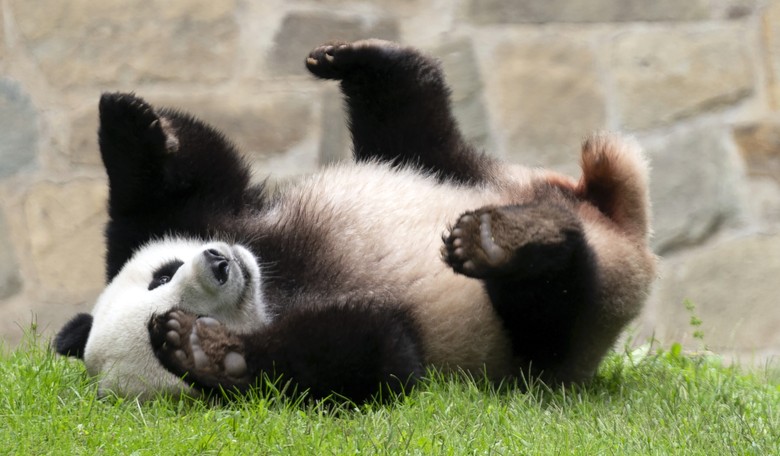
Two Chinese diplomats, Ping Ping and Fu Shuang, touched down at Hartsfield-Jackson Airport in Atlanta on Sunday morning.
No, they're not here to date Eric Swalwell.
They're actually giant pandas that will live at Zoo Atlanta for the next 10 years.
Thrilling news: The giant pandas have landed! Zoo Atlanta is overjoyed to announce that giant pandas Ping Ping and Fu Shuang have arrived in Atlanta. https://t.co/qdOjKl8DeT pic.twitter.com/jTnhYhyVvx
— ZooATL (@ZooATL) September 27, 2026
A pair of giant pandas departed Chengdu Shuangliu International Airport in southwest China's Sichuan Province on a chartered flight Sunday, bound for Zoo Atlanta, marking the beginning of their 10-year stay at the zoo. pic.twitter.com/Tgl5PMBDVm
— CBS News (@CBSNews) September 27, 2026
These cuties are from the Chengdu Research Base of Giant Panda Breeding, are six years old, and must remain in quarantine for a month before they'll be available to the viewing public. They arrived via a dedicated "FedEx Panda Express" Boeing 777 aircraft, a service that FedEx donated to this diplomatic gesture.
During his visit with Donald Trump last week, Chinese President Xi Jinping called the pandas an "envoy of friendship" between the Chinese and the Americans, and because you should never let symbolic diplomacy go to waste, he reportedly insisted that their arrival coincide with his visit to Washington, D.C. The truth is that their arrival has been in the works since April, and it's part of a "new International Cooperative Research Agreement on Giant Panda Conservation initiated between Zoo Atlanta and the China Wildlife Conservation Association."
Atlanta is now one of only three zoos with giant pandas in the United States — the San Diego Zoo and the Smithsonian's National Zoo are the others — and it's not the first time the city has welcomed pandas from the Chinese government. Lun Lun and Yang Yang were residents of Zoo Atlanta between 1999 and 2024, and during that time, they produced seven offspring. (I actually have several pictures and video of them out playing in their enclosure from when I took my cousin's little boy to the zoo several years ago.)
It's fun having them around, but make no mistake — China's panda diplomacy isn't just a kind gesture or contribution to conservation. It's a foreign-policy move, and it's something the Chinese government has used for decades, dating back to the 1940s. In 1972, when Richard Nixon visited the communist country, First Lady Patricia Nixon supposedly mentioned her fondness for giant pandas to Chinese Premier Zhou Enlai. Here's what happened next:
As a gesture of goodwill following President Nixon’s seminal state visit, Premier Enlai gifted two giant pandas to the American people. Nestled in the Nation’s Capital and with free admission, the President and Mrs. Nixon selected the Smithsonian’s National Zoo as the home for the giant panda bears. On April 16, 1972, the giant pandas Ling-Ling (a female) and Hsing-Hsing (a male) arrived at their new home. Over the next 20 years, Ling-Ling and Hsing-Hsing produced five cubs. Sadly, none of the offspring survived for more than a few days. But ever since their arrival, the pandas have symbolized cross-cultural collaboration between the United States and China.
The Chinese use pandas as diplomatic tools because, unlike the CCP, they're universally beloved, but the animals are only found in the wild in China, making them distinctively representative of the country. And while many zoos around the world willingly accept this "gift," it can also become a burden. In 1984, Deng Xiaoping decided that China would no longer give pandas away, but lease them instead. That fee can be quite expensive, as can the animal upkeep. Pandas in captivity need special care, are difficult to breed, and can eat up to 88 pounds of bamboo a day.
In 2011, for example, the Edinburgh Zoo was having trouble keeping up with how much its pandas ate, so it began asking for donations from locals and even importing bamboo from Amsterdam.
That said, while our governments may be adversaries, partnerships between the people in China and the U.S. have actually benefited these magnificent animals. Thanks to the work of scientists in places such as Chengdu and Atlanta, pandas, who have been a symbol of conservation for decades, were removed from the International Union for Conservation of Nature (IUCN)'s Endangered species list, and upgraded to Vulnerable.
My feelings on China aside, I look forward to seeing Ping Ping and Fu Shuang when the quarantine is over. I may even make a trip to the zoo — I don't live too far from it. But I do hope the zookeepers at least check them for spy cams...just sayin'.