
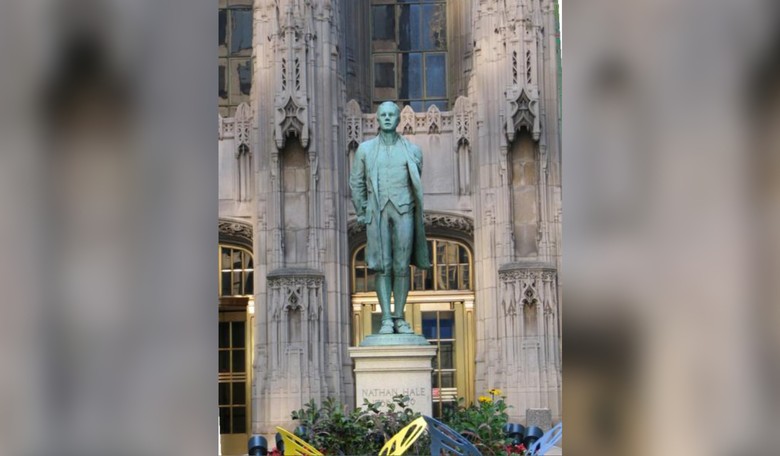
On Sept. 22, 1776, Nathan Hale took his last look out at the New York scenery of the place where he was to lose his life at only 21 years old. The British caught him doing spy work for the American revolutionaries, and spies died by the noose. Hale then uttered the famous words that an eyewitness reported, “I only regret that I have but one life to lose for my country.”
Last year, I noted that Hale had started on his undercover journey that ended so tragically on Sept.10, the same date on which, in 2025, Charlie Kirk lost his life to political assassination. Both Kirk and Hale were very young, both of them were fearless patriots, and both of them lost their lives because they took a stand for freedom. The era of risking one’s life for liberty and truth is not past. The need arises again in every generation, sometimes in a military context and sometimes in a culture war.
One day after being captured by the British, Nathan Hale was hanged for spying on this day in 1776. "I only regret that I have but one life to lose for my country." https://t.co/uS2xsVBTwU
— Today in History (@TodayinHistory) September 22, 2026
After all, Hale and George Washington’s army were not simply fighting foreign troops. They too were fighting a civil war, with estimates being that a third of the colonists were Patriots, a third were Loyalists, and a third were relatively indifferent about either side’s cause. And as many atrocities as the British committed in the colonies during the Revolution, the Loyalists show up as responsible for some of the most brutal killings. In 250 years, that much has not changed. We are still struggling to quell leftist, anti-American domestic terrorism, which sometimes takes the lives of Patriots like Kirk.
In fact, the man who betrayed the young spy Hale might have been a Loyalist relative, hence his ability to see through Hale’s rough disguise. Historian Henry Phelps Johnston was not so definite in his biography of Hale, but he did note that there were numbers of locals who could and possibly did recognize Hale as a Patriot.
In Walt Disney’s Revolutionary War tribute, Johnny Tremain, the character of James Otis reminds each of the Sons of Liberty what the cost of fighting the British will be. Looking at teenaged Johnny, he reflects, “To die young is more than dying, it is to lose so large a part of life.” That is the tragedy of a Nathan Hale, a Charlie Kirk, or the young American troops who died this year fighting Iran’s terrorist regime. But like the real James Otis and the young men he inspired to go to war in the 18th century, like Nathan Hale and all the young patriots in the 250 years since, we believe that they died for a cause greater than themselves, and that they died heroes.
Related: America 250: First Publication of ‘The Star-Spangled Banner’
Exactly two and a half centuries ago, Hale died the ignominious death of a rebel spy. But while the British who hanged him are long forgotten, Americans who know their history still speak Hale’s name with reverence. There are statues, monuments, stamps, and events in his honor. He died in the prime of his youth, a brilliant scholar and brave soldier. How many people could ever lay claim to such a legacy at the end of eight decades as Hale had at the end of two?
Today we honor Hale, and also every other brave American who lost his life for the cause of freedom. Without heroes like Hale, America could never have survived 250 years.