
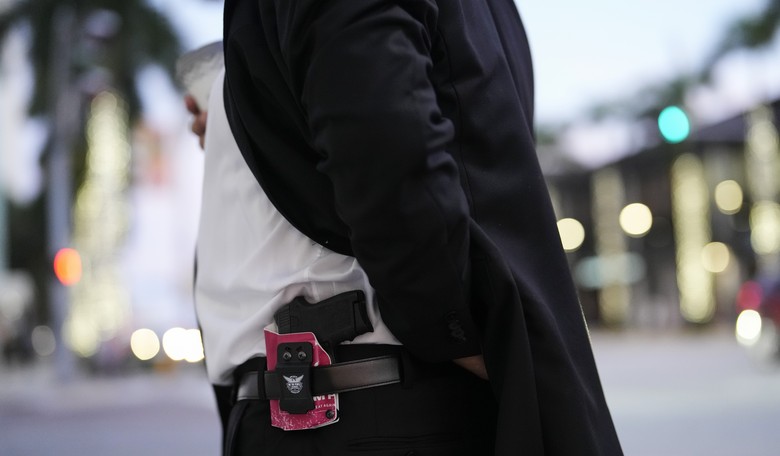
Late last month, the Supreme Court heard oral arguments in Wolford v. Lopez, a case challenging a newly imposed Hawaii law that presumptively bans concealed carry permit holders from any private property open to the public (like gas stations and shopping malls) unless they first get express permission from the owner. Combined with other restrictions, the law has the practical effect of making lawful public carry virtually impossible in Hawaii.
Fortunately, the nation’s highest court appears likely to strike down the new restriction. But there’s still so much work left for the court to do when it comes to protecting the right to keep and bear arms—including, specifically, against infringements by the Hawaiian government. Even without the express permission requirement hanging over their heads, Hawaiian concealed carry permit holders will still be prohibited from exercising their rights in an absurdly long list of “sensitive places.”
These include, among other locations:
Any bar or restaurant that serves alcohol, regardless of whether the permit holder imbibes;
Any “stadium, movie theater, or concert hall”;
Any place at which any sporting event of any level of competition is being held;
Any beach, playground, or park, including “any state park, state monument, county park, tennis court, golf course, swimming pool, or other recreation area or facility under control, maintenance, and management of the State or a county”;
Any parking area adjacent to the prohibited locations above.
Constitutionally, it’s abhorrent. As a matter of public policy, it’s laughable – and dangerous.
Americans use their firearms to defend themselves and others far more often than many people—and, apparently, the Hawaiian government—realize. A 2013 report by the Centers for Disease Control and Prevention acknowledged that almost every study on the issue has found that between 500,000 and several million defensive gun uses occur every year in the United States. An extensive 2021 national survey conducted by a Georgetown professor further substantiated this reality, concluding that Americans used their firearms defensively an average of 1.2 million times a year.
Many of these acts of armed self-defense occur outside of the gunowner’s home—including, at times, in precisely the types of public spaces where states like Hawaii now seek to ban the lawful possession of firearms. Just consider the following recent stories of armed self-defense in public spaces:
Dec. 9, 2025, Frankfort, Ky.: An Indiana couple drove to their son’s Kentucky State University dormitory to help him move out after “multiple armed, violent incidents” against him went unaddressed by school administrators. As they were gathering his belongings, a group of 20 to 30 individuals arrived—some of them allegedly armed with weapons—and began attacking the family. Several members of the group slammed the son onto the concrete and beat his head against the pavement with their feet and fists, then assaulted the father when he tried to intervene. In fear for himself and his family, the father drew his gun and shot at the assailants, killing one and wounding another. While local officials initially charged the father with murder and assault, a grand jury declined to indict him. Unlike most states, Kentucky doesn’t specifically prohibit the otherwise lawful possession of firearms on college and university campuses.
Dec. 9, Muncie, Ind.: An armed patron stopped another man’s brutal assault on staff and customers at a local tavern, shooting the assailant “in the buttocks” as he repeatedly struck a woman with a broken pool cue. The man had become increasingly belligerent, spitting in the faces of at least three people before using pool cues and metal bar stools to bludgeon anyone near him. Two victims reportedly sustained serious injuries, including broken ribs and a collapsed lung, before the armed patron intervened.
Dec. 15, Fernley, Nev.: A man saw another car that he believed had cut off his wife two days earlier in an unreported traffic incident. He followed that car into a Wendy’s parking lot, boxed it in to prevent the other driver from leaving, and started hitting the driver in the face and head hard enough to bloody his own hands. The driver grabbed his handgun and fired two shots through his car door in self-defense, causing the assailant to flee back to his own car, which he promptly moved out of the victim’s way. Police subsequently arrested the assailant.
Dec. 15, Mandeville, La.: Local officials hailed an armed neighbor as a hero for saving a woman’s life after her ex-boyfriend showed up at her home in violation of a no-contact order and assaulted her with a knife. The woman escaped through a window and knocked on several neighbors’ doors while screaming for help, but her ex-boyfriend followed her into the street and continued his assault. Finally, one neighbor—alerted by the woman’s screams—grabbed his firearm and ran out into the street, where he ultimately shot and killed the knife-wielding assailant.
Dec. 20, Winston-Salem, N.C.: An armed employee opened fire on two masked men who forced their way into a business while brandishing firearms, injuring one robber and sending the second fleeing. Police apprehended both suspects, who now face numerous felony charges.
Jan. 3, Fayetteville, N.C.: An armed restaurant patron fatally shot two brothers in self-defense during a confrontation that apparently began when the brothers misinterpreted the patron’s shirt as apparel from a rival biker club. The armed victim—a soldier stationed at nearby Fort Bragg—only shot the brothers after 911 callers say they “continuously hit him.”
Jan. 9, York, S.C.: When a 72-year-old driver shot at an 18-year-old driver during a road rage incident, the 18-year-old returned fire in self-defense, striking and injuring his older assailant. Police charged the older man with attempted murder, pointing and presenting a firearm, and malicious injury to property. Unlike many states, South Carolina doesn’t restrict the right of law-abiding young adults to exercise their Second Amendment rights in public.
Jan. 12, Sterling Heights, Mich.: Police say that a man who got into an argument with another guest at a house party walked out to the driveway and began shooting at the home. He injured three people before another guest returned fire with his own gun, striking the gunman and ending the attack. The gunman now faces three counts of assault with intent to murder, each of which carries a potential life sentence.
Jan. 16, Newport, N.C.: An employee checking on an estate property legally controlled by his law firm encountered a “squatter” illegally trespassing at the property. During an ensuing argument, the squatter pulled out a handgun and shot at the employee. The employee retreated to his car, grabbed his own gun, and returned fire in self-defense until the squatter fled. U.S. Marshals later captured the suspect 140 miles away. He faces charges for, among other things, attempted murder and being a felon in possession of a firearm.
Jan. 24, Sparks, Nev.: During a road rage incident, two suspects began physically assaulting two victims. The assault ended only after one victim drew a handgun and fired two shots at the assailants in self-defense. The suspects fled but police quickly identified and arrested them.
Jan. 27, Chicago, Ill.: Two armed men tried to rob a driver at gunpoint as he exited his car. The victim, a concealed carry permit holder, drew his own gun and fired multiple shots at the robbers, striking one in the legs.
Jan. 30, York, Pa.: Police say that a woman who brandished a gun at another parent during an altercation outside of a school “was within her rights to possess the firearm and display it to protect herself,” and won’t face criminal charges. The other parent involved in the altercation was referred to the local District Attorney for prosecution on unspecified criminal charges.
These stories illustrate the importance of the right to keep and bear arms outside of the home. It’s astonishing just how many of the lawful gun owners above would be considered criminals in Hawaii, simply because they exercised their constitutional right in a “sensitive” place or without first begging the owner’s permission.
Hawaii’s slew of spiteful post-Bruen laws restricting public carry have nothing at all to do with public safety or vindicating the rights of private property owners. They’re all just a vindictive effort to keep as many law-abiding gun owners as possible from exercising their right to bear arms in as many places as possible.
Draconian restrictions on the right to armed self-defense in public don’t make peaceable and law-abiding citizens safer. They just render them far less capable of defending themselves and others.