
I love keeping reptiles and amphibians, but don’t do live feeders. Naturally, this means being choosy with the species that I bring home. All of the snakes feed well on frozen mice (or, in the case of my Dasypeltis gansi, eggs — as that’s all he’s built to eat), my crested and gargoyle geckos get multiple varieties of Pangea fruity gecko diet, and my blue-tongue skink chows down on premium moist cat food mixed with fresh veggies and fruit, with his favorite canned snails to top it off.
When it comes to frogs, you have to be just as sensitive to what they eat and how they eat. Poison dart frogs need moving insects. Tomato frogs similarly wait to ambush live food.
But some of the big boys in the frog world can be fed well in captivity and achieve great growth without a live creepy-crawly in the house.
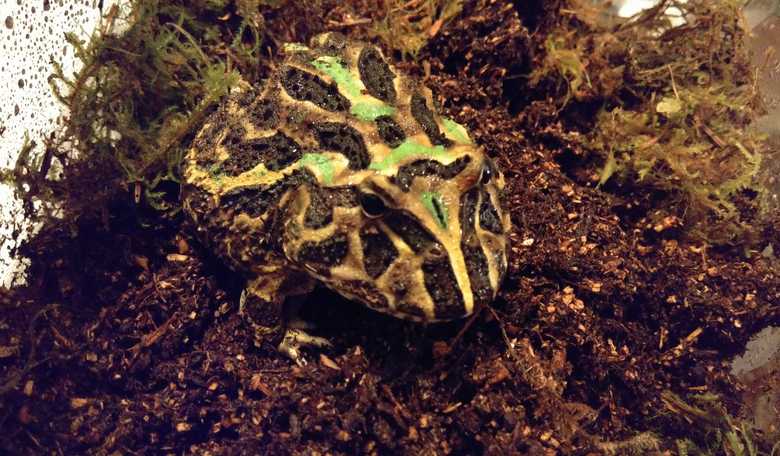
My Ceratophrys — known as “pacman” frogs or South American horned frogs — are happy to laze about and get their food delivered, as is my African bullfrog, or “pixie” frog. And, for their size and growth needs, they’re getting more well-rounded nutrition than eating crickets all day.
Here’s my juvenile pixie having a bite:
Everybody gets their own kind of Thanksgiving! pic.twitter.com/l4H792RmRv
— Bridget Johnson (@BridgetCJ) November 22, 2018
What you’ll need:
- Commercial pacman frog food. I swear by Hikari Pac Attack sticks, which are moistened in water for a couple of seconds and are ready to tong-feed. ZooMed also makes a powdered variety that is moistened and molded into shape, but it’s been sitting in the cupboard unopened since I ordered both and tried the Hikari first.
- Feeding tongs. The plastic 5-inch tongs are OK for feeding babies that are still an inch or two long, but you’ll want the 10-to-12 inch metal tongs for feeding anything larger as the frogs will jump up and bite fingers within reach while feeding (and their teeth hurt — been there).
- Canned insects, such as crickets, snails or grasshoppers for the big boys.
- Frozen pinky mice, or larger depending on the size of the frog.
How often you feed depends on the size of the frog. Hikari recommends frequency and volume in relation to the frog’s size, listed on the packaging.

Baby strawberry pineapple pacman frog (Bridget Johnson/PJ Media)
How to tong-feed:
- If possible, buy a frog that has been tong-fed by the breeder. My strawberry-pineapple pacman was fed pinky parts on tongs by the breeder in addition to live crickets, and was a snap to adapt to all tong feeding. I’ve had mixed luck with pet-store frogs: one refused to tong-feed, and one adapted quickly.
- If struggling to adapt a frog to a commercial diet, start the feeding session with a goody. If they’re used to crickets, start with a couple of canned crickets offered on tongs (canned crickets do tend to spoil pretty quickly in the fridge; you want to use an open can within about five days, and throw out if there’s any funky smell or anything growing on the bugs) or with a frozen/thawed mouse quickly run under hot water (I limit my frogs’ mouse intake to once a month).
- I find that the Pac Attack sticks are more eagerly accepted if moistened with hot water and served right away.
- Keep your hand high up on the tongs and wiggle the food in front of the frog. Sometimes they’ll be voracious, sometimes they’ll wait a few beats to pounce. Be patient.
- In the act of swallowing, they’ll flatten their eyes to their head. Wait for the swallow before offering more.
Remember to not feed in successive days — your frog needs time to digest. If you need to change out your frog’s substrate and water, do it before feeding so he can peacefully chill with a full tummy after feeding time.