





For decades, China has pursued one of the most audacious technology-acquisition strategies in modern history: if you can’t invent it, acquire it. If you can’t acquire it, copy it. And if you can’t copy it legally, steal it.
America is finally treating the problem with the seriousness it deserves.
The latest battleground is a federal courtroom in Brooklyn, where opening statements were delivered this month in the criminal trial of Huawei, the Chinese telecommunications behemoth central to Beijing’s technological ambitions.
The Justice Department accuses Huawei of racketeering, trade-secret theft, bank and wire fraud, sanctions violations, and other crimes in a years-long campaign that allegedly helped build its global telecommunications empire. Huawei denies the charges.
“Theft. Lies. Cover-ups. For 20 years that’s how Huawei, a global telecommunication company, victimized American companies and abused the American financial system to dominate telecommunications around the world,” Justice Department attorney Taylor Stout told the jury.
That is what makes this prosecution so important. This isn’t merely about punishing one company. It is about defending the most valuable thing America produces: ideas.
Semiconductors, artificial intelligence, telecommunications, aerospace, and advanced manufacturing are the foundation of economic and military power in the twenty-first century. American companies spend billions of dollars and decades developing these technologies. Allowing a strategic competitor to obtain them through theft is far from a victimless crime. It effectively means U.S. innovators are subsidizing the competitors seeking to displace them.
How blatant have Chinese efforts in this sector gotten? A Huawei subsidiary maintained a Silicon Valley office right next door to Nvidia, the American company at the center of the AI revolution and producer of some of the world's most coveted advanced chips.
Those chips illustrate precisely what is at stake.
The country that dominates artificial intelligence and advanced computing will possess enormous economic, intelligence, and military advantages. America reached the technological frontier through investment, research, and entrepreneurship. China should not be permitted to close the gap by simply co-opting those efforts.
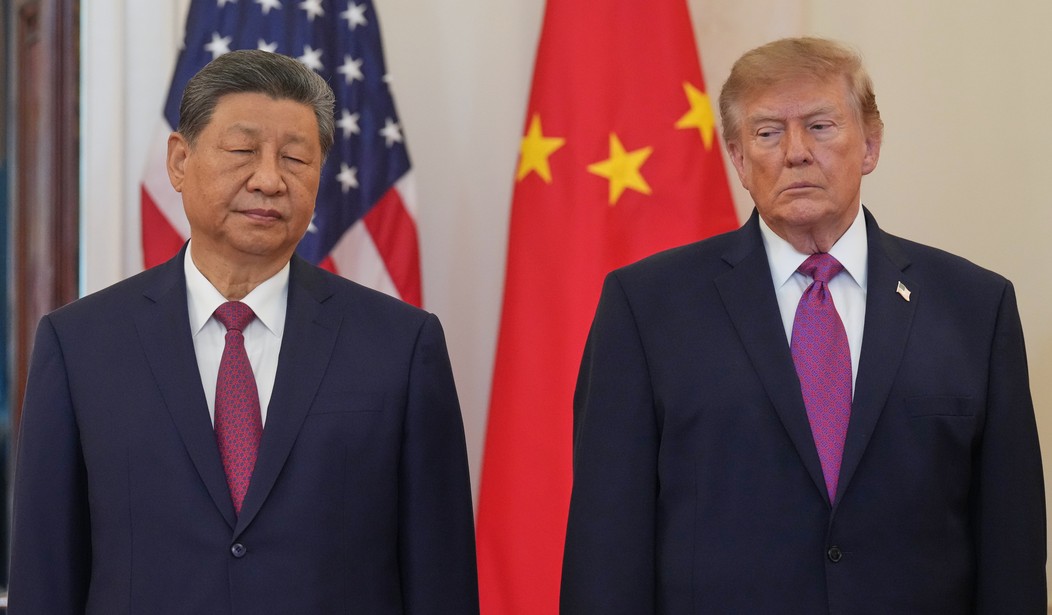
Despite the smiles and handshakes surrounding the recent Washington, D.C. summit, President Trump recognizes the challenge that President Xi’s China represents. And in short: the technological war is on.
During his first term, Trump signed an executive order restricting American companies from using telecommunications equipment deemed a national security threat, effectively pushing Huawei out of critical American 5G infrastructure.
His administration then went after Huawei's technological lifeline. Washington restricted U.S. chip technology from reaching Huawei, including through foreign semiconductor manufacturers reliant on American equipment and software.
That recognized an important economic reality. America's advantage isn't merely that it makes sophisticated technology. It occupies crucial positions throughout the ecosystem required to design and manufacture it.
China responded by pouring resources into its domestic semiconductor industry and reducing its dependence on Western supply chains.
So the U.S. answered another way: by creating competitors capable of challenging Huawei internationally, taking advantage of American ingenuity and tech know-how. This gives America greater scale in a global market where Huawei had remained unchallenged.
This is the competition America should want: American innovation against Chinese innovation — not American innovation against Chinese stealing our innovation.
Understand that the necessity for this ongoing technological cold war invokes an unfortunate historical irony: it was Washington itself that helped create our main geopolitical rival.
In 2000, President Bill Clinton vigorously supported permanent normal trade relations with China and its entry into the World Trade Organization. His administration argued that WTO membership would open Chinese markets, strengthen intellectual property protections, and integrate China into the rules-based international economy. Clinton went further, arguing that economic opening would promote broader political liberalization. In sum: by making China richer, we would make the Chinese more like us.
To say that wager did not play out as hoped would be the geopolitical understatement of the century.
Trump is now confronting that blunder’s consequences, many of which are undergirded by advanced Chinese technology. For example, Chinese tech firms have exported surveillance and censorship technologies to governments around the world, potentially enabling the sort of mass surveillance that strengthens totalitarian control.
If that doesn’t sound like America’s problem — it is. Because whether it is Iran, Latin America, Africa, or Europe, whoever controls the advanced technology those areas rely upon will emerge as the twenty-first century’s superpower.
Which is why the Brooklyn prosecution matters far beyond Brooklyn. The stakes are larger than whether Huawei committed the particular crimes alleged in the indictment. A jury will decide those charges, as it should.
The larger principle shouldn't be controversial: American intellectual property isn't free for the taking.
America spent decades hoping that bringing China into the international economic system would make China play by its rules.
The Huawei trial represents the opposite proposition: if you want access to the American market, American technology, and the American financial system, you play by American law.
And if prosecutors prove that you stole America's technology, you answer for it in an American courtroom.
Which is how genuine competition works.
Editor's Note: Do you enjoy PJ Media's conservative reporting exposing the radical left and woke media? Support our work so we can keep bringing you the truth.
Join PJ Media VIP and use promo code FIGHT to receive 60% off your membership.

Join the Conversation
VIP members get the ability to comment on articles.