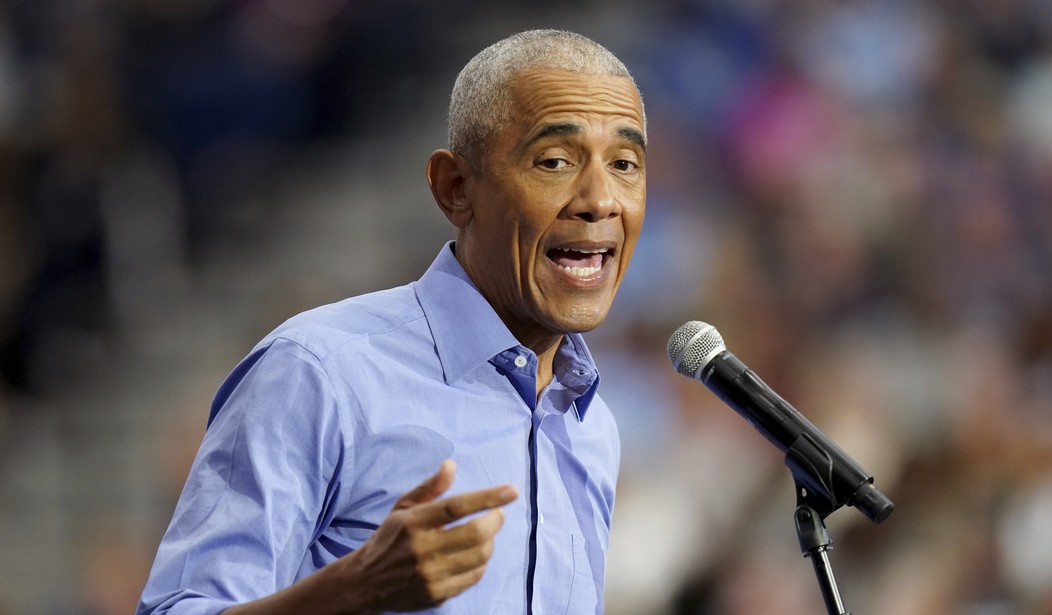

Democrats have one move they trust when they get nervous, and they've been running it for a decade: call Barack Obama. The media treat each of his returns to the campaign trail as an event that should have Republicans shaking. The far more revealing story is what the call says about the party making it, and whether the man answering can still deliver.
That question came up Monday on CNN's NewsNight, where Elie Honig reported that Obama will campaign later this month with Michigan Democrat Senate nominee Abdul El-Sayed. Obama has also recorded two dozen ads for the party's Senate and gubernatorial candidates, with more trail appearances to come. Honig then turned to Scott Jennings and asked whether Republicans "welcome or fear Barack Obama's involvement in these midterms."
"Well, neither, because it's expected," Jennings said. "He campaigns in every election. He's the most partisan, ate up with politics ex-president we've ever had. I expect him to show up in every race, in every jurisdiction of the country. He can't stand it. He has to be involved in politics all the time."
He's right. Republicans aren't fearing Obama's involvement, and for starters, it was inevitable that he'd jump in. Nobody at the RNC is losing control over their bowels because Barack Obama is once again clamoring for the spotlight in an election year.
What should amuse Republicans is where he's going. Obama is going to stump for El-Sayed in Detroit, a Democrat stronghold if one ever existed. A confident party doesn't spend its biggest name on a city it should carry in its sleep. Sending Obama into Detroit is a de facto acknowledgment that Democrats are worried about their own base turning out.
Jennings saw the same thing, and he pointed to El-Sayed's bruising primary against the more moderate Haley Stevens.
"What it tells me, though, is that all this Democratic confidence you hear out there about El-Sayed is a little misplaced because I don't think Obama would be going there if they were so confident about it," he said.
Recommended: Mamdani Tries to Hide His Jew-Hatred and Only Exposes It Further
"He has significant trouble with African-American voters in the Democratic primary," Jennings added about El-Sayed. "He has not shored up that support in Michigan. They need Obama to try to do that. I'm not sure it's going to be the total answer, but it's not really a surprising development to me."
"Obama campaigns in every election. He's the most partisan ate up with politics ex-President we've ever had." "All this Democrat confidence about El-Sayed is misplaced, Obama wouldn't be going there if they were confident." Scott Jennings is right. Democrats are panicking. https://t.co/FhMzWqOkBk
— Thomas Hern (@ThomasMHern) October 6, 2026
So Obama's involvement looks less like a show of strength and more like an admission that Democrats have a problem. The real question is whether it will work. And we don't have to look far back to see that Obama's ability to deliver for his party isn't as strong as it used to be.
Consider the final weeks of 2024, when Obama barnstormed the battlegrounds for Kamala Harris. He campaigned for her in Pennsylvania and dropped by a campaign field office in Pittsburgh. He held a rally at a Nevada high school. He rallied with Tim Walz at the University of Wisconsin-Madison. He joined Kamala, Bruce Springsteen, and Tyler Perry at a huge rally in Georgia, their first joint campaign appearance. In late October, he campaigned in Michigan, including a Detroit event with her campaign. With the exception of Georgia, Obama carried every one of those states when he ran for president. These were his states and his voters.
Yet Kamala lost all of them.
That's why Honig's question misses the point. Asking whether Republicans fear Obama assumes his involvement moves votes. The better question is whether it helps Democrats at all. If he couldn't win a single swing state for Kamala in 2024, what good will he be in 2026?