


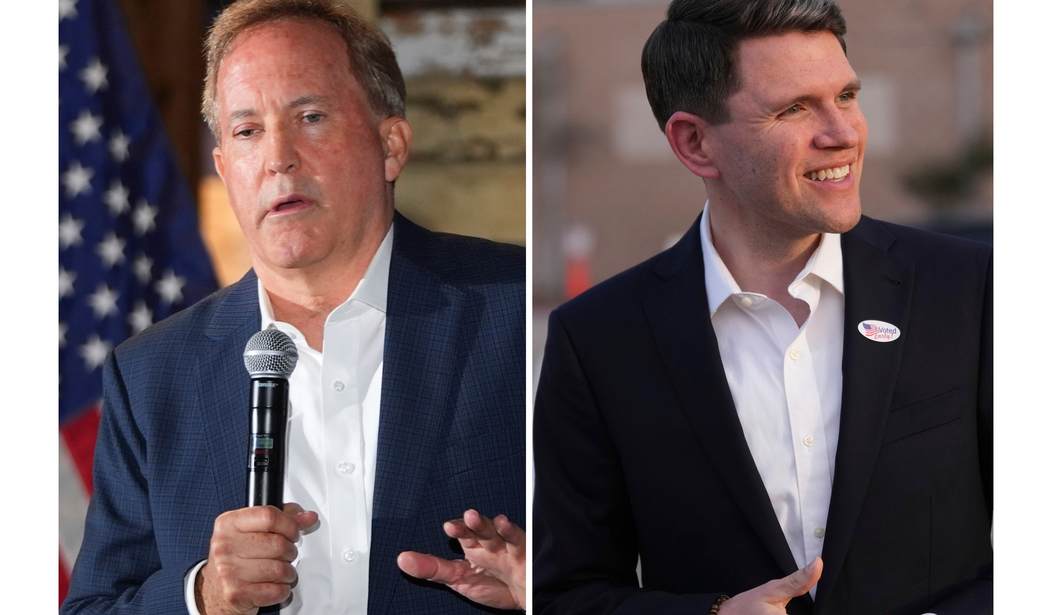
Texas Attorney General Ken Paxton just released one of the most brutally accurate campaign ads of the cycle against James Talarico (D-Texas). The ad is devastating because it's true. Every quote in it is real, cited, and about as damning as political rhetoric gets, though they are spliced together in a way that is clearly done for dramatic purposes. The way Paxton chose to deliver those quotes should give conservatives pause, not because of what's being said, but because of how it's being shown.
Has Talarico said “God is nonbinary,” or "God is not a Christian"? Yup. Has he claimed there are "six genders," called Jesus "a radical feminist," and described himself as "a Christian who hates Christianity”? Yep. These quotes are accurate.
Paxton didn't need to embellish a thing.
Here's where it gets complicated. The 30-second spot doesn't just show video clips of Talarico. It features an AI-generated version of him reciting these lines to the camera, in his own voice. Nobody watching would mistake it for real footage. But it rubs me the wrong way. Perhaps mostly because Paxton didn't need a synthetic Talarico. The real Talarico said every one of these things, and we have the footage to prove it.
NEW AD: James Talarico is weaponizing faith to sell a radical agenda, and he even brags about hating Christianity. pic.twitter.com/Wa2nQ3vsIq
— Attorney General Ken Paxton (@KenPaxtonTX) September 8, 2026
Now, of course, Spencer Pratt did something similar with his own AI ads this cycle. Those were effective and funny, but in the videos I saw, I don’t recall Pratt ever using AI to manufacture footage of his opponents saying anything. He never borrowed their likenesses or voices.
This is all new territory, and the ethics of this practice are debatable. But if the real audio and video already exist, why manufacture a replacement at all?
This situation brings to mind something from 2016, when Trump was first running for president. I was working as an architect, and a coworker shared a meme on Facebook. It quoted Trump telling People magazine in 1998 that he'd run as a Republican "because they're the dumbest group of voters" and that they'd "believe anything on Fox News."
None of that ever happened. The interview didn't exist. It was a fabricated quote. But that didn’t stop it from going viral. I knew it was fake, and I told my coworker and showed her the proof. She left the post up regardless. Her reasoning? "It sounds like something he would say."
That memory has stuck with me for a decade, and it should stick with anyone who assumes the truth eventually wins out. Long before artificial intelligence entered the picture, a fake meme could outrun any correction. Countless people believed that fabricated Trump quote before it was debunked, and plenty kept believing it and sharing it after. The lie didn't need to be good. It just needed to be believable to anyone who wanted to believe it.
Heck, how many people still believe that Sarah Palin said “I can see Russia from my house” as an example of a foreign policy credential when it was actually Tina Fey parodying her on Saturday Night Live?
ICYMI: Amy Acton’s ‘Assassination Attempt’ Narrative Is Falling Apart
Now project that dynamic forward, except swap the clumsy meme for a video that looks and sounds completely real. Artificial intelligence is advancing so fast that a fully convincing fake video, one showing a candidate saying or doing something he or she never did, is coming soon; it maybe already be here. And when it lands days before an election, there won't be time for a fact-check to catch up before the damage is done.
We’ve already seen a preview of this working with photos. Leftists have circulated AI-manipulated images claiming to show Trump involved with Jeffrey Epstein’s criminal activity. Those images went viral almost instantly, faster than anyone could push back. I still see fake Trump/Epstein photos floating around social media.
Talarico earned every bit of criticism in that ad. His own words are damning enough without any embellishment, and Paxton was right to put them front and center. But normalizing AI-rendered likenesses in campaign ads hands the same tool to people with far less regard for the truth. Seriously? We're supposed to trust that only the honest side ever uses it that way?
That's the trajectory we're on. Even a blatantly obvious AI-generated video, one nobody could mistake for real, will circulate long enough that plenty of voters will believe it before anyone corrects the record.
This is not a good thing.