


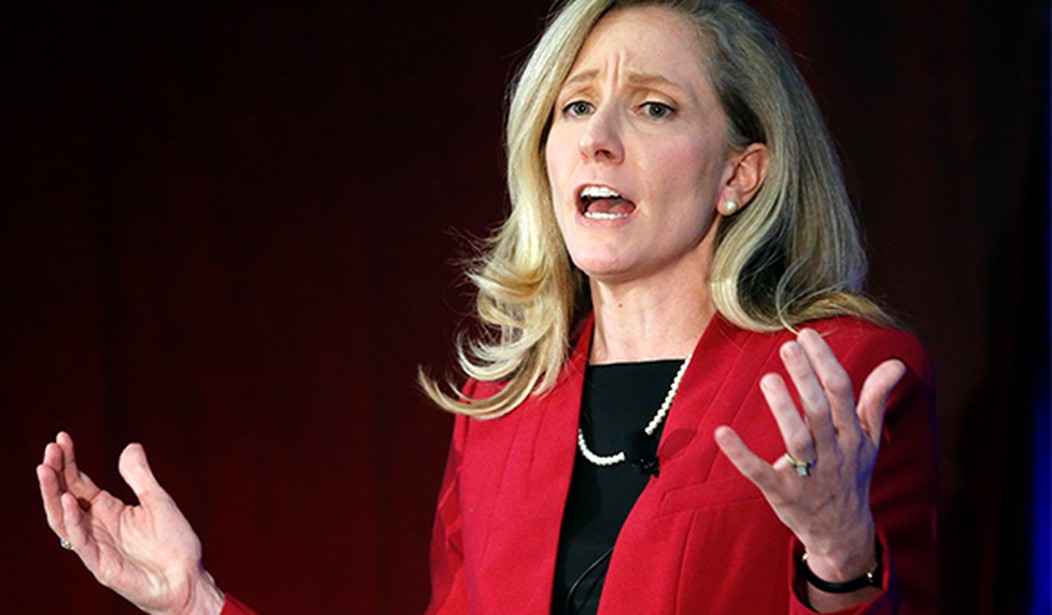
Gov. Abigail Spanberger (D-Va.) is sending a quiet but unmistakable signal about her party’s redistricting referendum, and it's not a confident one. And that tells us that she likely believes her big plan to gerrymander more seats for the Democratic Party in Washington is going to go down in flames.
Spanberger still supports a "yes" vote on the April 21 referendum and hasn’t changed her position. The referendum, if passed, would give the Democrat-controlled General Assembly the power to redraw Virginia’s congressional maps mid-decade, creating a 10-1 Democrat advantage. She signed the enabling legislation herself back in February. She even cut an ad for it. But supporting something and fighting for it are two very different things, and Democrats are starting to notice the gap between those two postures, and they’re not happy.
She's been pulling back from public campaigning on this issue. No rallies, minimal visible effort. That's not the behavior of someone who thinks she's winning. And it looks like she isn’t.
While it may be politically smart to distance yourself from a failed campaign, her fellow Democrats are not happy about the situation. There have been pointed criticisms that Spanberger hasn't shown up publicly to drive enthusiasm for the measure.
Recommended: Chuck Schumer Doesn’t Want You to See This Video About Iran
Spanberger pushed back when reporters asked about it outside the Executive Mansion in Richmond. "I have made it very clear that I support a yes vote, and I think Virginians should vote 'yes,'" she said. And then she gave a standard line about wanting to focus on governing.
Right.
That kind of careful distancing doesn't come from nowhere. Politicians instinctively distance themselves from things they sense are going sideways. The fact that Spanberger is creating tension with her own party while initially being all in supporting the referendum, to now doing nothing to support it, tells you plenty about where her internal polling likely is.
Despite the fact that this should be her honeymoon period, voters clearly feel they were deceived by her gubernatorial campaign, in which she campaigned as a moderate, only to align with a radical left-wing agenda upon taking office. A Washington Post-Schar School poll has her at 47% approval, with 46% disapproving and 7% undecided. That's essentially a coin flip. She's not sitting on a mountain of political capital, and she knows it.
Of course, she's hedging.
The entire premise of this referendum was aggressive. Democrats want to redraw Virginia's congressional maps to flip as many as four seats currently held by Republicans. The pitch was sold as a response to GOP-led redistricting in states like Texas, moves that President Donald Trump has openly encouraged to level the playing field because Democrats have spent years gerrymandering blue states. That didn’t stop Democrats from framing their power grab as a defensive counterpunch.
But Virginia voters don’t appear to be buying the message she’s selling.
The early voting data is also a big factor here. Republican-leaning congressional districts are outpacing Democratic ones in turnout by a significant margin. More than 42,000 voters cast ballots early in the 1st District alone, where Republican Rob Wittman represents parts of Richmond. The heavily Democratic 4th District managed just over 24,000. In the Richmond suburbs, Hanover County had a nearly 7% share of registered voters casting early ballots — one of the highest rates in the state.
The numbers and Spanberger’s own behavior suggest that the referendum is going down.