





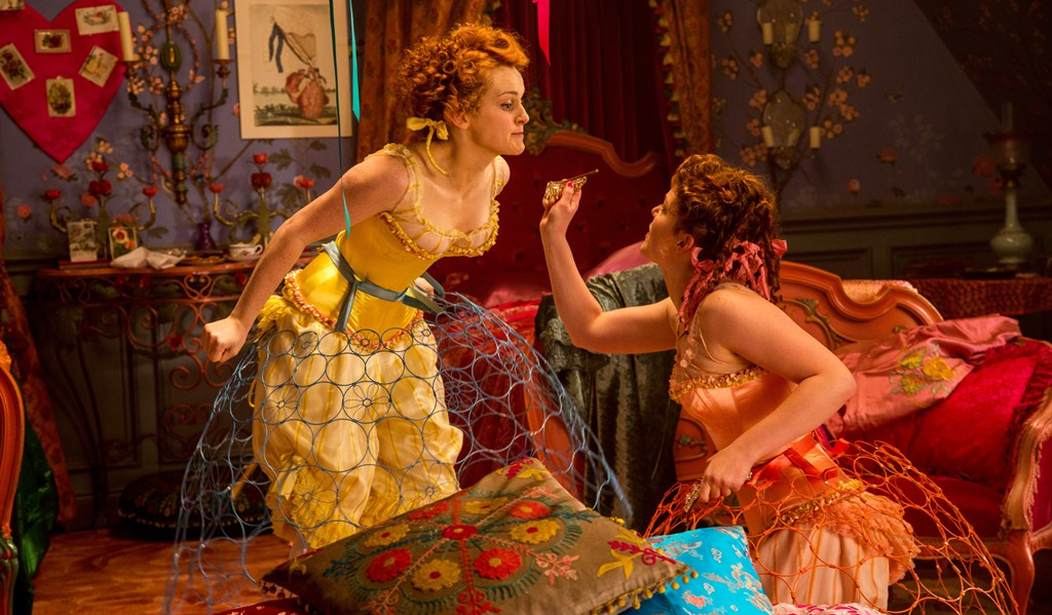
In the Brothers Grimm version of Cinderella, far grittier than the sanitized Disney retelling, the wicked stepsisters commit a desperate act. Determined that the prince’s glass slipper must fit, one slices off a toe, the other a heel, each in turn cramming her mutilated feet into the delicate shoe. They limp forward smiling, willing reality to conform to their chosen story. But the blood dripping from the slipper betrays them.
We are watching something strikingly similar play out in real time.
In the June 2 Los Angeles mayoral primary, incumbent Karen Bass led as expected. Populist outsider Spencer Pratt held a clear second place on election night. Progressive City Councilmember Nithya Raman was well behind; on election evening, she delivered what sounded like a tearful and reflective concession speech. Then the extended mail-in ballot count began. Day after day, Raman gained ground, often disproportionately in new batches. By June 8, she had overtaken Pratt, against all odds, securing the runoff spot against Bass.
This surge may reflect California’s uniquely shaped election rules that seem to favor Democrat candidates. It may reflect outright cheating. But one thing is clear: The preferred narrative arc had to prevail. In some manner, the raw election-night signal was being reshaped to fit the slipper. We can all see the blood trail.
Stories have always shaped human life, but they do so in three distinct and increasingly conflated ways.
In the first way, stories function as healthy inspirations and patterns, true aspirational Forms. Like Plato’s ideals, they belong in the realm of the perfect and unchanging, beyond daily mud and compromise. They offer models of virtue, courage, resilience, and redemption: the hero’s journey, the fairy tale restoration of justice, the quiet triumph of decency. These are not blueprints for utopia, but beacons inviting us to reach higher amid life’s inevitable mess. When kept in their proper compartment, such stories ennoble us without demanding that we amputate reality to serve them.
In the second, more intense way, stories become tools for self-deception and, later, deception of everyone else. Here we take raw information about reality and shape it into tales that mimic the classic Forms, borrowing their emotional power and moral clarity to sustain a perpetual Narrative about civilization itself. We prune inconvenient facts, amplify fitting details, and frame events into tidy scripts of heroes, villains, and inevitable progress.
In the age of mass media, this scales into industrial Narrative management: legacy outlets, platforms, and institutions collaborating to edit messy Reality into satisfying installments, shaping a story that people can comfortably tell about themselves and their world. Early COVID pronouncements hardening into a single plot, or historical figures flattened into oppression narratives, are examples. The edited version begins to feel more real than raw data. Pruning prepares the ground for worse: once we ignore what doesn’t fit, it becomes easier to believe the story should override the facts.
The third way is the most dangerous. Stories turn into molds into which we force reality itself. This is the amputation phase. When the Narrative becomes more “real” than stubborn, fractious truth, we stop editing the telling and start editing the world. Blood in the shoe is dismissed as an inconvenience.
This third way seems more common today. You see it when personal stories about one’s own gender, the most basic element of self-identity, override biological reality, leading to hormones, surgeries, and compelled speech as “edits” to real life. We see it in politics when election-night signals are overwritten by extended counts leading to statistically improbable results until the “correct” candidate advances. We see it in legal arenas where cases are framed as monster-villain arcs, with precedents and standard practices massaged to deliver the demanded result.
This is Frankensteinian hubris: the conviction that our chosen story, our cultural Narrative, justifies overriding consent, ballots, bodies, biology, and norms. Reality must yield.
Why Now? The Immersion Thesis and Loss of Ballast
This inversion did not emerge in a vacuum.
Recall the 1982 film Mazes and Monsters, where a young man is so immersed in a role-playing game that he can no longer distinguish fantasy from reality. He hunts imaginary demons in real tunnels and stabs an innocent man. It was cautionary then, and widely mocked by actual players of Dungeons & Dragons, of which the titular game was a fictionalization. But we should not have mocked. Today it feels like a civilizational metaphor, not a story about a game.
A hundred and fifty years ago, stories were episodic and bounded: church sermons, fireside readings, occasional theater. Hands stayed busy with real tasks like spinning, farming, and mending, while one person read aloud; that physical activity provided constant ballast. Stories punctuated life; reality anchored it.
Today, we live in a state of total narrative saturation. Streaming delivers story arcs on demand, even when in line at the grocery store or post office. Games, increasingly immersive, let us be the hero. Social media and 24-hour news feeds of endless moral dramas are shaped reality-TV-style into clear story arcs. Narrative is no longer occasional; it is the environment. It is our environment. We are living in Story Structure. Fewer people are grounded in “real things”: manual labor, unmediated nature, quiet boredom, unpredictable face-to-face life. Without that ballast of pure reality, compartmentalization between story and reality weakens. Aspirational forms leak into truth. The edited Narrative feels more vivid and urgent than messy reality.
Ultimately, the stepsisters’ impulse no longer seems grotesque. When you dwell inside stories long enough, the desired ending feels like something that must be made to happen. The slipper simply has to fit.
Consequences: When Reality Breaks
When the Narrative remakes the world, the blood seeps out. Narrative shaping is not always destructive; shared stories can build cohesion within a relatively homogeneous culture. But we live in a deeply polarized time, with competing grand narratives and dozens of side stories. When one side forces reality into its preferred plot, the other side becomes enraged, confused, and alienated. The amputation and pruning that The Other Side commits feel like aggression against their lived truth. And frankly, in a very real way it is, even if it’s not deliberate.
Elections that appear to rewrite themselves, medical interventions promising identity alignment but delivering pain and regret, legal processes engineered for predetermined outcomes: these confirm to large portions of the public that institutions today are serving one Narrative rather than truth. Trust collapses. Rebuilding legitimacy becomes extraordinarily difficult.
We suffer cultural and spiritual disenchantment. The aspirational Forms meant to inspire are cheapened when pressed into partisan service. The result is not reenchantment — the ultimate purpose of a story — but a deepening of cynicism. We live inside competing halls of mirrors, mistaking reflections for substance.
The human cost is tragic. Forced “utopias” always deliver sterility, division, and brittle cities, and to shape them, some part of the culture must be lopped off; we have seen this dozens of times with communist revolutions and similar movements. The stepsisters may squeeze into the carriage, but they cannot walk without pain. Neither can a civilization which maims its foundations for one faction’s tale. And the damage remains even when the lie is revealed and repaired.
This scales into civilizational self-sabotage. Each amputation makes the next easier, until reality rebels through failure, backlash, and withdrawal of consent. The blood trailing behind the slipper is the symptom of a deeper wound: refusing to let stories remain stories and truth remain truth.
Recovery: Reclaiming Compartmentalization
We are not doomed to limp forward in bloody slippers. The blood is the clue that can wake us.
Recovery starts with a story detox. Stories are beacons and patterns, not blueprints or weapons. They inspire without colonizing reality. Reality is fractal, full of trade-offs and surprises. It demands humility, not sorcery. Instead of shaping reality to fit story structure, we need to let stories be stories and news be news. Joe Biden famously once referred to Barack Obama as a “storybook, man.” This is the error we must stop making as a culture.
Rebuild ballast. We must fill our hands with real tasks, appreciate unmediated and uncurated nature, engage in face-to-face community, and experience quiet boredom. If we reduce immersion in endless scripted content, which has become the norm in our lives, we can restore the boundary between Forms and flesh.
We must all demand more, storytellers and story-consumers alike. Offer inspiration without demanding that reality submit. Point out the amputations and grotesqueries, and don’t allow the self-appointed storytellers to explain those things away. Insist on factual evidence over narrative satisfaction.
We do not need one shared story to live peacefully. We need a shared commitment to let reality be messy while still aspiring to something better. Seeing the blood is the beginning of wisdom. From there, we can walk upright again — not perfectly, but honestly — refusing to maim ourselves or our common culture for any tale.
Editor’s Note: Hollywood, academia, and liberal elites are out of touch with the average American.
Help us continue to report the truth about what 77 million patriots voted for by joining PJ Media VIP and using promo code FIGHT to receive 60% off your membership.


Join the Conversation
VIP members get the ability to comment on articles.