





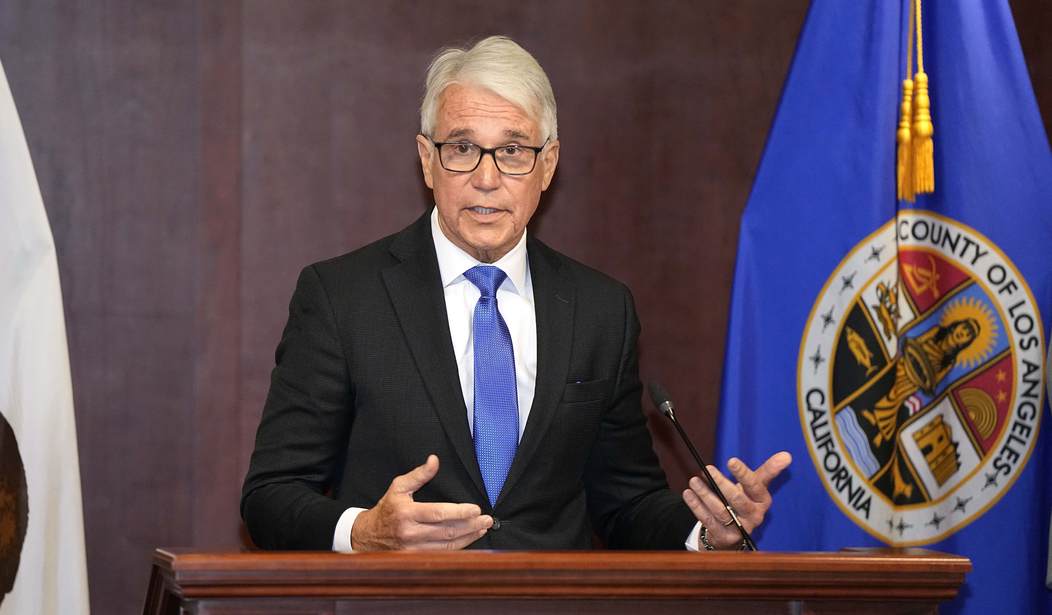
In the 2020 race for Los Angeles County district attorney, George Gascón, flush with $2.25 million in cash from George Soros and millions more from other well-heeled, progressive donors, defeated incumbent Jackie Lacey, taking advantage of the anti-police hysteria that followed the death of George Floyd in Minneapolis, when an astonishing number of people came to adopt the magical thinking that criminals would be less inclined to mischief if we would but stop treating them like criminals.
It wasn’t long before the magical thinking came to its inevitable collision with reality and a sufficient number of voters awoke to the fact that society is better served when people unwilling to tame their predatory impulses are housed safely away from their law-abiding fellow citizens. In the 2024 election, Gascón, who four years earlier had defeated Lacey with 56% of the vote, was trounced by Nathan Hochman by a 60-40 margin.
Gascón is not missed, except, that is, among the criminal class who benefitted from his lenient policies, and at the Los Angeles Times, where magical thinking on crime still predominates. In a story published Feb. 13, the Times laments that Hochman has been less zealous than his predecessor in prosecuting police officers who, in the eyes of the writers and editors at the paper, have transgressed.
“Police cases under L.A. district attorney ending in dropped charges, losses and plea deals,” reads the headline, which of course is crafted to imply sinister doings in the D.A.’s office. And the story’s opening sentences offer the barest distillations of three cases which, again in the Times’s judgment, were pursued with insufficient vigor. “All three cases had similar outcomes,” says the Times, “charges dropped or reduced to no time behind bars after a plea deal.”
It is well known among journalists that few people read beyond the headline of most news stories, so in beginning the story as he does, Times writer James Queally succeeds in perpetuating the narrative that Hochman has allowed himself to be blinded to cases of excessive force by police. Those who read on will discover that the law and the facts of these cases do not readily lead to the conclusions they would wish at the Times. Those who explore further into facts omitted in the story will find even more evidence that the cases are not cut and dried.
Take for example the case of the “seven California Highway Patrol officers who piled atop a man screaming ‘I can’t breathe’ as he died following a drunk driving stop.” In March 2020, officers from the CHP’s Altadena station stopped Edward Bronstein, 38, on suspicion of driving under the influence. Bronstein refused to provide a breath or blood sample, as California law requires, so officers went to a judge and obtained a warrant authorizing a forced blood draw. The Times story does not link to video of the incident, which, given what we now know of the outcome, is indeed heartbreaking to watch, but it shows Bronstein being restrained not by seven officers but five, with a sixth only briefly assisting. A sergeant, who never laid a hand on Bronstein, filmed the incident with a video camera.
None of the officers used any force beyond what was needed to hold Bronstein still while a nurse drew blood from his arm. To say that police officers should be forbidden to use that level of force in similar situations is to say that drunk drivers have a right to resist the lawful collection of evidence of their guilt.
As the video begins we also see that Bronstein reneges on an agreement he made to provide a voluntary blood sample, and based on my own experience in dealing with impaired drivers, I can speculate that Bronstein, before the camera rolled, engaged in lengthy but dishonest negotiation with the officers before they sought and were given the warrant.
In 2023, Gascón’s office charged the seven CHP officers and the nurse with manslaughter, but Hochman dismissed the case against all the officers but the sergeant, whose charge was reduced to a misdemeanor for which he was sentenced to a year of probation. The nurse is still facing a manslaughter charge, presumably for his failure to initiate lifesaving measures when Bronstein appeared to lose consciousness.
The state of California settled a wrongful-death lawsuit with Bronstein’s family for $24 million, which may at first sound like a tacit admission that the officers were liable for his death, but I would argue that the officers, while not causing his death, did not react quickly enough when Bronstein’s medical distress should have been apparent. As with George Floyd, whose death came two months later, Bronstein did not die as a result of unlawful force, but rather from heart failure resulting from his own resistance to lawful force.
It is not until the 33rd paragraph of the Times story that readers are informed that the “Los Angeles County coroner’s office could not conclusively determine Bronstein’s cause of death but attributed it to ‘acute methamphetamine intoxication during restraint by law enforcement.’” Indeed, the medical examiner’s website reveals the manner of death in the Bronstein case to be “undetermined.” One need not be a legal scholar to find reasonable doubt in a homicide case where the medical evidence has failed to prove a homicide occurred in the first place.
Hochman’s failures, says the Times, “have infuriated the loved ones of victims of police violence, local activists and even former prosecutors, who say Hochman’s backslide on the issue was predictable after he received millions in campaign contributions from police unions.”
The story quotes a single “former prosecutor,” Greg Apt, one of the many former public defenders Gascón hired and placed in positions of authority in the D.A.’s office. Prosecutors have an ethical obligation to bring charges only when they are confident they can prove a defendant’s guilt beyond a reasonable doubt to a jury, but under Gascón and his band of defense attorneys masquerading as prosecutors, when it came to charging police officers, the governing philosophy seemd to be, “Let the process be the punishment.”
Gascón’s defeat was cheered among actual veteran prosecutors in the D.A.’s office, and by police officers who watched as defendants were given every benefit of the doubt while their own actions were scrutinized at every turn. Under Nathan Hochman, sanity has returned to Los Angeles County courtrooms, which the Los Angeles Times thinks is unfortunate.
Editor’s Note: Support and follow PJ Media’s coverage of crime and other key news in this midterm election year. Join PJ Media VIP and use promo code FIGHT to get 60% off your membership.
Join the Conversation
VIP members get the ability to comment on articles.