


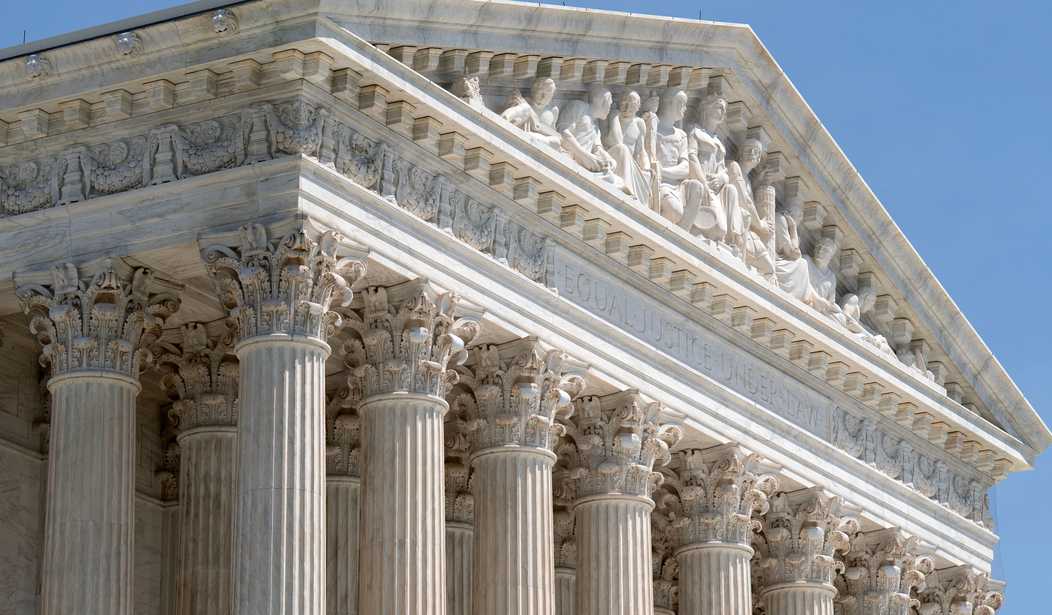
I had occasion over the last week or so to become embroiled in a discussion over Students for Fair Admissions v. Harvard, a 2023 Supreme Court ruling. That’s the basis of this piece. Any discussion of the ruling needs to have some rather voluminous background attached to it, because on its own, it makes no sense at all to most folks.
Back in 1964, this country somehow managed to pass a genuinely far-reaching Civil Rights Act — one that reaffirmed, in plain English, that all men are created equal and are to be treated that way, regardless of race, color, religion, sex, or national origin. It made discrimination unlawful. Full stop.
Mind you, not unlawful, except when it's the fashionable kind. Not unlawful, unless a university really wants to. Unlawful, period. This includes the supposedly well-intentioned, feel-good, "it's for a good cause" version. The courts have spent decades since correctly noting this lines up with the 14th Amendment:
No state shall make or enforce any law which shall abridge the privileges or immunities of citizens of the United States; nor shall any state deprive any person of life, liberty, or property, without due process of law; nor deny to any person within its jurisdiction the equal protection of the laws.
Simple enough that even a law school admissions committee is able to follow it. Should be able to, anyway.
Enter two Supreme Court rulings I've spent several evenings wading through, and I'd suggest you do the same, because together they produce something rather special: total incoherence dressed up in a robe. In Gratz v. Bollinger (2023), the Court had the decency to strike down the University of Michigan's practice of handing out 20 automatic points — out of 150 — simply for being the correct shade of favored minority. Good. Solid. Constitutional, even.
And then, because consistency is apparently for suckers, along came Grutter v. Bollinger, which reaffirmed 1978's California v. Bakke and announced that race absolutely, positively should factor into admissions after all. The ruling admits outright that the law school's policy "reaffirm[s] the Law School's longstanding commitment to one particular type of diversity" — which is a very fancy way of saying "yes, we discriminate by race, on purpose, and we'd like credit for it." Not only racial bias, mind you, but racial bias that's subjective, arbitrary, and entirely dependent on the personal whims of whoever's running the admissions office that year. I dare anyone to explain to me how that's meaningfully different from the arbitrary, personality-driven racial gatekeeping Alabama was running in the 1950s. Go ahead. I'll wait.
Now for the shocker: These two rulings came down from the mountain on the very same day.
So much for Dr. King's dream of a nation where people get judged by the content of their character instead of the color of their skin. So much for Justice John Marshall Harlan's dissent in Plessy v. Ferguson: "The law regards man as man, and takes no account of his surroundings or of his color." So much for the Civil Rights Act of 1964. So much, apparently, for the 14th Amendment itself, which the Court seems to regard as more of a suggestion than actual binding law.
Worse still, this entire exercise was undertaken to fix a problem nobody could actually document. There has never been a shred of documented discrimination against minority applicants at the University of Michigan. None. Zero. In fact, thanks to the very policy the school was defending, black applicants were 170 times more likely than white applicants to be admitted to Ann Arbor. The Court looked directly at that number and shrugged, opting instead to invoke a "compelling interest in obtaining the educational benefits that flow from a diverse student body." Compelling to whom, exactly?
I've got two problems with that reasoning, and neither of them is small.
First, that's not a constitutional argument. It's a political one, and a flimsy, short-shelf-life political argument at that. Even Justice Sandra Day O'Connor, the deciding vote, admitted as much in writing: "…we expect that 25 years from now, the use of racial preferences will no longer be necessary." Fascinating. So somewhere around 2028, presumably, the Court planned to revisit this and reverse itself? Well, it actually wasn’t that long. Clearly, though, this was an advocacy ruling, not one based on the Constitution itself.
Let's assume, for the sake of argument, that the Constitution stays roughly what it's been for the last 200-plus years. If a remedy is constitutional today, how exactly does it stop being constitutional on some arbitrary future Tuesday without the underlying document itself changing? Constitutional status doesn't work like a coupon with an expiration date. These race-based schemes were and are illegal and unconstitutional, which means to make these rulings, the Court had to simply set the Constitution down and step around it.
And even that 25-year promise is on shaky ground — Justice Ginsburg herself reminded everyone we can't count on that timeline actually holding. So did we put the Constitution on pause for a quarter century, give or take, until some future court decides it's ready to start enforcing it again? And if we can shelve it once for a popular enough cause, what exactly stops us from shelving it again next time, for a considerably less popular one?
Huh. Kinda like putting the Constitution on pause for Roe v. Wade, where the court sought to address something that was never in the document and was, by the Tenth Amendment, the purview of the states, isn’t it?
Here's the thing, though — I could almost, almost stomach this nonsense if I believed for one second that in 25 years, or 250, this ruling would actually make racism disappear. It won't. It's not just ineffective — it's actively counterproductive to that goal, which brings me to my second objection:
There's a massive difference between mandating "racial diversity" and cultivating actual, true diversity.
Racial diversity just means the room contains a satisfying assortment of skin tones. True diversity means the room contains different ways of thinking, different politics, different life experiences — regardless of what anyone looks like. There is no compelling state interest in mandating the first one, in a society that's supposedly trying to become racially neutral.
Recommended: Hasan Piker, Abdul El-Sayed, and Voters Who Can Read the Room
To be crystal clear: diversity of thought is a genuinely worthy goal, arguably one of the state's largest legitimate interests, and I'd defend it all day long. But watch how badly it gets tangled the moment you try to manufacture that outcome by counting the color of noses at the door, instead.
Justice Anthony Kennedy's dissent includes testimony from a former UM Law School admissions director recounting a debate over whether Cuban applicants should count as Hispanic — a debate one professor objected to on the grounds that Cubans tend to vote Republican. Does that sound like a man deeply committed to racial equality, or does it sound like garden-variety liberal-flavored stereotyping wearing a diversity costume?
The Court in Bollinger seemed convinced it could engineer true diversity by mandating racial diversity as a proxy. That's not just a flawed strategy; it's potentially fatal to the actual goal, because it drags us backward, right back into treating race as the defining feature of a person, exactly the poison the Constitution was supposed to be curing us of. Even Justice O'Connor's own writing tacitly concedes the point.
This whole project — counting the melanin content of every applicant walking past the admissions desk, and one assumes eventually every other institution downstream — rests on a genuinely revolting premise: that a person's race dictates their thoughts, opinions, and ideas. I'll go a step further than merely calling that flawed. That's racism. Ugly, unapologetic racism, laundered through the language of "diversity" so nobody has to feel bad about endorsing it.
We fought an actual war, not that long ago, against a regime built on the exact same premise — that race sits at the very center of a person's being, dictating his thoughts and worth. We beat that idea on a battlefield at enormous cost. And here we are, watching the Supreme Court wave a modernized version of it back through the door, dressed in the language of compassion instead of conquest.
The Grutter ruling is particularly rich, given that its principal author, Justice O'Connor, wrote just days earlier in Georgia v. Ashcroft that the Court should "encourage the transition to a society where race no longer matters: a society where integration and color-blindness are not just qualities to be proud of, but are simple facts of life." Lovely sentiment. Genuinely correct. Also 180 degrees removed from the ruling she authored days earlier. One wonders if anyone in that building talks to each other.
I hasten to point out that Grutter has since been overturned, in Students for Fair Admissions v. Harvard, and rightly so. It was decided alongside a companion UNC case. In that case, the Supreme Court explicitly overturned the Grutter precedent that student body diversity constitutes a compelling state interest justifying race-conscious admissions. A five-to-four divided Court outlawed affirmative action in college admissions nationwide, ruling race generally can't be used as a factor. So the O'Connor "25 years" prediction actually landed almost on schedule — Grutter was decided in 2003, and SFFA overturned it in 2023, twenty years later, several years ahead of her own stated expectation.
One more point almost nobody wants to touch: In Grutter, Justice Thomas raised Morehouse College, where under 1% of the student body is white or Hispanic. "Do we have any sense," Thomas asked, "that the traditionally black colleges will now start admitting more whites for the sake of diversity?" Of course not, and Thomas knows it. So is diversity a sacred, compelling state interest everywhere — or only in the direction that's politically convenient?
Let me be clear about what I'm not saying: I don't doubt the Court wants, and wanted even then, a society without racism. That's a legitimate, worthy goal. What I question — on logical, moral, and constitutional grounds simultaneously — is the idea that you fight racism by practicing more of it, just aimed in a different direction. Diversity of race for its own sake is racism. Full stop, no asterisk.
Thurgood Marshall warned about exactly this in Brown: "Distinctions by race are so evil, so arbitrary and invidious that a state, bound to defend the equal protection of the laws must not invoke them in any public sphere." The Court ignored him. It also ignored someone with even more standing on this particular subject — Frederick Douglass, a fellow Rochesterian, who put it better than I ever could, even filtered through 150 years of changing language:
"What I ask for the Negro, is not benevolence, not pity, not sympathy, but simply justice.… All I ask is, give him a chance to stand on his own legs! Let him alone!… our interference is doing him positive injury."
The Court brushed that aside, too. What's left in the wreckage is more confusion and a fresh coat of paint on the same legal racism we've supposedly been trying to scrub off since the 1800s.
The Court ostensibly took these Michigan cases for the specific purpose of settling, once and for all, whether it's constitutional to fight racial bias with more racial bias. The irony writes itself. And the answer was sitting right there in plain sight the entire time — the Court just insisted on manufacturing gray areas in a question that was never actually gray.
Racism, ironically enough, is a black-and-white issue, same as most things once you strip the euphemisms away. Either it's there, or it isn't. Either it's legal, or it isn't. Either our legal system tolerates it, or it doesn't — there's no dignified middle setting. What the moment called for was a clean ruling honoring Dr. King's dream, Douglass's plea, Marshall's warning, Harlan's dissent, and the actual text of the 14th Amendment. What we got instead flew directly in the face of every one of them.
Americans of every race are still paying for that mistake, despite those Michigan rulings being overturned.