


Well, as someone who retired from the cargo relocation business — yeah, as a truck driver — I'm super pleased about this.
President Trump announces plan to replace illegal alien truck drivers with veterans 🇺🇸
— Daily Wire (@realDailyWire) July 15, 2026
"In many cases…we're going to say any American who has driven a heavy truck for our military will automatically be eligible for a CDL." pic.twitter.com/2SkPZJy0g2
President Donald Trump delivered this bombshell in Carlisle, Pa., just outside Harrisburg, at the Defense and Innovation Summit. My source won't confirm the exact building, but I'd bet money it happened at the Army War College, since that's what Carlisle Barracks does. So nobody should blink when the topic turns to an issue that hits our veterans harder than most.
If you've driven I-81 south of Harrisburg and passed the tanks and helicopters lined up along the shoulder near Milepost 54, you've seen the place.
At the summit, Trump framed the idea as a two-part move: strip commercial licenses from illegal immigrants driving trucks, then funnel veterans into the empty seats. He said the administration would move to get "illegal alien truck drivers who are just killing a lot of people — they can't read signs, a lot of them are on drugs or alcohol, and they shouldn't be driving these things," then pivoted straight to the veterans pitch: any American who drove trucks for the military would automatically qualify for a commercial license.
None of this dropped out of nowhere. Trump's administration has been building toward it for over a year. It started in April 2025 with the executive order requiring English proficiency for commercial drivers. Trump pushed harder at February's State of the Union, urging Congress to pass the "Dalilah Law" — named for a girl injured in a crash involving an undocumented truck driver — barring states from issuing CDLs to people here illegally. In March, DOT's Non-Domiciled CDL Final Rule kicked in, restricting non-domiciled CDL issuance and renewal to a narrow slice of visa holders and stripping licenses from roughly 200,000 immigrant drivers. This week, DOT finalized another rule forcing states to run every CDL applicant through the SAVE immigration-status database before issuing a license — closing what Secretary Duffy calls a "safety loophole." Now, at Carlisle, Trump bolted on the veterans piece — new ground, since it moves past yanking licenses and into actually fast-tracking replacements.
Imagine that. A government that focuses on putting American citizens to work.
Naturally, the usual outlets are clutching pearls on schedule. The New Republic, frantic in its objections, warns that fast-tracking what it calls "untested drivers" creates a safety hazard.
Cute complaint. Apparently illegals driving trucks and killing people doesn't register as a safety hazard, but let a veteran use two years of combat-zone driving experience to get a job, and suddenly everyone's wailing. Shocking, I know. You can't lose a workforce that never should have been hauling 80,000-pound rigs down our highways in the first place and replace it with guys who hauled munitions through Fort Bragg without somebody on the left finding a way to be furious about both halves of that sentence at the same time. The "fascist" card tells you everything about how thin their argument is.
The World Socialist Web Site upped the ante, calling the March licensing rule a "fascistic assault on immigrant workers." Apparently, nothing screams measured political analysis like invoking fascism over a DMV database check. The American Prospect ran with, "Trump strips commercial driver's licenses from 200,000 legal immigrants who bring your goods to market." While technically true, it's conveniently silent on the detail that DOT's own audits caught thousands of those licenses carrying expiration dates that didn't match the holder's actual work authorization. That's not fascism. That's a filing cabinet nobody opened for a decade. Increasingly, it looks like the people who were supposed to be checking never wanted to for their own idealistic reasons.
Here's the fight the trucking industry can't even settle among itself: The American Trucking Associations claims the country is short 82,000 drivers this year, heading toward 160,000 by 2031, and points to a workforce averaging 57 years old. Fine. But University of Pennsylvania economist Steve Viscelli, no MAGA plant, calls that framing a fiction.
States hand out roughly 400,000 new CDLs a year. The real problem, Viscelli argues, is that 35% of new hires quit within 90 days and turnover at the big carriers runs 90–95% annually. Translation: the industry doesn't have a driver shortage. It has a churn problem. Overly aggressive hours-of-service enforcement, ticket-happy regulators hunting for anything they can write up, and genuinely unreasonable working conditions all feed that churn.
Large truckload carriers run annual turnover rates of 90–95%, and some recent reports put the biggest carriers above 95%. Read that twice — they turn over their entire driving staff in less than a year. Job-hopping plays into that number, exactly as the ATA claims. Drivers with a bad employer bail for the next company when the grass looks greener on the other side of the fence. What the ATA conveniently skips is that the grass looks greener over there because that's where the septic tank is.
Then there's the new driver who climbs into the seat and bails once the lifestyle doesn't match the recruiting pitch. People find out the hard way just how brutal this job actually is. Lack of home life, mediocre pay, and a mountain of daily legal requirements all feed that turnover number. Smaller companies tend to do better, mostly because they run tighter, more personal operations. I drove for one for years. Even there, the job itself was brutal — weeks of eat, sleep, drive, repeat with nothing else — and it wears a person down. It scares new drivers off fast.
Handing the empty seats to veterans doesn't fix that machine — it just changes whose name sits on the pink slip six months from now, unless somebody also fixes why drivers keep walking away. I've lived the draconian regulatory environment every driver faces, and I'll tell you straight: that's the real issue.
So here's where we actually stand: the administration is pushing a path to work for veterans more seriously than Washington has bothered to in a decade. The "fast-track" is a rebrand of a program most of the government forgot it already had, and the industry's own economists say none of it touches the real reason drivers keep quitting. Everybody's shouting past everybody else, the CDL office keeps normal business hours Monday through Friday, and Dalilah Coleman is still relearning how to walk. Washington just rediscovered the light switch — and called a press conference about electricity.
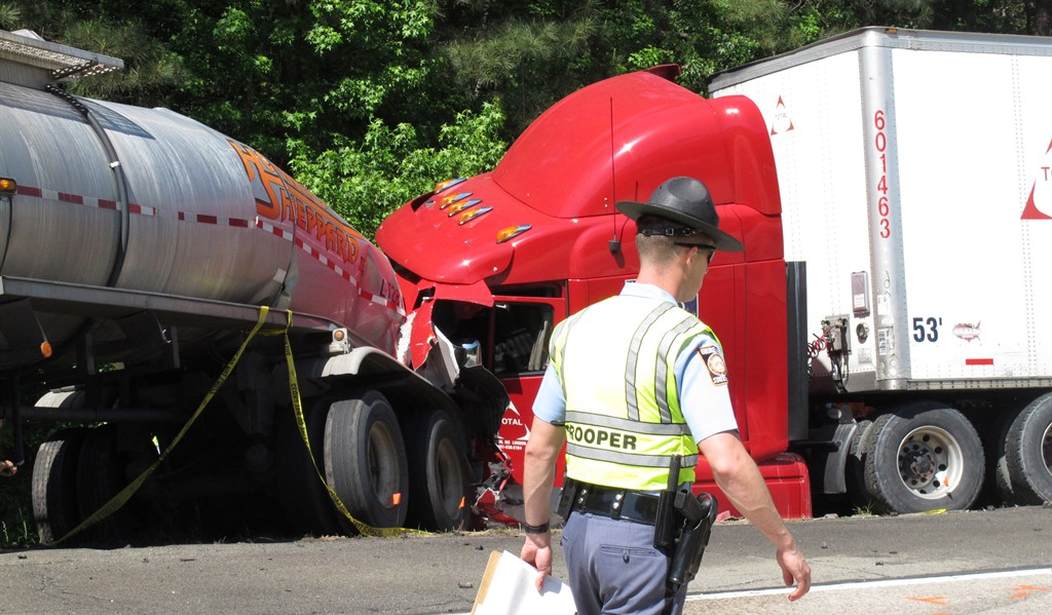
One of the most recent and highest-profile deaths involving a CDL-holding illegal immigrant happened just 65 miles north of where President Trump stood at Carlisle. Trooper Michael Pahira was risking his life on the shoulder of I-81 running a truck inspection, which I note with some annoyance. I say that with annoyance because I've driven past that stretch several hundred times over fifteen years, and I can tell you that stretch isn't wide enough for a proper inspection under the best conditions. Construction in the area at the time made it worse. Fair question: whose safety did that inspection actually serve? Not the driver's. Not the trooper's.
None of that excuses the illegal driver being there in the first place. And it doesn't make funneling American veterans into these jobs a bad idea — not remotely. But it does expose how aggressive commercial vehicle enforcement has become, and in my view, that aggression is part of the retention problem nobody at DOT wants to touch.
I know this writing seems like a mixed bag — a little blurry. But that's what we're dealing with here.
My gut-level reaction is this: More actual American citizens — veterans, especially — in these seats is a real step forward, and I'm all for it. But somebody in Washington needs to take a hard look at the role government itself plays in both the retention crisis and the safety failures.
And given that it took literally years to reach this obvious first step, don't hold your breath waiting for Washington — or even the states — to handle the rest.