


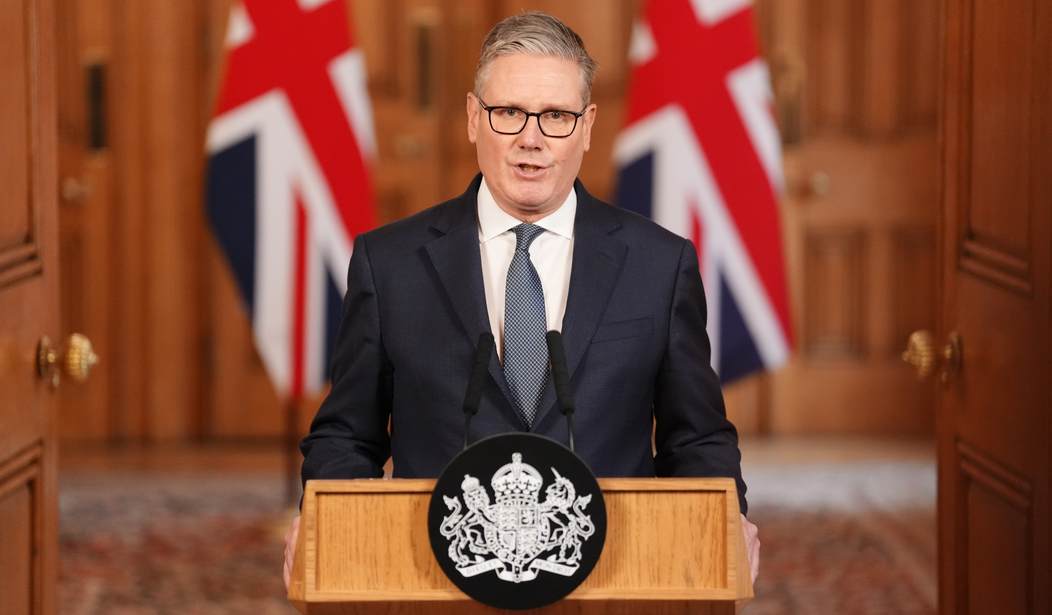
My longtime readers will know I’ve been watching the British Parliament and the back and forth over Prime Minister Keir Starmer’s appointment of Peter Mandelson as Ambassador to the United States. One of the reasons for my outsized concern is how what the supposedly United Kingdom does affects us. What I have for you today is some proof of that connection and justification of that concern.
If you’re already familiar with the story and the players, I apologize, but I feel I must, out of courtesy, provide backfill for those who are not.
For months now, the UK's Labour government has displayed a consistent pattern of weakness, both at home and abroad. Starmer has failed to lead effectively on nearly every front: the ongoing Islamic migration crisis, a deteriorating fiscal picture, a crumbling NHS, and a standard of living that has been in free-fall for years. The UK voters, even those who have traditionally voted Labour, are furious. The resulting arguments in the British House of Commons have been nothing short of epic, as you may imagine.
Now, in the last several weeks, a fresh scandal has broken. Starmer's handpicked Ambassador to the United States — widely regarded as the most prestigious diplomatic post Britain can offer — is Peter Mandelson, a man who maintained a long, close relationship with Jeffrey Epstein. As investigators have dug deeper, they have also uncovered his ties to both Moscow and Beijing. That’s about as quick a backgrounder as I can provide.
So, as a result of all of this, the Conservative Party in the UK, ably led by Kemi Badenoch, called for what they termed an emergency debate. At the outset of this scheduled affair, Badenoch rose to speak.
(NOTE: These will be extended quotes, but my editorial reasons for including them should become obvious as we go forward. Understand please that these quotes are programmatically derived from the video, which I will also include, and may contain errors, which that method tends to provide all too generously.)
Mr. Speaker, I beg to move that this House has considered the matter of the government's accountability to the House in connection to the appointment of Peter Mandelson. And can I thank you, Mr. Speaker, for granting this important debate.
The prime minister personally decided to appoint a serious, known national security risk to our most sensitive diplomatic post. Peter Mandelson was not just a man who had already been sacked twice from government for lying, not just a man who had a public relationship with a convicted pedophile, but a man with links to the Kremlin and China. Links so close that they were raised as red flags with the prime minister before his appointment.
Hold on — let's take stock of what we've got, before moving forward.
Badenoch drops the Epstein scandal almost as an aside, but the Epstein business is hitting the UK just as hard as it hit here in the States — and in some ways harder, because unlike what we’ve seen with the constant harangue against President Trump, in the cases now surfacing in the UK, there is actual, documented proof, such as in the case of Peter Mandelson.
It doesn't take much imagination to connect the dots on Mandelson's appointment. Starmer chose a man who was, shall we say, on comfortable working terms with the very people Mandelson would now deal with professionally on this side of the Atlantic. That alone implies something worth sitting with: Far more people in our own government were involved with Epstein than have ever been named — and some may still be. All part of the clique, it would seem. As for the possibility of less-than-professional interfacing? Well, I'll leave that to your imagination.
But then we come to the very point of this discussion. Note again that Badenoch labels Mandelson as “a man with links to the Kremlin and China. Links so close that they were raised as red flags with the Prime Minister before his appointment.”
Badenoch continued (emphasis added):
Yesterday, the prime minister did not deny that he knew about these links before he appointed Mandelson. He could not deny this because, by his own admission, he had seen the documents that proved the links. I cannot overstate how serious a matter this is. The prime minister sent a known security risk to Washington to a position where he would see our most important allies' top secret intelligence.
What if he had seen something and leaked it to one of our enemies? How much would that have damaged our security partnership? We cannot even be sure that didn't happen.
Indeed so.
Starmer's tenure in Number 10 has had no shortage of domestic rot, but most of that is for the British House to fight out. I may well express opinions on examples of that rot, particularly when comparing them to such instances in our own country, but in the end, these are domestic affairs for Britain to deal with.
From an American perspective, however, this attempted appointment buries all of it. When you include that appointment with the rest of the rot, the pattern exposed is cause for great alarm here in the States, and in the whole of the West.
Appointing Mandelson can only be considered, from the view here in the U.S., a direct breach of the trust that our mutual international security requires. Unless, of course, the goal was never Western security at all, but rather, making Russia and China comfortable and ceding to them covert control of both our nations. That may seem so much hyperbole to some, I suppose, but given everything we're watching unfold, it has to sit on the table as a very real and frightening possibility.
It also fits the pattern: Starmer has flatly refused to back American efforts to defang Iran — the world's single largest state exporter of terrorism, and a country that, like Mandelson, has well-documented, active ties to both Beijing and Moscow. The pieces fit together very neatly. The question is whether anyone in power is willing to say so out loud, including the Conservatives in England.
The story gets worse. The depth of the cover-up in these matters and the pressure exerted to get Mandelson into his newly appointed position, regardless of the red flags, speaks of some force being exerted from outside the British government. Badenoch continues:
What is most extraordinary is, the prime minister appointed Peter Mandelson before vetting was complete. He did this despite a letter from the then-cabinet secretary, Lord Casease, clearly expressing to the prime minister that the process required security vetting to be done before the appointment.
So how can he then have claimed on the floor of this house that the process was followed when he knew that it had not been?
He mentioned the word “process,” Mr. Speaker, more than a hundred times in parliament yesterday, but he was the one who didn't follow that process.
This morning, we have heard the bombshell testimony of the former permanent secretary of the Foreign Office, Siri Robbins. Siri Robbins had a long and distinguished career serving ministers. He is not the sort of person to give us a frank personal account of how things played out last January. So when he told us today that Downing Street put the foreign office under constant pressure to clear Peter Mandelson, that Number 10 showed a dismissive approach to Mandelson's vetting process, when he told us that it would have been very difficult indeed to deny clearance, and that doing so would have damaged U.S.-UK relationships, we know he is giving us the slightest indication of how bad things were: That there was actually an overwhelming drive from the prime minister's office to ensure Peter Mandelson was installed as ambassador.
He has told us that Number 10 showed no interest in the vetting, no desire to wait and ensure due process was followed. In fact, the cabinet office even questioned the need for Peter Mandelson to be vetted at all. The same cabinet office that had discovered Mandelson's links to Epstein, China, and Russia in its due diligence. The cabinet office which the minister is in charge of right now.
Where's the prime minister?
Instead, Mr. Speaker, according to Robbins, the focus was on getting Mandelson out to Washington quickly. And before the vetting even started, Peter Mandelson had already been granted access to, and I quote, highly classified briefing on a case-by- case basis.
This is what the prime minister calls full due process.
At this point, one of the Back Benchers spoke up, saying:
Also in the testimony today, did she not find it astonishing that, uh, that the ex-leader of the foreign office said that he was made to understand that, before they had completed their clearances, that Mandelson already had STRAP clearance, which gives him access to the most secure and most dangerous information held by government.
The camera goes back to Kemi Badenoch:
Uh, can I thank my Raj friend for that, Robin's constant pressure on the foreign office to get the appointment done.
The prime minister, as my right honorable friend, uh, has just mentioned, placed top secret intelligence in the hands of a man he knew to be a national security risk. He did so before the official security vetting, not just knowingly, but deliberately and to an extent that left a senior civil servant with a distinguished career under the clear and obvious impression that the vetting must return only one possible outcome, that Peter Mandelson was appointed.
Yes, I know — this piece is already overlong in terms of quoted material. However, I quote all of this to make a very serious point: Did all of this happen to satisfy Putin and Xi? Consider Badenoch’s comments later on:
Mr. Speaker, I'm raising these concerns because of the seriousness of the situation the country is now in. With war in Europe, war in the Middle East, a cost-of-living crisis, and a global energy shock, we need a prime minister who has a grip on national security.
Yet last week, the former Labour Defence Secretary and former NATO Secretary General, Lord Robertson, warned that the Prime Minister had a corrosive complacency when it comes to defence. This is the same man who wrote the Prime Minister's strategic defense review. He is ringing the alarm bell, warning us of the grave consequences of the government refusing to take the tough choices needed to increase defense spending. This matters because if we cannot trust our prime minister to tell the truth about this ambassadorial appointment, the whole full truth, a key appointment in Britain's national security architecture, it calls into question the assurances he gives us on everything else.
There it is, kids. That's the heart of it: If Starmer can't be trusted on Mandelson — and by extension on Epstein and Iran, all of which touch on our mutual defense — what can we trust him on? Look at the full picture: everything Badenoch laid out, the UK's posture on NATO, its refusal to act against Iran, or even to aid us in our efforts, and a military it has deliberately hollowed out while expecting America to cover the gap. Add it all up.
It is not a stretch but a logical conclusion that elements within the Labour government hold split loyalties. Not just Starmer, but those around him. And as a practical matter, that means one thing: As long as Labour runs Britain, the United States cannot afford to share anything touching our national security with it. Full stop.
The long-standing and vital alliance isn't the issue. The people currently running it on their end are.
As you might imagine, I’ll be watching.
Recommended: Are We Seeing the Makings of an Iranian Civil War?
For the sake of completeness, I’ll include the vid that the above quotes are taken from.