


Time was, AM on what is called “medium wave” was the method of broadcasting—and indeed the only one—unless you considered long wave, which was mostly European stations, most of which are no longer on the air. Major Armstrong had yet to invent and work the kinks out of FM radio, and even when he had done that, FM radio wasn’t on the same band of frequencies it’s on now. His experimental W2XMN was on 42.8 MHz, but naught but a paltry few had a receiver capable of listening to it. (And by the way, if you're in the New York City area, I gather the station is still there and on the air after all these years. It’s running, as I gather it, a feed from WNYC, which is the public broadcaster there. Sometimes atmospheric conditions are such that I can hear that station here outside Rochester.)
Most people know that AM broadcasters of today are limited and coordinated by the FCC, with the most powerful stations being limited to 50,000 watts of carrier power, with peak power of ~125,000 watts. (Remember, AM alters the carrier at an audio frequency rate, with negatives going to 0% of the carrier and 125% positives, which means that the peak is 125% of the carrier power, which is allowed in the U.S.) Usually, power is measured as an unmodulated carrier, so let’s stick to the 50,000-watt rating. (It’s a bit more complicated, but let’s keep it simple for this discussion.)
But there was a time in fairly recent history when experimental stations were allowed a 500,000-watt carrier (peak power of a shade over 2.5 million watts!!!), and the one example here in the U.S. was WLW in Cincinnati. It’s that station and its higher-power history we’re going to discuss today.
WLW has a rather storied history as a result of this high-power period. The station was founded by Powel Crosley, who was granted the call sign WLW in 1922, and it made its maiden broadcast on March 23 of that year. At the time, they were running a paltry 5 watts, though that quickly went to 50 watts. Then they went to 500 watts in September of that year and 1,000 watts in May of 1924. Crosley was always a strong advocate of higher power, saying that it would overcome the static associated with AM to this day. So, in late 1925, WLW started using a new 5,000-watt transmitter.
It was about this time that General Electric started designing and building 50,000-watt transmitters, installing one of the first at WGY in Schenectady, New York, a station they owned at the time. By the time 1928 rolled in, WGY, KDKA in Pittsburgh, and WEAF in New York City were also at the 50,000-watt level. (WEAF later changed its call sign to WNBC and is now WFAN on 660 kHz.)
WLW, meanwhile, after buying up competitor station WSAI, moved their transmitter to Mason, Ohio, which is where their first 50,000-watt station was installed, using a 1928 Western Electric model 7C transmitter. (That transmitter is going to play large in our story.)
With 50,000 watts, WLW had (and still has!) most of the nation covered with signal at night.
Then, as fate would have it, along came Germany’s lean toward the Nazi movement. Joseph Goebbels was appointed propaganda minister in 1933, a period in time when radio was, as I said, the social media influencer of the day. He demanded a high-power transmitter capable of covering the world. The Deutschlandsender III was built near Herzberg an der Elster between 1936 and 1939. With a power of 500 kW, it was one of the most powerful transmitters in the world when constructed, and its antenna tower—standing 325 metres (1,066 ft) tall—was the second-tallest man-made structure on Earth at the time.
Crosley, who was still championing high-power stations, saw an opportunity and began campaigning for his station to run similar power levels, on the idea of giving our side an equal voice. He went to literally everyone, including Franklin D. Roosevelt, to pitch his case. Finally, in May 1934, FDR pushed a ceremonial button on his desk, and the 500,000-watt monster roared to life. At full cry, the new transmitter drew enough power to light a city of 100,000 people. That power was delivered to a Blaw-Knox tower of some 800 feet.
Random examples: For those of you who know about CB radio, those frequencies are around 11 meters, and police radios these days usually work around 1.75 meters (say, 154 MHz) or 70 centimeters (460 MHz).
Crosley had the regulators of the day convinced that the way to go was to set up what were then called A1 clear-channel stations with 500,000 watts each, and the whole nation could be covered easily. Crosley hired RCA, which then subcontracted Westinghouse and General Electric, and together the build cost Crosley a half million dollars. (That’s $12 million in today’s money.) Not a paltry sum, particularly in the depths of a depression.
Another aside: The big project was merely an amplifier, the sole purpose of which was to take the 50,000-watt signal from the old (by now heavily modified) WE 7C transmitter and add another zero for the 500,000 watts. The complexity of this thing and the sheer size of it was awesome, even for today, much less for the time.
During this supercharged era, WLW carried programming from both the NBC Red and NBC Blue networks, along with select CBS offerings. The station also played a role in founding the Mutual Broadcasting System, a network through which major clear-channel stations shared popular shows across the country — including WXYZ Detroit’s The Lone Ranger and WGN Chicago’s Lum and Abner. In 1935, the Mutual Broadcasting System broadcast the first nighttime major-league baseball game, with rising WLW star Red Barber calling the action.
Powerful? Absolutely. By day, with the amplifier running, WLW could reach most of the country. At night, when the ionosphere shifts, coverage expanded to a worldwide scale.
Those living near the transmitter site, however, often got more reception than they bargained for. WLW engineers had to be called out to rewire homes where lights simply refused to turn off. Gutters rattled loose from buildings. A nearby hotel’s neon sign never went dark. Farmers even reported hearing the station broadcasting through their barbed-wire fences, no radio receiver involved.
I used to know someone who worked at WLW at the time who has since passed on, and he told stories I’ve never been able to verify, but I’ve no doubt they were true.
I’ll pass one story on, but to understand this story, you need to understand that coaxial cable had not yet come into vogue as yet, and certainly coax couldn’t have handled that much power anyway. Coax, you see, is today commonly used to conduct RF energy from the transmitter to the antenna, but no such luck back in 1935. So, what they used was something called open air feed lines. These were heavy wires held on what are best described as telephone poles. This worked very well for the purpose and was actually far more efficient than even the coax of today.
The trouble was that the arrangement tended to be affected by rain and snow. At one time, I worked at a station with open air feed lines. You could always tell when the station I worked at was getting rain because the field readings would change. Because I was working with only 5,000 watts, nothing much beyond that change in readings ever happened.
With 500,000 watts however, a LOT happened. Those open air lines would tend to intermittently arc in the rain, using the raindrops as a current path. At the time, it was common practice for station engineers to walk underneath those feed lines with a field strength meter, and recording numbers at various spots along the path. At those power levels and at the time, it was one of the few ways available to measure antenna performance. When those energy arcs would happen, you could hear what was on the air in the air, being the signal was amplitude modulated. My friend told me it was the strangest experience, seeing a bolt of fire coming out of the sky, screaming German at you. (Oh, you’re one of them, huh?)
Tell you what: Let’s take a guided tour of the transmitter facility. Remember this was a dozen years ago. I’ll have some sad updates for you later on.
Having myself supported a bank through the Y2K debacle, I can fully understand the need to fall back on the 7C, because there were no microprocessors to fail as it went by midnight. I happened to have been listening from my perch outside Rochester, NY that night, and I recall the on-air talent mentioning that the on-air audio with that 1926 model was the best they’d ever heard. Not bad for a 74-year-old transmitter! They finally switched back to one of the Harris rigs once they were convinced it was operational. The 7C hasn’t been back on the air since that day, but it’s still (nearly) operational.
During my truck-driving career, I often drove overnights and wound up listening to stations hundreds of miles away. If you have an AM radio in your car, take the time to go out to your car and fire up the AM section on your radio some night and do a band sweep. You’ll be amazed at what you can hear. Since I was in the Northeast usually, my ears overnight ended up on CFZM/740 in Toronto, or 890/WLS in Chicago, 720/WGN also in Chicago, 650/WSM in Nashville (great if you like country—they do Grand Ole Opry broadcasts), 1070/WWVA in Wheeling, West Virginia, 1140/WRVA in Richmond, 1120/KMOX in St. Louis, 1630/KCJJ in Iowa, 1210/WPHT in Philly, as well as 1060/KYW also in Philly, 1020/KDKA in Pittsburgh, too, and of course 700/WLW. Those are just a few of what you can hear just about anywhere in the Northeast. How good each comes in is often a question of weather around the country. After a few years I got to the point where I could tell where the weather hot spots were by means of seeing which stations were coming in at night and which were not.
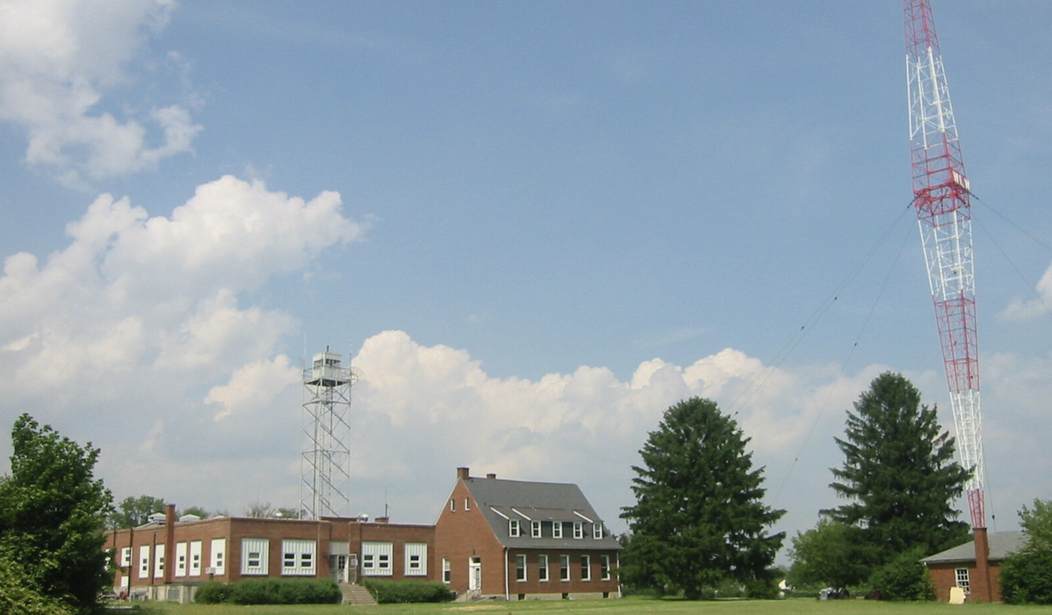
Time goes on, of course, as it always has. The real estate in Mason, Ohio, was getting too expensive, and a lot of the field around the WLW transmitter site got sold off. For a while there, we were worried that the tower itself would suffer or be removed outright. We have seen a number of AM stations across the country go that way, sadly. I’ll let my good friend, Don Vallone, KD2REU, pick up the story from here:
So, the cooling pond that the big gun needed to keep from frying itself is now gone, as are the trees that were there since the 1930s, and a few of the support buildings. But the transmitter building is still there, as is the tower itself. The tower is a historical monument, and there’s a State of Ohio sign marking it as such, so it’s not going anywhere, thankfully.
Most AM stations have what’s called a “ground plane” under the antenna, spreading out in all directions as long as the antenna is tall. To a large degree, WLW’s antenna doesn’t need a ground plane because of its design. It is an arrangement called a “center-fed” antenna, where the bottom half of the antenna is what most stations would call a “ground plane.” It’s a fairly unique design in AM broadcasting, though I have a much smaller version of that design in my ham radio station.
That brings us to today, and how things are going. In my not-so-humble opinion, I think Crosley had it right. We’d have been better off with a few clear-channel stations running 100,000–250,000 watts. Yeah, given the problems they had, 500,000 watts is probably overkill. But consider the political issues involved. Congress decided to limit the power of AM transmitters to 50,000 watts because owners of smaller stations vote, and winning votes is always the main need of any politician. The attitude of the FCC today is promoting what they call “local programming.” A valid idea in theory, but lacking in actual practice.
Thing is, most of the smaller stations can’t develop local programming for expense reasons, and so end up running network shows such as Red Eye Radio and Coast to Coast AM. Local programming is pricey and beyond most local stations anymore. Does several hundred smaller stations running the same programming from a network serve the public better than larger stations who could afford to generate their own programming? It’s a reasonable question, but given current politics, the test can’t be made. (Shrug)
As I think I’ve mentioned in previous columns, radio is a lifelong love of mine, and so this historical exploration was a joy for me. I’ll be honest with you: I originally planned on writing a column about AM radio disappearing under the weight of real estate prices and operational costs. I still plan to do that, but the deep dive on WLW took me to a different place. So, look forward to that column in the near future. Meanwhile, I hope you enjoyed our visit today.
I want to take a moment to thank Randy, K7AGE, and Don, KD2REU. Randy’s pic is adorning the masthead of today’s column, and two of the YouTube clips are his, and Don’s responsible for the update.
73,
Eric K2ENF