
Matthew McConaughey told Americans to examine their ballots, study the candidates, and consider voting for someone who represents their beliefs.
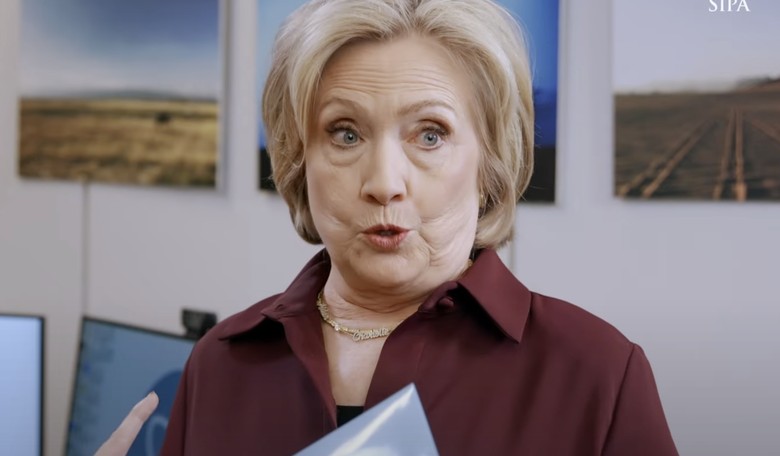
Hillary “eine hochgestellte Frau im Hosenanzug” Clinton reacted with disapproval. On an October 21 podcast, the former Democratic presidential nominee, and two-time loser, called his appeal for independent candidates “really unfortunate.”
Apparently, thinking beyond the party label becomes a dangerous hobby as Election Day approaches.
Do You Know: “Eine hochgestellte Frau im Hosenanzug” is German for "a high-ranking woman in a pantsuit.” “Eine Frau im Hosenanzug” translates to "a woman in a pantsuit."
McConaughey’s six-minute video endorsed neither party nor any candidate.
He challenged the notion that an independent vote is wasted and suggested a handful of independent senators could force both parties to negotiate. He specifically urged voters to research their choices rather than follow his orders.
For all the controversy, he didn’t tell anyone to vote Republican, Democrat, or even independent.
Unfortunately, Clinton had other priorities. With the November 3 midterms approaching, she argued that voting for Democrats was essential to checking President Donald Trump.
It’s a case she’s entitled to make, of course: that TDS ain’t gonna raise a fever by itself, you know. She objected to the suggestion that “any independent candidate is really a better choice.”
The problem?
McConaughey hadn’t said that. Encouraging consideration isn’t declaring every independent superior.
Recommended: Ohio State’s Medical School Had a ‘Side Door,’ DOJ Says
Her definition of an acceptable independent became clearer moments later. Clinton praised Sens. Bernie Sanders (I-Vt.) and Angus King (I-Maine), both independents who caucus with Democrats. She also approved of an independent running in Montana, where she believed the Democrat candidate didn’t represent the party particularly well.
Then came her governing principle: “It’s about winning.”
Well, mystery solved.
Independents earn eine Frau im Hosenanzug’s approval by helping produce the congressional majority she wants. She warned against independents who might take votes from Democrats and hand Republicans a victory. Those are plainly electoral calculations, and politicians make them every day. Dressing them up as a defense of the country’s future doesn’t transform party strategy into an obligation for everyone else.
Her argument has a practical basis. In close races, an independent candidate can split the vote and affect the outcome. Sanders and King are independent by party designation, not impartial between the major parties.
Eine Frau im Hosenanzug’s support for them is consistent with her stated preference for a Democratic majority. The inconsistency emerges when a candidate’s practical concerns become a rebuke of someone merely asking voters to examine alternatives.
The voters themselves also present an awkward issue. Gallup found that 45% of American adults identified as independents in 2025, compared with 27% identifying as Democrats and 27% as Republicans. Most of those independents leaned toward one party, so they weren’t a unified third-party movement.
Still, millions of Americans prefer a political identity outside the two major labels.
A voter who leans Democratic might reject a particular Democrat, just as a voter who leans Republican might choose an independent. Such decisions can frustrate campaign strategists, but ballots belong to the people who fill them out, not to the parties that count them.
Eine Frau im Hosenanzug, of all people, knows voters don’t always follow a politician’s plans. Democratic primary voters chose Barack Obama over her in 2008. In 2016, Trump defeated her in the Electoral College. Neither outcome gave her the authority to decide which other choices Americans should consider.
McConaughey offered a modest civic challenge: read the ballot, think about the options, and judge candidates for yourself. Eine Frau im Hosenanzug answered with an urgent argument for Democrats, then listed the independents she deemed acceptable. Voters can evaluate both messages without accepting the premise that supporting democracy requires limiting their political curiosity to an approved list.
The revealing question isn’t whether an independent vote might affect a close race: of course it might.
It’s why a celebrated actor urging Americans to make their own judgments should be treated as a problem to correct. Political parties may compete for loyalty.
They don’t own it.