
Fredric Flom was 25 years old when the sky disappeared beneath him on August 8, 1966. The Menasha native had lettered in four sports at Lawrence University, joined ROTC, married his college sweetheart, Ginny McKee, and became an Air Force fighter pilot.
Then his F-105 Thunderchief was hit over North Vietnam. Flom ejected, was captured almost immediately, and disappeared into a prison system his family could barely imagine.
What followed consumed six and a half years of his life. Flom endured captivity in North Vietnam, including time in the prison Americans came to know as the Hanoi Hilton.
A later congressional tribute described the tiny dark rooms, summer heat, bitter winter cold, torture, rats, and starvation he recorded from inside.
He survived all of it while knowing almost nothing about when, or whether, he would ever see Wisconsin again.
His family was serving a sentence of its own. Flom and Ginny already had a daughter, Julie, when he left for Southeast Asia. Their son Erik was born one month after Flom was shot down. For more than six years, a little boy grew up with a father he had never met while his father sat behind locked doors thousands of miles away.
Near the end of his captivity, Flom began doing something extraordinary. During his final 16 days as a prisoner, he secretly kept a diary on 27 tiny cigarette wrappers. He wrote about prison conditions and what he had endured, then hid the wrappers from the guards. The Wisconsin Historical Society later described Flom’s journal as the only known diary smuggled out by a Vietnam prisoner of war.
Recommended: A Century After Houdini’s Last Escape, Appleton Still Claims Him As Its Own
There’s something deeply personal about those scraps. Flom’s captors could control the doors, the food, the lights, and nearly every movement he made. They couldn’t decide what he remembered or whether he would leave behind his own account. Twenty-seven little wrappers became his way of making sure his experience belonged to him.
One surviving wrapper carries a different kind of message. On February 24, 1973, with freedom finally close, Flom wrote Bob Hope to thank him for remembering America’s POWs. He told Hope that his programs made the prisoners feel that home was “much closer than it really is.”
The Library of Congress still preserves the note, written on the back of a wrapper by a man who had spent years wondering how far away home had become.
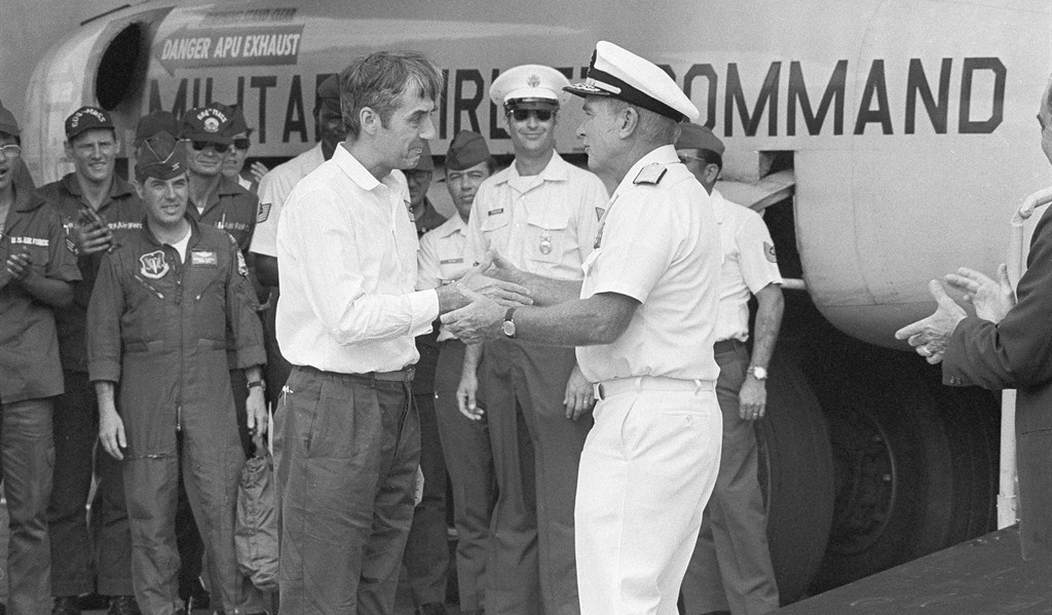
On March 4, 1973, Flom was released during Operation Homecoming after 2,401 days in captivity. Thousands later gathered in Appleton to welcome him home. Waiting among everything he had missed was Erik, the son born after his capture. A father who had spent more than six years surviving finally got to meet the boy who had spent his entire life without him.
From Veteran Tributes:
His 1st (of 2) Silver Star Citation reads:
First Lieutenant Fredric R. Flom distinguished himself by gallantry in connection with military operations against an opposing armed force near Yen Bay, North Vietnam on 8 August 1966. On that date, Lieutenant Flom was a member of a flight assigned the hazardous task of re-evaluating low level delivery tactics for use beneath low ceilings in the dense hostile fire environment of the Red River delta. Despite the highly vulnerable nature of the delivery maneuver for the prescribed munitions, Lieutenant Flom braved a barrage of savage defensive fire to ensure the precise placement of his ordnance on his target military complex. By his gallantry and devotion to duty, Lieutenant Flom has reflected great credit upon himself and the United States Air Force.
Flom refused to spend the rest of his life living inside a prison that no longer surrounded him. He continued flying with the Wisconsin Air National Guard and Air Force Reserve, later became a commercial pilot, raised his family, and kept moving forward. His family remembered him saying he had enjoyed a wonderful life, “except for maybe those seven years.”
Fredric Flom died in 2021, but the cigarette wrappers remain. They survived guards, prison cells, six and a half years of war, and the long trip home because one Wisconsin airman decided his story was worth carrying with him.
Twenty-seven scraps of paper were almost nothing.
They were also enough to bring his voice home.