





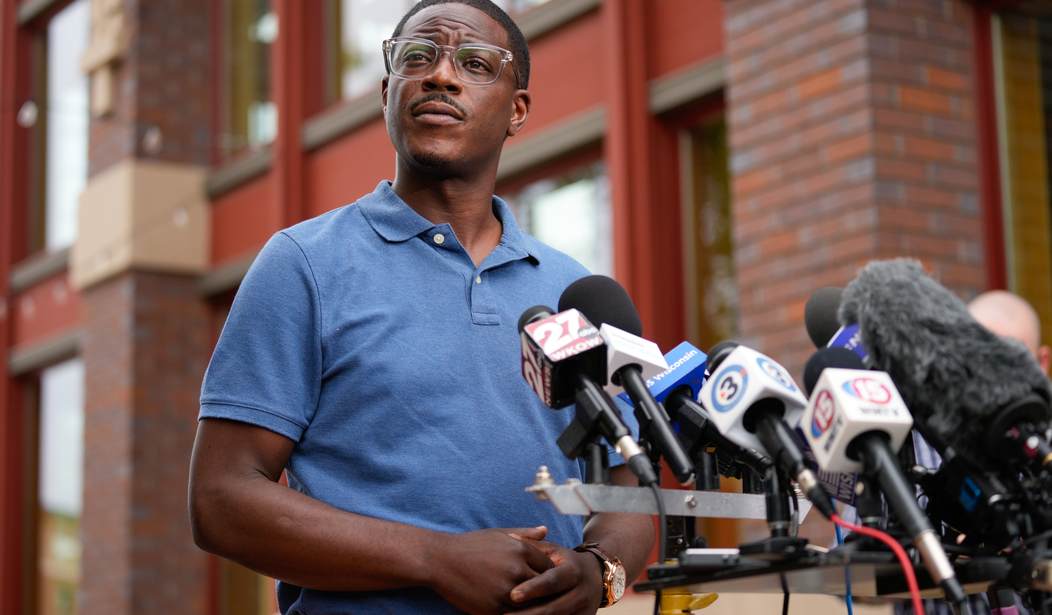
David Crowley has a problem with the congressional record, and it’s sitting in plain sight. The Democratic nominee for Wisconsin governor recently said Republican Tom Tiffany had “voted six times to defund police here in the state of Wisconsin.”
It’s a strong line in a close race, especially when public safety is already one of the sharpest points of disagreement between the candidates. The trouble is that the six votes don’t support the accusation Crowley attached to them.
There’s one point Crowley can use fairly against Tiffany. In September 2022, Tiffany voted against the Invest to Protect Act, a bipartisan bill designed to send federal grant money to smaller police departments for training, equipment, mental-health support, recruitment, and retention. The House passed it 360-64.
Tiffany was among 55 Republicans voting no, while 153 Republicans voted yes.
The vote belongs in the debate, and Wisconsin voters can decide whether Tiffany should’ve supported the bill, but voting against additional federal spending for police departments isn’t the same thing as voting to take money away from police departments.
The rest of the record makes Crowley’s wording even harder to defend. The six votes cited against Tiffany included opposition to broader legislation funding more than a dozen federal agencies, grants for violence-intervention programs, and a measure providing grants so mental-health professionals could respond to certain emergencies. None of those votes reduced existing police funding.
From Wisconsin Watch:
Milwaukee County Executive David Crowley, the Democratic nominee, claimed Tiffany voted six times to defund the police.
None of those House votes would have taken money away from law enforcement.
Tiffany voted against a bill that would have directly funded local police departments.
Other measures he opposed were different, including:
- Funding more than a dozen federal agencies, including NASA and the Commerce and Justice departments.
- Health and Human Services grants for violence intervention programs.
- Grants for mental health professionals, rather than law enforcement, to respond to certain emergencies.
We found no evidence that Tiffany backed reducing police funding.
One of those measures, the Break the Cycle of Violence Act, passed the House in 2022 with only one Republican vote. Tiffany joined 206 other Republicans in opposing it. Another, the Mental Health Justice Act, centered on grants for mental-health responders rather than sending police to some behavioral-health calls. Calling those votes “defunding police” requires a definition so broad that almost any vote against any public-safety proposal could qualify, not to mention squinting your eyes really tight.
The surrounding record also cuts against Crowley’s characterization. Earlier that same month, Tiffany introduced the House companion to Sen. Chuck Grassley’s (R-Iowa) Combating Violent and Dangerous Crime Act, legislation aimed at strengthening federal violent-crime laws. Weeks later, Tiffany told Wisconsin voters it was time to stop the “defund the police" movement. Rhetoric doesn’t erase a roll-call vote, but it makes the claim that Tiffany himself was voting to defund police look even more restrained.
Crowley is free to argue that Tiffany has been too stingy with federal police grants. He can point to Invest to Protect and ask why a congressman representing a heavily rural district opposed money aimed at smaller departments. Tiffany should answer that question.
Crowley’s larger claim goes well beyond one vote. “Defund the police” has a specific political meaning: reducing law-enforcement funding and shifting resources elsewhere. A review of Tiffany’s six cited votes found no evidence that he supported doing so.
Scrutiny becomes important when reviewing the word “defund.” It fast became one of the most loaded words in American politics after 2020 because it meant taking resources away from police and redirecting them. If every vote against creating or expanding a grant program counts as defunding, the term stops describing a policy and becomes little more than campaign paint.
The timing raises the stakes. The latest Marquette Law School poll put Crowley at 49% and Tiffany at 46% among likely voters, with the result inside the poll’s margin of error. Thirty-eight percent of independent likely voters remained undecided.
We can completely trust the polls, amirite?
When a governor’s race may turn on voters who haven’t made up their minds, campaigns are going to hit hard, which they should. But the harder the accusation, the stronger the evidence needs to be.
Crowley had a perfectly usable criticism in front of him; Tiffany voted against a bipartisan bill that would’ve sent money to small police departments, and 153 House Republicans supported it. Instead, Crowley upgraded that vote, and five others, into “defund the police.”
Crowley had a perfectly usable criticism in front of him: Tiffany voted against a bipartisan bill that would’ve sent money to small police departments, and 153 House Republicans supported it. Instead, Crowley upgraded that vote, and five others, into “defund the police.”
I know both sides tend to, well, exaggerate circumstances. But Crowley enjoys built-in advantages Tiffany doesn’t, including a friendlier media environment, favorable polling narratives, and a political culture willing to reinvent yesterday’s record when today’s campaign demands it.
When those advantages all lean in the same direction, a shaky accusation hardens into accepted truth before most voters ever bother to look at the roll call.
Support independent conservative journalism that checks the roll calls instead of repeating campaign talking points. Join PJ Media VIP and save 60% with promo code FIGHT.

Join the Conversation
VIP members get the ability to comment on articles.