Eighty-two years is a long time for a piece of an airplane to wait in a jungle. A battered wingtip from a P-38 Lightning now sits inside the Richard I. Bong Veterans Historical Center in Superior, Wisconsin. Its red paint is worn, and the metal carries the scars of time. Yet three faded numbers, 993, helped prove exactly what it was: part of the fighter once flown by Maj. Richard "Dick" Bong. America's highest-scoring fighting ace.
Bong's story began far from the Pacific. He was born in Superior in 1920 and raised on a farm near Poplar, one of nine children. He learned responsibility early, driving farm machinery, hunting, fishing, singing in the church choir, and watching airplanes cross the northern Wisconsin sky. Those planes helped plant an idea that eventually took him from a farm field to combat.
He learned to fly through the Civilian Pilot Training program while attending the State Teachers College in Superior. Bong entered Army Air Corps flight training in 1941, earned his wings in January 1942, and eventually found his airplane in the Lockheed P-38 Lightning.
The P-38 looked unlike almost anything else in the sky. Twin engines, twin tail booms, and heavy firepower gave it an unmistakable silhouette. Bong turned it into something more. In the Southwest Pacific, he began piling up victories against Japanese aircraft until he surpassed Eddie Rickenbacker's World War I record.
One P-38 carried something no performance chart could measure. On its nose was a large photograph of Marjorie "Marge" Vattendahl, Bong's girlfriend back home. He joked that she had become the most shot-at girl in the Pacific. The photograph became famous; so did the plane.
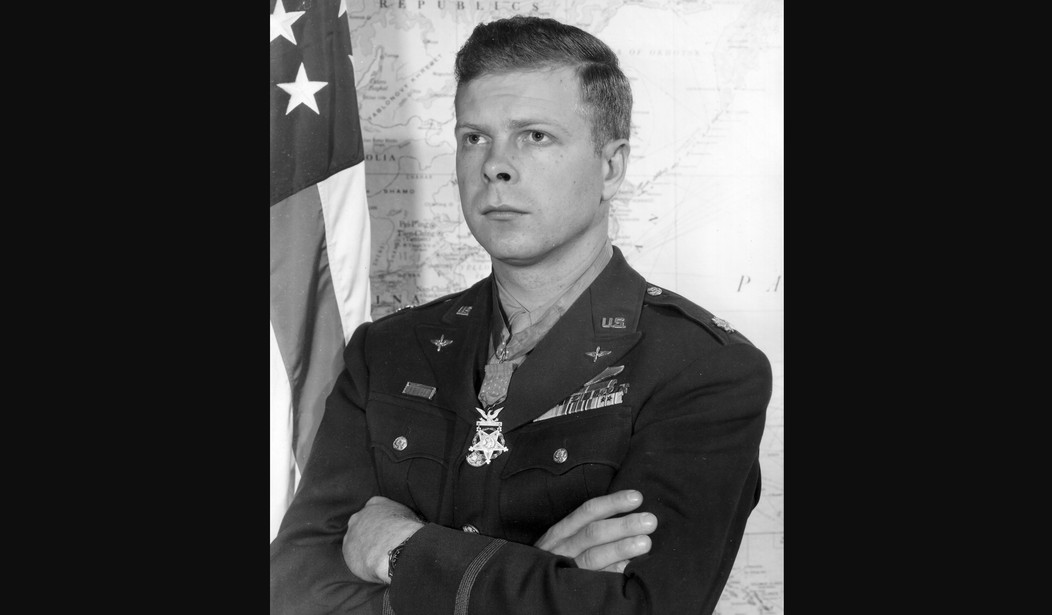
Bong eventually reached 40 confirmed aerial victories. He flew more than 200 combat missions and 500 combat hours. Even after being assigned as a gunnery instructor and no longer required to fly combat missions, he volunteered to return to the fight. Gen. Douglas MacArthur personally presented him with the Medal of Honor in December 1944.
The first "Marge," however, never made it home with him. On March 24, 1944, 2nd Lt. Thomas Malone flew P-38 serial number 420103993 on a weather reconnaissance mission over New Guinea. Mechanical and electrical failure forced Malone to bail out. He survived, while the P-38 disappeared into the jungle.
Dick came home and married Marge in Superior on Feb. 10, 1945. Their wedding became local news because America already knew both names: the pilot and the young woman smiling from the nose of his fighter.
Their marriage would last only six months.
After combat, Bong became a test pilot and worked with Lockheed's new P-80 Shooting Star jet. On August 6, 1945, the same day an atomic bomb fell on Hiroshima, Bong's P-80 suffered an engine failure after takeoff near Burbank, California. He bailed out too low for his parachute to save him.
He was only 24 years old. For decades, "Marge" remained where she fell. In May 2024, a team led by Pacific Wrecks located the crash site. Confirmation came from those final three digits, 993, still visible on the wingtip. Eighty years of jungle could scar the aluminum, but it couldn't erase the identity.
In July 2026, the Wisconsin Air National Guard helped bring the recovered wingtip out of Papua New Guinea. It traveled through Guam and Hawaii, appeared at EAA AirVenture Oshkosh, stopped in Poplar, and finally reached Superior. On September 21, the Bong Center placed it on public display in front of its restored P-38.
I'm a big fan of YouTube's Fat Electrician, and he did a wonderful piece on Bong:
Dick Bong never lived long enough to grow old with Marge. He never saw the jet age he helped usher in, and he never saw how firmly Wisconsin would hold onto his name.
But 82 years after a fighter fell into the New Guinea jungle, a piece of "Marge" made it back to the place where their story began.
For Dick and Marge, home was always Wisconsin.