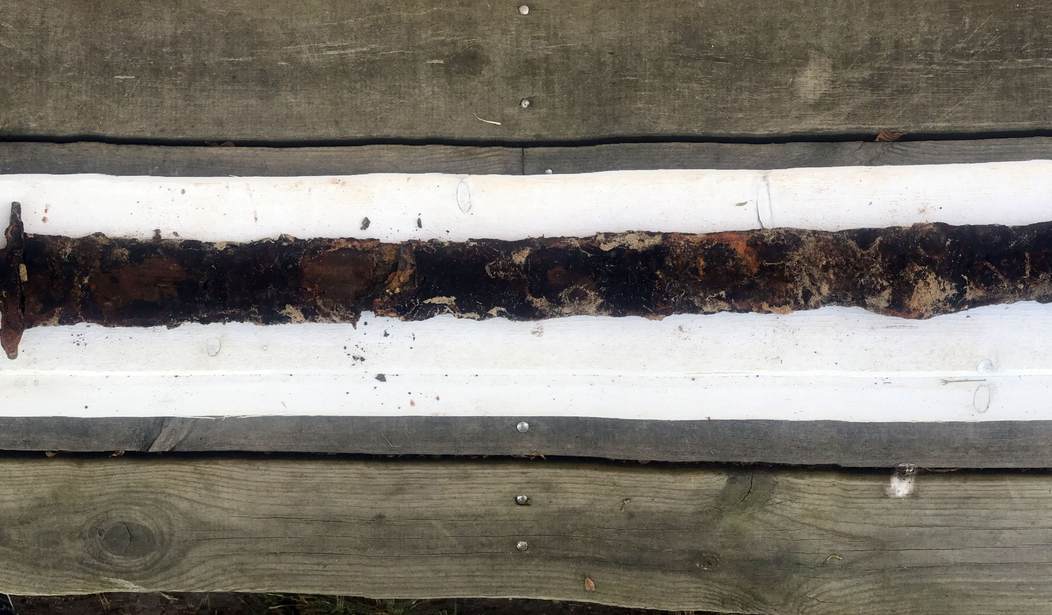
In the spring of 2019, workers at a gravel operation beside the Danube River in Austria watched an excavator pull strange pieces of rusted iron from beneath the water. Most riverbed iron isn't worth a second glance. These pieces were different; there were hundreds of them.
The workers reported the find instead of sending the rusty metal to a scrap dealer. Archaeologist Peter Trebsche later called their decision a "minor miracle." Researchers now know why. The workers had stumbled onto the largest known collection of prehistoric iron bars ever found in Europe.
From Antiquity:
Professor Trebsche and Dr Marion Berranger from the Université de Technologie de Belfort Montbéliard analysed and radiocarbon dated the find, concluding that it is a huge assemblage of iron bars dating to the La Tène period.
Comprising at least 500 iron semi-products together weighing more than one tonne, the Deinham mass find is the most abundant assemblage of Iron Age bars currently known in Europe.
Likely lost in a shipwreck, the iron was probably being transported down the River Danube for trade, highlighting the large-scale, well-organised inland shipping capabilities of later prehistoric Central European societies.
Archaeologists recovered 540 fragments. After matching broken pieces, they determined the hoard represented at least 500 individual iron bars. Together, researchers estimate they originally weighed about 2,282 pounds.
The iron dates most plausibly to the late third or second century B.C., when iron production was exploding across Central Europe. What happened to it remains a mystery.
Researchers believe the bars were probably cargo aboard a vessel that sank on the Danube more than 2,000 years ago. No ship has been found, so the wreck remains an archaeological conclusion rather than a recovered vessel.
From Cambridge:
All bars have a double-pointed shape, though several variants can be distinguished. Most bars are elongated and willow leaf-shaped; these are either completely symmetrical (variant 1), slightly asymmetrical in the longitudinal axis (variant 2), slightly asymmetrical in the transverse axis (variant 3) or have a shoulder on one side (variant 4). Some bars are shaped like a parallelogram (variant 5) or have a curved (convex) side in combination with either a straight side (variant 6), a single-peaked side (variant 7) or a double-peaked side (variant 8).
The bars were forged to be pointed, blunt or flat at each end; most display one pointed and one flat end. Most ends are straight, though some are bent upwards or bent over at 180°, and a small number are rolled inwards.
Then comes the number that transforms a pile of rusty iron into something easier to understand.
One metric ton of iron was enough to forge roughly 500 swords, each weighing around 3-1/2 to 4-1/2 pounds. Researchers say the Denham cargo contained enough material to equip a large group of warriors, even after allowing for metal lost during the forging process.
Nobody knows whether swords were ever the intended destination. The iron could've become farm tools, equipment, construction material, or thousands of other objects. Archaeologists calculate the same cargo could've produced as many as 8,000 heavy iron nails. That would've supplied nearly half the nails needed for the massive 4.35-mile defensive wall surrounding the Iron Age settlement at Manching.
The cargo also reveals something easily lost when we imagine Europe before Rome dominated the continent. These communities weren't simply making iron for their neighbors. Someone produced more than a ton of semi-finished metal, loaded it onto water transport, and moved it through an organized trade network along one of Europe's great rivers.
Researchers believe the iron was probably forged upstream in Bavaria. Iron-production centers flourished there during the period, including around Kelheim, around 137 miles upriver from Denham. Similar bars have been found around Manching, Kelheim, and the Upper Palatinate, strengthening the Bavarian connection. Tests now underway may eventually identify the metal's actual source.
Its destination is still unknown.
Somewhere more than 2,000 years ago, people mined the ore, smelted the iron, forged hundreds of bars, assembled a remarkably valuable shipment, and sent it down the Danube.
Then something happened.
The cargo vanished beneath the river and stayed there while Rome rose and fell, kingdoms appeared and disappeared, and Europe changed beyond recognition.
A gravel excavator finally brought it back.
We still don't know who was waiting downstream for all that iron. We only know somebody lost enough of it to arm 500 warriors.
And for more than two millennia, the Danube kept the secret.