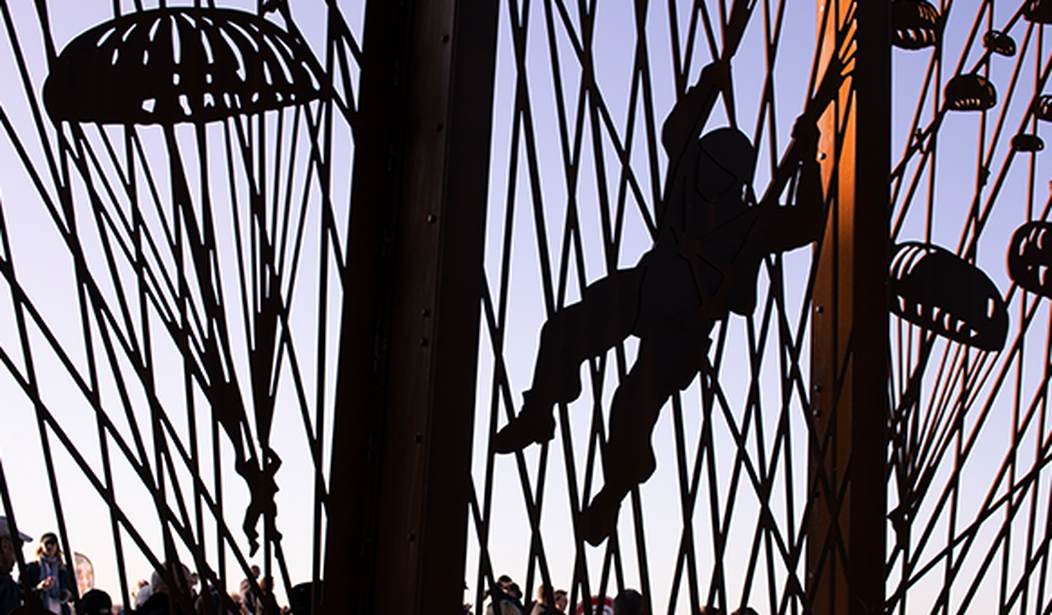
Gen. Stanislaw Sosabowski knew Operation Market Garden was asking men to gamble with their lives on hope.
He said so.
Then, when his warnings were ignored, he took his Polish paratroopers into the fight anyway.
On Sept. 17, 1944, the Allies launched one of World War II's boldest operations. American, British, and Polish airborne troops would seize a chain of bridges through the Netherlands. British ground forces would race north along a narrow highway, cross the Rhine at Arnhem, and open a path into Germany.
Success might shorten the war.
Failure could strand thousands of lightly armed paratroopers far behind German lines.
Sosabowski saw the danger before the first aircraft left England. He questioned the intelligence, the timetable, and the assumption that German resistance near Arnhem would be weak. Polish historical records note that he opposed the operation's assumptions and warned about weaknesses in Gen. Montgomery's plan.
From the Institute of National Remembrance:
Under Sosabowski's command, the Brigade began intensive training. In the Scottish town of Upper Largo, the Poles established their own training center, where they completely adapted the park and the "Largo House" building to their own needs. At their own expense, they built a parachute tower and an obstacle course called "Monkey Grove." The Brigade's motto became "The Shortest Way," and its banner, made in occupied Warsaw, bore the Latin motto "Surge Polonia" ("Rise, Poland").
His concerns proved painfully accurate.
German armored units were near Arnhem. British airborne troops landed miles from their primary bridge, radios failed, and bad weather delayed reinforcements, while the single road carrying ground troops north became a bottleneck vulnerable to German attacks.
Recommended: From the Gates of Auschwitz: Why Anger Is the Only Honest Response
The British 1st Airborne Division fought desperately around Arnhem while relief forces struggled to reach it.
Sosabowski's Polish 1st Independent Parachute Brigade had been created with another dream entirely. These men had hoped to parachute into occupied Poland and help liberate their country.
Instead, they were sent to the Netherlands.
Bad weather delayed their deployment. When the Poles finally dropped near Driel on Sept. 21, the British position north of the Rhine was already collapsing. Sosabowski and his men repeatedly tried to get across the river to reinforce them.
The Poles fought on.
They defended Driel against German attacks and helped cover the evacuation of surviving British airborne troops from the Arnhem pocket. Ninety-three Polish soldiers were killed during the battle or later died from their wounds.
Market Garden, Monty's Folly, failed.
The Allies never secured the bridge at Arnhem. Thousands of British troops were killed, wounded, or captured, and the hoped-for path across the Rhine remained closed.
Then somebody needed to carry the blame.
Sosabowski became one of the men chosen to carry it.
Polish historical records describe the accusations against him as unjust. Despite having warned about the operation before it began, he was criticized afterward by senior British commanders. Under British pressure, Polish authorities removed him from command of his brigade on Dec. 27, 1944.
Think about the sequence of events.
He warned them.
They went ahead.
He obeyed.
His men fought and died.
The plan failed.
They blamed him.
Sosabowski survived the war, but he couldn't return to the Poland he spent his life defending. A communist regime controlled his homeland. After leaving military service in 1948, the general who had commanded paratroopers at Arnhem remained in Britain and worked as a manual laborer.
He died in 1967.
It took history a little longer to catch up.
In 2006, the Netherlands awarded the Polish 1st Independent Parachute Brigade the Military William Order, the country's highest military decoration. Queen Beatrix posthumously awarded Sosabowski the Bronze Lion for bravery and leadership.
The queen called the long failure to recognize the Poles a historical error.
Sixty-two years after Arnhem, somebody finally said what should've been said in 1944.
Sosabowski didn't fail his soldiers.
He had seen the danger, told his superiors what they didn't want to hear, and then led his men to fight when the order came anyway.
There are easier ways to look wise than warning supremely arrogant people (looking at you, Monty) before a disaster.
There are easier ways to look brave than going with them after they ignore you.
Gen. Stanislaw Sosabowski did both.