Clara Barton was 40 years old when she reached Antietam on Sept. 17, 1862. She wasn't a doctor, wasn't formally trained as a nurse, and wasn't under military orders to be anywhere near the fighting.
She went anyway.
Around her, nearly 100,000 Union and Confederate soldiers were locked in a battle that would leave more than 23,000 men killed, wounded, or missing before darkness finally quieted the guns.
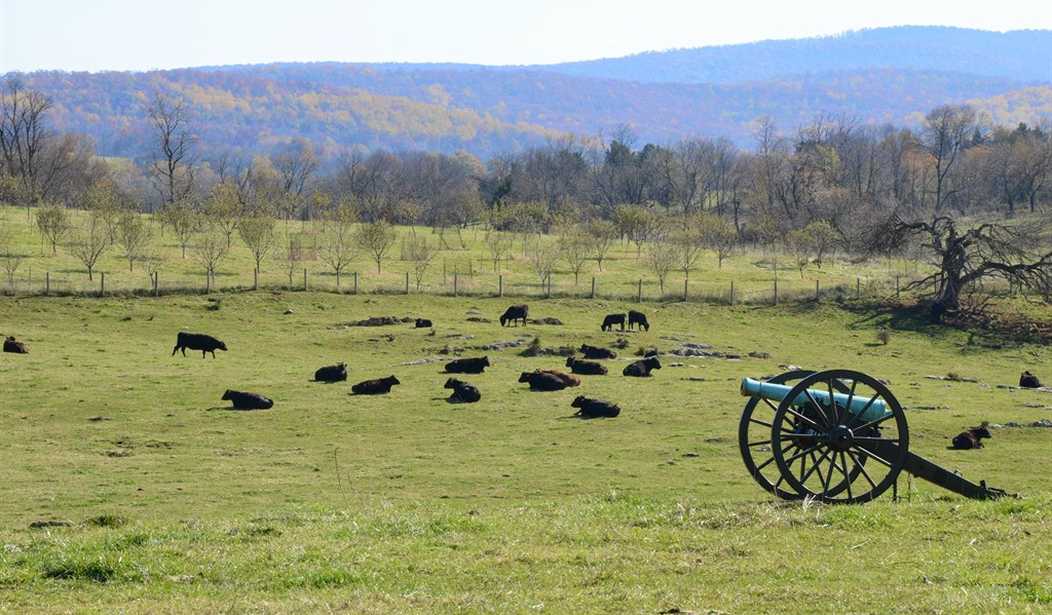
Antietam remains the bloodiest single day in American history.
Barton had spent months pushing military officials to let her take supplies closer to the front. She had already cared for wounded soldiers returning to Washington and had seen what happened when battlefield hospitals ran short of almost everything.
At Antietam, she arrived near the northern edge of the Cornfield around noon with wagons carrying medical supplies she had collected herself. Surgeons were so desperate for dressings that some were using corn husks on wounds.
From the National Park Service:
Then Miss Barton got down to work. As bullets whizzed overhead and artillery boomed in the distance, Miss Barton cradled the heads of suffering soldiers, prepared food for them in a local farm house, and brought water to the wounded men. As she knelt down to give one man a drink, she felt her sleeve quiver. She looked down, noticed a bullet hole in her sleeve, and then discovered that the bullet had killed the man she was helping.
Undaunted, the unlikely figure in her bonnet, red bow and dark skirt moved on—and on, and on. Working non-stop until dark, Miss Barton comforted the men and assisted the surgeons with their work. When night fell, the surgeons were stymied again—this time by lack of light. But Miss Barton produced some lanterns from her wagon of supplies, and the thankful doctors went back to work.
Barton opened her supplies and went to work.
The Cornfield had already become one of the worst killing grounds of the Civil War. Infantry formations had crossed and recrossed the same ground while artillery and rifle fire cut men down by the thousands. Barton moved among the wounded, bringing water, preparing food, holding injured men, and giving surgeons bandages they badly needed.
At one point, she knelt beside a wounded soldier and lifted his head to give him water.
She felt her sleeve move.
A bullet had passed through the fabric of Barton's dress without touching her. It struck the wounded man she was holding and killed him.
Barton stayed.
Later, another wounded soldier had a bullet lodged in his cheek and wanted it removed. Barton had no surgical training, but at his insistence, she took out her pocketknife and extracted it.
There is something almost impossible to picture from our distance in time. A woman who had begun working life as a schoolteacher was standing amid one of the worst battlefields this country has ever seen, performing emergency medicine with whatever she had in her pockets.
Nobody had assigned her to the job. She had seen a need and refused to remain safely behind it.
Barton kept caring for wounded men for days after the battle. Eventually exhaustion and typhoid fever badly weakened her. Still, Antietam was only one stop in a war that would take her to other battlefields, including Fredericksburg and the campaigns around Richmond.
The war ended, but Barton's work with its soldiers didn't.
President Abraham Lincoln authorized her effort to help families locate missing Union servicemen. Her Missing Soldiers Office exchanged roughly 63,000 letters and helped determine the fate of more than 22,000 missing men.
From the National Park Service:
By 1863, the Army Medical Department was geared up for a major war, overwhelming any efforts made by a single individual such as Miss Barton. But she continued working at battlefields as the war dragged on. Miss Barton threw herself into her next project as the war ended in 1865.
She helped with the effort to identify 13,000 unknown Union dead at the horrific prisoner-of-war camp at Andersonville, Ga. This experience launched her on a nationwide campaign to identify soldiers missing during the Civil War. She published lists of names in newspapers and exchanged letters with veterans and soldiers' families. The search for missing soldiers and years of toil during the Civil War physically debilitated Miss Barton. Her doctors recommended a restful trip to Europe.
Years later, Barton traveled to Europe and learned about the International Red Cross movement. In 1881, at age 59, she founded the American Red Cross and led it for more than two decades. The organization Americans now associate with disasters, blood drives, military families, and emergency relief grew from a woman who had spent years walking toward people everyone else was desperately trying to carry away from danger.
History gave Clara Barton a fine title: the Angel of the Battlefield.
I prefer the image from Antietam.
A wounded soldier is lying in her arms. A rifle cracks somewhere beyond her. Barton feels the tug on her sleeve and finds the bullet hole. Then she realizes the man she was helping is dead.
From the National Park Service:
Miss Barton continued to do relief work in the field until she was well into her 70s. But she was not a strong administrator, and political feuding at the American Red Cross forced her to resign as president in 1904.
Never married, Miss Barton was wedded to her convictions. She died in 1912 at age 90 in her Glen Echo home. She is buried less than a mile from her birthplace in a family plot in Oxford, Mass. There is a monument to Clara Barton at Antietam on the north end of the Battlefield.
She could've stopped; nobody would've blamed her for leaving.
Clara Barton found another wounded man.
And she kept working.