



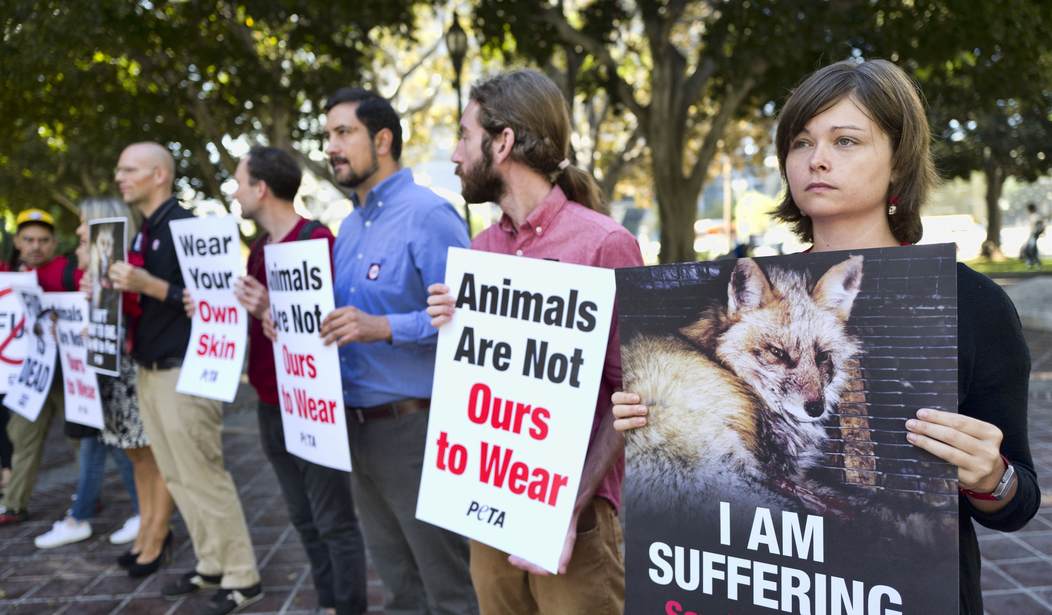
PETA has a problem that would be almost funny if the organization hadn't worked so hard to create it. Once upon a time, it uncovered something worth taking seriously.
The organization turned 46 years old on Friday.
In 1981, PETA's first undercover investigator exposed the treatment of 17 macaque monkeys at the Institute for Behavioral Research in Silver Spring, Maryland.
From PETA's website:
PETA’s founder, Ingrid Newkirk, leafed through the pages of the U.S. Department of Agriculture’s list of laboratories, picked the closest one, and asked her colleague, Alex, to see if he could get inside. He did and began working as a volunteer at the Institute for Behavioral Research (IBR). IBR was a federally funded laboratory in Silver Spring, Maryland, now closed down for reasons that will soon become apparent.
What PETA Found Inside the Laboratory in Silver Spring
It was run out of a warehouse by psychologist and animal experimenter Edward Taub, a man with no medical training. There, we found 17 monkeys living in tiny rusty wire cages caked with years of accumulated feces in a dungeon-like room. There was no veterinarian to tend to their serious wounds, and they had a lot of them.
Taub, who also had no veterinary training, nevertheless subjected the monkeys to surgeries in which he severed their spinal nerves, rendering one or more of their limbs useless. By means of electric shock, food deprivation, and other cruel methods, he forced them to try to regain the use of their impaired limbs to pick up raisins from a tray—or else go without food.
In one experiment, monkeys were shut inside a converted refrigerator and repeatedly electro-shocked until they finally used their disabled arm, if they could. The inside of the refrigerator was covered with blood. In another experiment, monkeys were strapped into a crude restraint chair—their waist, ankles, wrists, and neck held in place with packing tape—and pliers were latched as tightly as possible onto their skin, including on their testicles.
The case pushed the young organization into national attention and became a major moment in the modern animal-rights movement.
Whatever anybody thinks of PETA today, the Silver Spring case involved real questions about the treatment of research animals, not a woman wearing body paint outside a seafood restaurant.
Forty-five years later, gravitas appears to have fallen off PETA's endangered-species list. Modern activist culture has a weakness for confusing attention with accomplishment, and PETA has turned the habit into an art form.
The organization now advises Americans to treat cockroaches with compassion. Its website says killing cockroaches is "cruel and futile."
From PETA's site:
Cockroaches are opportunistic. Unlike most animals, they thrive in human environments. The insect’s incredible ability to adapt to almost any environment on Earth leads to frequent close encounters with humans. Unfortunately, the typical response is, needless to say, less than hospitable.
In fact, homeowners in the U.S. spend nearly $5 billion a year on pesticides in a vain attempt to create “pest-free” homes. Not only are these substances toxic to children and animal companions, they also don’t solve the problem over the long term. The best way to remove roaches from your home is simply to keep a clean house. Eliminating sources of food, water, and shelter is a far more effective—and certainly more humane—way to resolve conflicts with these critters.
Did You Know?
Cockroaches first appeared in the Paleozoic era, approximately 400 million years ago, and they have changed very little since then. These insects have probably withstood the test of time because of their ability to survive extreme natural disasters such as floods, droughts, and fire.
Although cockroaches have preferred food sources, if they’re hungry enough, they’ll eat almost anything. Even products that humans cannot eat, such as starch-based paints, wallpaper paste, envelope glue, and bar soaps, can provide critical nutrients for these tiny animals.
Cockroaches can also hold their breath for up to 40 minutes and can run about 59 inches per second—proportionally, that’s three times as fast as a cheetah!
Another PETA page declares that cockroaches deserve "empathy and dignity" and encourages readers to intervene if they see someone preparing to harm one.
Somewhere, an exterminator just felt a disturbance in the Force.
Consider the homeowner who flips on the kitchen light at 2 a.m. and watches six roaches conduct what appears to be a staff meeting behind the toaster. PETA would apparently prefer conflict resolution. Perhaps mediation would work; maybe the roaches could receive a strongly worded eviction notice and 30 days to vacate.
The comedy didn't retire with the roaches. In July, a nearly nude PETA supporter covered in red body paint posed as a lobster on a giant plate outside the Maine Lobster Festival.
From PETA:
Just outside the main entrance of the Maine Lobster Festival on Wednesday, a woman body-painted as a lobster will lie across a giant dish, next to a lemon wedge and butter, reading, “Try to Relate to Who’s on Your Plate.” The display will urge attendees to skip the carnage inside the festival—where around 16,000 lobsters will be steamed alive—and instead of taking a life for a fleeting taste, go vegan.
PETA has also sent a letter to festival Board of Directors President Celia Knight asking her to rename the cruel spectacle “The Red Death Festival”—because that’s precisely what it is for the thousands of lobsters who turn red as they’re steamed to death each year—and replace events such as the lobster-eating contest with attractions designed to inspire empathy for lobsters, such as enduring increasingly high temperatures in “The Heat Challenge.”
“The Maine Lobster Festival celebrates the torment and massacre of thousands of sentient animals, who feel pain as keenly as any dog, cat, or child,” says PETA founder Ingrid Newkirk. “No meal is worth such cruelty, and PETA urges everyone to show compassion to all sea life by going vegan.”
In August, another nearly nude "lobster" appeared outside a restaurant while a fake chef prepared to drag her toward a steaming pot. PETA called the spectacle an "eye-popping plea."
For once, we have common ground.
Meanwhile, the serious work of protecting animals in movie and television productions has a history that predates PETA by decades. American Humane began monitoring animal welfare on film sets in 1940, 40 years before PETA was founded.
Its "No Animals Were Harmed" program says it protected over 100,000 animals across more than 1,000 productions in 2025.
So when an animal walks safely off a movie set, PETA doesn't deserve a victory lap merely because somebody at headquarters owns red body paint and knows how to send a press release.
There's a useful cause buried beneath all the theater. Animals shouldn't be tortured, laboratories should face scrutiny, and film productions should protect the critters they use.
Americans can understand those principles without holding a candlelight vigil for a cockroach named Steve.
PETA's biggest problem is PETA itself. An organization, to which El Rushbo once referred as "3 guys and a fax machine," that once forced Americans to look at disturbing evidence too often spends its energy begging Americans to look at PETA.
The Silver Spring monkeys deserved our attention. Cockroaches deserve many things, apparently, but representation by counsel shouldn't be one of them.