


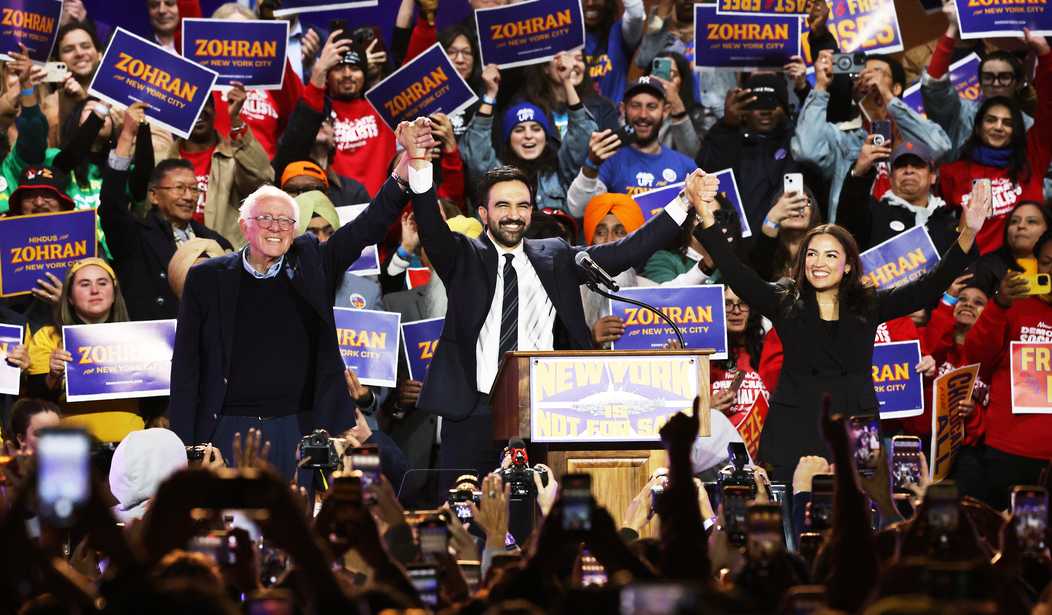
Zohran Mamdani (Communist) took office as mayor of New York City on Jan. 1, giving American socialism its largest electoral victory in roughly a century. The Democratic Socialists of America celebrated him as one of their own. The organization puts its national membership above 100,000 after reporting 65.5% growth in 2025.
From the Democratic Left:
DSA has seen multiple spikes in growth in response to national events, and Trump’s second inauguration was no exception. Membership has skyrocketed to over 100,000 members nationally, an increase of 65.6% just in 2025.
In the midst of this growth, DSA members are debating how various chapters have approached growth and member retention. My chapter may have something to add to this conversation: last year, Kansas City DSA more than doubled its membership from 245 to 548, which was twice the national average rate of growth. Our performance ranked sixth among chapters with 100 members or more. We added more net members, 303, than some chapters that started the year at twice our size. The trend continues: so far in 2026, KS DSA is the tenth fastest growing chapter by net members added. Statistics here are from Democratic Left’s “How DSA’s Top-Ranking Chapters are Changing” and the “April Growth and Development Commission Member Report.”
A handful of key people moved to Kansas City in late 2024, coinciding exactly with the “Trump bump” and setting up ripe conditions for growth. The “new to KC” comrades had been members of other DSA chapters and brought a crucial outside perspective. At that time the chapter didn’t have an active campaign or many defined structures, and our steering committee was burnt out, as all its members had served multiple terms. We were suffering from the “donut effect” where a chapter’s core members (the donut-hole) exhaust their capacity and drop out with no one to replace them.
These new members proposed different structures to help us organize better. Eventually, they were voted into leadership. Although the prior members of our steering committee were inexperienced, we did have dedication and a sense of urgency. The real core to our growth, I believe, is that we treat every day like a gift: another day to organize and build relationships within and outside of our communities.
American socialism doesn't rise on a fixed generational schedule. It returns in bursts when economic pain, resentment toward powerful institutions, and political disappointment create an opening. Each revival looks different enough to be sold as something fresh.
The first true national crest came during the Progressive Era. Eugene Debs won 900,370 votes in the 1912 presidential election, or 6% of the total. The Socialist Party held around 1,000 elected offices, most of them local. Its members governed cities, entered state legislatures, and sent Victor Berger of Wisconsin and Meyer London of New York to Congress.
From Ohio State University:
Organizationally, the Socialist Party was as strong as it had ever been. In 1910 they elected their first Congressman, Victor Berger of Milwaukee, Wisconsin, and pulled approximately 700,000 votes in various races throughout the nation. By 1912 the party held in the neighborhood of 1000 elective offices around the country, most of them municipal offices in pockets of Socialist strength throughout the Midwest. Other areas of strength included the new state of Oklahoma, where more than half of all farm families were landless tenants, and parts of the far west and California where industrial development had been particularly naked. In Oklahoma and other parts of the southwest, a strange alliance formed between socialism and conservative evangelical Protestantism, creating a sort of rural socialist revivalism no European Marxist (and in fact few American Marxists) could ever fathom. Such grassroots socialist development, strange though the roots often were, encouraged party leaders to believe a breakthrough might be at hand. In fact, the socialist vote had recently shown remarkable growth.
Nevertheless, the Socialist Party also entered 1912 almost as divided internally as the two major parties. The vast majority of Socialists holding office were not fire-breathing radicals or orthodox Marxist ideologues, but constructive reformers only a little to the left of progressive Democrats or Republicans. Their success revealed a major fissure in the party between politically-oriented reformers and labor radicals. The conservative wing, led by Berger, drew most of its strength from skilled workers in the northeast and Midwest, many of them ethnically German and/or employed in industries which retained a heritage of skill and craft (Berger’s strength in Milwaukee, for example, was based in the brewing industry and affiliated with the conservative trade unionism of the American Federation of Labor). Berger was opposed by an alliance of agrarian radicals, purist Marxists, and the hard-core labor radicals either involved in or supportive of the International Workers of the World and its policy of direct action against capitalism. These radicals opposed the skilled unionism in which much Midwestern socialism was based, some on grounds of socialist doctrine and some because it conflicted with their strategy of organizing the unskilled, and resented Berger’s strength within the party. They also disagreed among themselves as much as they agreed.
World War I broke much of that momentum. The federal government prosecuted antiwar activists under the Espionage Act, Debs went to prison, and the Russian Revolution split American socialists between reformers and communists.
What looked like a rising national party quickly fractured.
The Great Depression opened another door. Norman Thomas drew 884,781 votes as the Socialist presidential nominee in 1932, but Franklin Roosevelt captured the nation's demand for action. Organized labor grew stronger, government expanded, and several ideas once promoted by socialists entered mainstream Democratic politics.
The Socialist Party never recovered its earlier electoral strength.
A third wave arrived in the 1960s and early 1970s. Students for a Democratic Society, antiwar organizers, black radicals, and parts of the feminist movement pushed socialist or Marxist ideas into universities and protest politics.
Although several founding members of SDS came from socialist and democratic backgrounds, SDS as an organization identified itself as an educational and social action organization that brought various political groups together. SDS believed their views would revive the American democratic spirit. What made SDS unique from the Old Left is that it stressed new issues, explained in a new way by fresh faces. No longer was the defining political issue of the Left labor, and no longer was the entire political sphere systematically categorized by the power elite identified by C. Wright Mills in The Power Elite, 1956. Now, “the students were doing it; they were the resource people; they were the speakers, and to me they seemed eloquent; and they knew what they were talking about. They debated things going on around the world.” Students have a larger responsibility than merely learning in a classroom. As Alan Haber articulates in 1960, the role of the student “[also] involves the attainment of knowledge and the development of skills and habits of mind and action necessary for responsible participation in the affairs of government and society on all levels-- campus, community, state, national, international.” Students, in essence, had a duty to actively participate in society. Members of SDS (and the New Left) often grew interested in activism after either observing or participating in the Civil Rights Movement in the South, and through interaction with the Students Nonviolent Coordinating Committee (SNCC). Tom Hayden was one of these students whose interest was sparked by the sit-ins and Civil Rights Movement taking place in the South. In his “Special Report: Revolution in Mississippi,” Hayden writes an account describing the discrimination and segregation against black in McComb, Mississippi. To Hayden, this circumstance in McComb serves as a microcosm of the racial tensions across the nation and as an indicator that Americans have to take an active role in politics in order to change its social structure. Thus SNCC and the Civil Rights movement had a major impact on shaping the vision of SDS in the 1960s.
Their influence was cultural and institutional more than electoral. They changed the language of the left without building another Debs-sized party.
The current wave began after the 2008 financial crisis. Occupy Wall Street turned inequality into a national cause. Sen. Bernie Sanders (Commie-Vt.) made democratic socialism a presidential campaign brand in 2016 and 2020. Rep. Alexandria Ocasio-Cortez (D-N.Y.) carried it into Congress. Mamdani has now carried it into the mayor's office of America's largest city.
The numbers show why the movement shouldn't be dismissed. A 2025 national survey found 39% of Americans viewed socialism positively, while capitalism's favorable rating had fallen to 54%. Younger adults remain more willing than older Americans to associate socialism with equality, affordable services, and economic security.
America isn't trapped in a perfect 25-year cycle. Socialist politics grow voters when people decide the existing system has failed them. It fades when prosperity returns, factions split, voters reject the results, or major parties absorb the most popular demands.
Forgetting is the constant.
New voters hear promises of fairness, security, and affordable living without carrying the memory of earlier movements, internal battles, government coercion, or economic disappointment.
History doesn't return on schedule. Political salesmen simply keep finding a new audience.
Help PJ Media keep challenging the left’s recycled ideas and defending the principles that made America prosperous. Join PJ Media VIP today and save 60% with promo code FIGHT.






Join the conversation as a VIP Member