





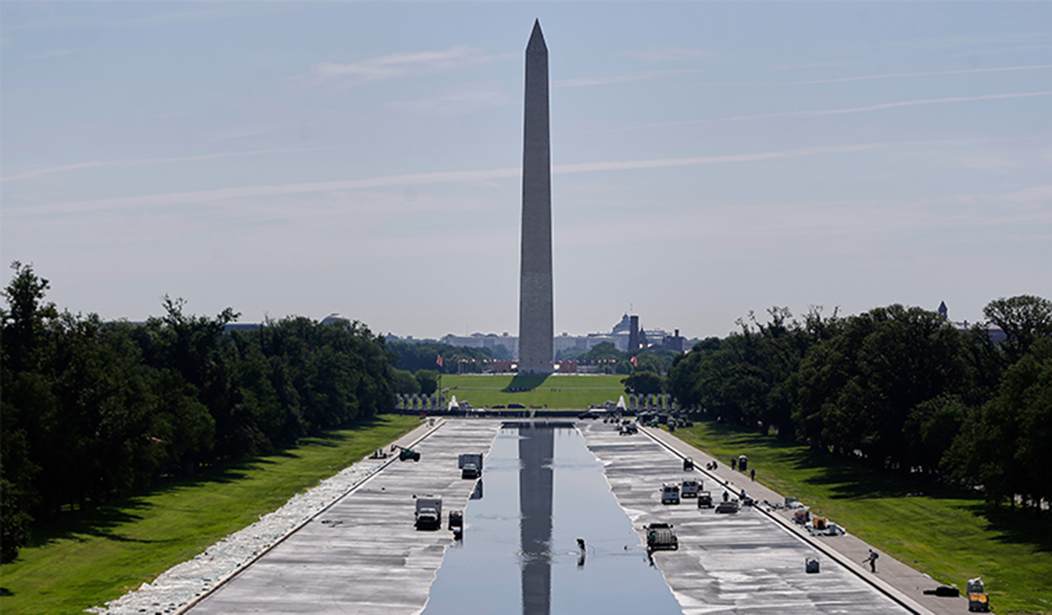
David Hearn's case was supposed to show that the federal government would defend America's monuments. Instead, the three-time U.S. Olympic canoeist spent five hours in custody, faced a felony indictment, and stared at a possible 10-year prison sentence over damage prosecutors now say he didn't cause.
The department said information provided since the indictment of former Olympic canoeist David Hearn revealed the damage was the result of a “flawed installation by the contractor” and because of “the rush to complete the project prior to events associated with the America 250 celebration in the weeks surrounding Independence Day 2026," according to the Associated Press.
“Given all of this newly discovered information, it is difficult to attribute the widespread damage to the Reflecting Pool to vandalism, let alone to establish that fact beyond a reasonable doubt,” U.S. Attorney Jeanine Pirro said in the filing.
Hearn stopped at the Lincoln Memorial Reflecting Pool during a 64-mile bike ride on June 19. He said he reached into the water to examine blue coating that was already peeling, briefly touched a loose piece, and let go when a park employee told him to stop.
Prosecutors accused him of causing at least $1,000 in damage.
On July 2, U.S. Attorney for the District of Columbia Jeanine Pirro announced a felony destruction-of-property indictment and described the incident as deliberate damage.
An indictment was returned today charging David Hearn, 67, of Bethesda, Maryland, for charges related to vandalizing the Lincoln Memorial Reflecting Pool on June 19, 2026, announced U.S. Attorney Jeanine Ferris Pirro.
“After months of renovations ordered by President Trump to prepare our capital for America’s 250th anniversary—including the restoration of more than 50 parks, 48 monuments, and 22 fountains—these deliberate acts of destruction set back real progress and violate the law,” said U.S. Attorney Pirro. “Vandalism at treasured places like the Reflecting Pool is an affront to our shared history and the dignity of our national heritage. These monuments belong to all of us, and we will protect them—and hold accountable those who seek to deface or diminish them.”
On July 2, 2026, a grand jury in Superior Court returned an indictment against Hearn for one count of felony destruction of property in violation of DC Code § 22–303. A court hearing is scheduled for July 9, 2026.
The indictment was in response to an incident that occurred on June 19, 2026, in which Hearn allegedly ripped a piece of the recently installed blue pool sealant on the bottom of the reflecting pool at the Lincoln Memorial.
Joining U.S. Attorney Pirro in the announcement was Deputy Chief David Lamond of the U.S. Park Police.
Her office moved Friday to dismiss the charge after new records showed the liner failed because of flawed work by contractor Atlantic Industrial Coatings and a rush to finish the project before the America 250 celebration.
The government's own filing raises the hardest question. The Interior Department initially gave prosecutors what Pirro's office described as incomplete, bare-bones information.
Key records arrived only after the indictment. Prosecutors wrote that they wouldn't have sought the grand jury charge if the department had supplied those records earlier. A later inspection found widespread damage, including areas in the middle of the pool where a vandal was unlikely to stand and peel the coating.
Pirro deserves credit for moving to end the case once the fuller record arrived. Prosecutors have a duty to correct course when evidence no longer supports a charge.
Government lawyers said in a 20-page court filing that additional documents provided by the Interior Department since the indictment of David Hearn show that the damage was the result of a botched installation by a contractor as well as “the rush to complete the project prior to events associated with the America 250 celebration in the weeks surrounding Independence Day 2026.” In addition, a recent visual inspection revealed damage throughout the pool, including in the middle — where prosecutors say a vandal would not likely attempt to peel the lining.
“Given all of this newly discovered information, it is difficult to attribute the widespread damage to the Reflecting Pool to vandalism, let alone to establish that fact beyond a reasonable doubt,” said the filing from U.S. Attorney Jeanine Pirro.
Hearn’s lawyers said in a statement that the case against him should never have been brought.
“Its dismissal today does not erase the abuse of government power in arresting and charging a patriotic American who did nothing wrong. The government’s approach was ready, fire, aim. The administration owes Mr. Hearn an apology,” the lawyers said.
Dropping a weak case, however, doesn't answer why the government brought a felony indictment before it understood the condition of the pool, the contractor's work, or the records held by another federal agency.
Hearn's liberty and reputation were placed at risk while agencies failed to share basic information. A felony prosecution isn't a press conference prop; it carries legal bills, public humiliation, lost time, and the threat of prison.
None of those costs vanish when prosecutors file a motion weeks later.
President Donald Trump had publicly blamed vandals for the pool's peeling surface. Protecting national monuments is a proper goal, and officials were right to investigate possible damage. Public certainty can't replace proof, especially when a criminal charge may send someone to prison for a decade.
Warning signs appeared before Friday's retreat. A National Park Service official told the grand jury that the pool already had major problems. It was leaking over 1,000,000 gallons of water each week, its expansion joints had outlived their service life, and the liner already had a rip.
The witness couldn't identify damage caused by Hearn and said the same repairs would've been needed regardless of what he did.
The Justice Department's motion still requires a judge's approval and seeks dismissal without prejudice. Even so, the government has admitted the central claim behind the felony case can't be proved beyond a reasonable doubt.
The duty to guard monuments never outranks the duty to protect people from careless prosecution. David Hearn shouldn't have needed a defense team to uncover what the Interior Department already knew. The charge may disappear, but the fear, expense, and public accusation won't.
A government with the power to take freedom owes every defendant more than a fast accusation; it owes patience, evidence, and enough humility to learn the facts before it asks a grand jury to put someone's future at risk.
Government power needs watchdogs, especially when an accusation arrives before the evidence. PJ Media keeps asking the questions officials would rather avoid. Join PJ Media VIP today and get 60% off with promo code FIGHT.
Join the Conversation
VIP members get the ability to comment on articles.