





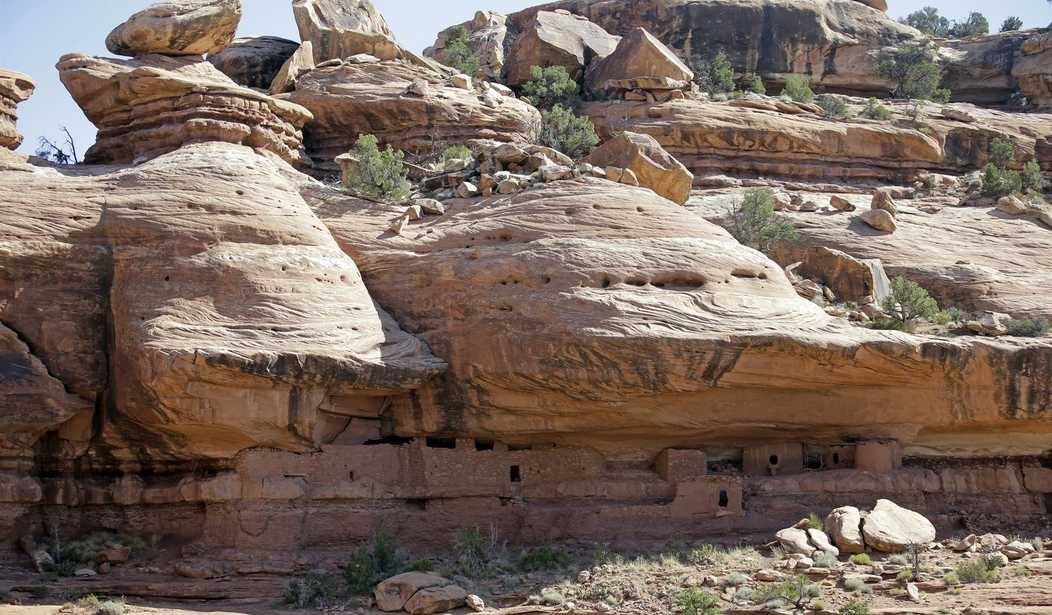
President Donald Trump signed two proclamations Monday, and the usual alarms sounded before the ink had time to dry. He reduced the boundaries of Bears Ears and Grand Staircase-Escalante national monuments in southern Utah, then explained the decision in language Washington rarely uses.
“They took the land from the people quite honestly,” Trump said. “We’re giving it back.”
The federal government still owns the land. Trump's action reduces the acreage covered by monument restrictions, opening more ground to grazing, motorized recreation, logging, mining, and other uses subject to federal law and permitting. From Reuters:
Trump made the announcement at the White House alongside Utah Governor Spencer Cox and the state's two U.S. senators, Mike Lee and John Curtis, all Republicans.
"We're doing something very dramatic and very important for the people of Utah, and the people of our country, because many people use it," Trump said.
Trump reduced the size of the monuments during his first term, and they were later expanded by former President Joe Biden despite opposition from Utah state officials.
Bears Ears was established by former President Barack Obama in 2016. The monument, named for twin buttes that resemble a bear's head on the horizon, is home to cultural and archaeological sites that are sacred to several Native American tribes.
Grand Staircase-Escalante was established in 1996 by former President Bill Clinton. Numerous dinosaur fossils have been found in the monument, known for its colorful rock formations, over the last two decades.
Bears Ears falls from about 1.36 million acres to 121,100; Grand Staircase-Escalante drops from roughly 1.87 million acres to 181,500.
Critics immediately treated the proclamations as an attack on nature, tribal history, and public lands. First Nation leaders warned that Bears Ears contains sacred sites, ancestral villages, burial grounds, medicines, and other cultural resources. From the Associated Press:
Davina Smith-Idjesa, a citizen of the Navajo Nation and co-chair of the Bears Ears Inter-Tribal Coalition, said tribal leaders had braced for a reduction since Trump was elected to a second term. She said Monday it was “heartbreaking” and accused federal officials of sidestepping their legal responsibility to consult with tribal nations that would be impacted.
“From a Navajo perspective, Bears Ears is not simply a piece of federal public land,” Smith-Idjesa said. “This is a living cultural site that holds our histories, our ceremonies, our traditional foods and medicines and our ancestors’ footprints.”
Utah officials have long fought against the monument designation and have argued that the state should be in charge of controlling its own lands. Trump in his first term reduced their size, calling their creation a “massive land grab.” Combined they span more than 3.2 million acres (13 million hectares), an area nearly the size of Connecticut.
Environmental groups are preparing another court fight over whether a president can reduce boundaries created by an earlier administration.
Court fight: two words that are as predictable as the sunrise when it comes to Trump. In this case, how dare the current president change something a previous president has done? It's not like he's similar to a CEO or anything.
Right?
Tribal concerns belong in the debate, but they definitely don't settle it. Utah communities also have a stake in how millions of acres around them are managed.
Utah Gov. Spencer Cox stood beside Trump and pointed to the Antiquities Act's requirement that monuments cover the smallest area compatible with protecting historic and scientific objects.
Congress passes laws to establish national monuments, often as part of larger land, defense or other bills. It does not establish national monuments using the Antiquities Act; this power is assigned to the President. Search Govinfo by national monument name to find laws ranging from boundary expansions or reductions, designation changes, authorization of special resource studies, to testimony surrounding the laws.
Congress typically renames national monuments. A list of recent changes to the National Park System includes new national monuments established by presidential proclamation or the legislative process, as well as name changes to existing national monuments.
Sens. Mike Lee and John Curtis (both R-Utah) and Rep. Celeste Maloy (R-Utah) also supported the move. Utah officials have spent years opposing decisions made in Washington while local communities lived with the consequences. From Congresswoman Celeste Maloy's press release:
“When Utahns found out that the Glen Canyon National Recreation Area’s Travel Management Plan included nonsensical restrictions on motorized access, they reached out for help. We took legislative action and, through this CRA, reversed a rule pushed through by the previous administration. Utahns shouldn’t be shut out of decisions that affect their own backyard. Now we can continue to recreate in the National Recreation Area. Thank you to our Senators for working with me to get this done for Utah,” said Rep. Maloy.
“Restoring off-road access in Glen Canyon is an important step to ensure our public lands remain open to the people—not closed off by Washington bureaucrats,” said Senator Curtis. “I’m proud to have worked alongside Senator Lee and Representative Maloy to get this bill signed into law and make sure the voices of Utahns were not just heard, but respected. I look forward to getting out to Glen Canyon and enjoying its roads with my fellow Utahns.”
“This was a classic case of sue-and-settle policymaking where bureaucrats caved to activists and cut Americans out of the process. That’s not how representation is supposed to work,” said Senator Lee. “I’m proud President Trump signed this CRA into law—making it clear that environmental groups don’t get to dictate our National Recreation Areas through backroom deals. That’s exactly what happened at Glen Canyon, and this law puts a stop to it. If it says, ‘National Recreation Area’ on the map, people should be able to recreate there.”
The reaction reveals a familiar rule in modern politics. When a Democratic president expands federal control, the decision is framed as protection. When Trump limits federal restrictions, the same political class reaches for words such as “destruction,” “plunder,” and “desecration.”
Monument status isn't the only protection available for archaeological sites, scenic land, or tribal resources. Utah contains millions of acres within 77 federal wilderness study areas, and those lands remain under separate management rules. Resource development also doesn't begin simply because a monument boundary moves.
Former President Joe Biden restored the larger boundaries in 2021 after Trump reduced them during his first term. The monuments have become political property, growing or shrinking whenever control of the White House changes.
Congress could establish lasting boundaries and management rules, but presidents have repeatedly used the Antiquities Act to make sweeping decisions without Congress.
President Trump chose Utah communities over the assumption that more federal restrictions are automatically wiser. Ranchers, workers, recreation users, county officials, and families who live near these lands aren't threats to be managed from Washington. Their livelihoods and judgment belong in the decision.
Preservation has value; so do access, jobs, energy, grazing, and local authority. The left's knee-jerk outrage leaves little room for any interest beyond the cause it has chosen.
Trump's greatest offense was reducing Washington's reach and saying why. He considered the people who live with federal land policy, not merely the activists who campaign around it.
For his critics, Orange Man Bad remains easier than admitting Utah may know something about Utah.
Washington’s political class has plenty of defenders. The people living with its decisions need some, too. Join PJ Media VIP and save 60% with promo code FIGHT.
Join the Conversation
VIP members get the ability to comment on articles.