


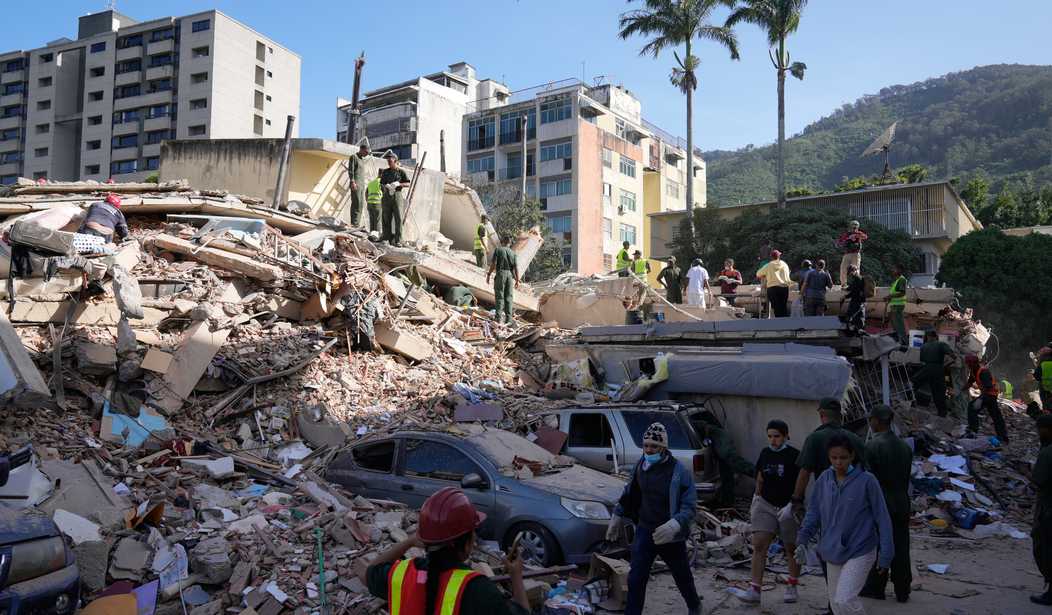
Venezuela didn't get one earthquake on Wednesday evening; it got two, and the second came before most people could even understand the first one had ended. A magnitude 7.2 quake struck the country's northern coast.
Just 39 seconds later, a magnitude 7.5 quake followed. Over 180 people died, about 1,500 were injured, and thousands were reported missing as buildings fell in Caracas, La Guaira, and beyond.
Learn More: My PJ Media teammate Sarah Anderson has done yeoman's work writing about the human toll the Venezuelan earthquakes have wrought.
Scientists call the event a doublet. It's a tidy-sounding word, almost harmless, but the reality is brutal. A doublet happens when two earthquakes of similar size strike close together in time and location. The first isn't simply the “real” earthquake and the second a routine aftershock.
As Phys.org explains, in a normal sequence, the largest quake is the mainshock, and the aftershocks are smaller quakes nearby. In a doublet, the fault system delivers two major blows, often because one rupture shifts stress onto a nearby piece of the same broken system.
Most earthquakes occur along plate boundaries, which is where tectonic plates meet.
A rupture where the Caribbean and South American tectonic plates meet unleashed the two quakes this week.
The doublet occurred where the Caribbean plate, located north of Venezuela, moves eastward relative to the South American plate at an average rate of 0.79 inches (2 centimeters) a year.
"It's a large displacement," Goulet noted. "It's on the order of the San Andreas fault."
The movement was a shallow strike-slip faulting, which occurs when two blocks of rock slide past one another horizontally.
That kind of movement is not more dangerous by default, Goulet said.
"A more vertical motion can be more damaging," she said, adding that other factors, including the length of the rupture, determine the amount of damage.
The boundary between the Caribbean and South American plates is less active than others, said David Naar, associate dean at the University of South Florida's College of Marine Science.
Christine Goulet, director of the U.S. Geological Survey's earthquake science center in California, described doublets as less common than the usual mainshock and aftershock pattern, but hardly unheard of. They can happen anywhere faults are complicated enough to rupture in stages.
Venezuela's northern fault zone fits that description. The Boconó fault runs roughly 300 miles along the Venezuelan Andes, where the Caribbean plate and South American plate grind past one another.
The motion was shallow strike-slip faulting, which means two blocks of crust slid past each other horizontally. Shallow quakes typically cause more damage because the energy reaches people and buildings with less distance to fade.
The Caribbean plate north of Venezuela moves eastward compared with the South American plate at about 0.79 inches a year. That sounds like such a tiny distance until centuries of pressure break loose in mere seconds.
The wider fear came from the calendar. Northern California had a magnitude 5.6 quake near Mendocino County; Japan, the Philippines, Papua New Guinea, and Venezuela also shook within hours. From the Ocean Exploration:
Most of the active volcanoes on Earth are located underwater, along the aptly named “Ring of Fire” in the Pacific Ocean. Made up of more than 450 volcanoes, the Ring of Fire stretches for nearly 40,250 kilometers (25,000 miles), running in the shape of a horseshoe (as opposed to an actual ring) from the southern tip of South America, along the west coast of North America, across the Bering Strait, down through Japan, and into New Zealand.
The Ring of Fire is the result of plate tectonics. Much of the volcanic activity occurs along subduction zones, which are convergent plate boundaries where two tectonic plates come together. The heavier plate is shoved (or subducted) under the other plate. When this happens, melting of the plates produces magma that rises up through the overlying plate, erupting to the surface as a volcano.
Subduction zones are also where Earth’s deepest ocean trenches are located and where deep earthquakes happen. The trenches form because as one plate subducts under another, it is bent downward. Earthquakes occur as the two plates scrape against each other and as the subducting plate bends.
The Ring of Fire lived up to its fearsome name, and human beings did what human beings do when the earth starts moving: they sought a pattern. From Eyewitness News 7:
The earthquake also rattled the Milo Foundation animal rescue sanctuary, where both animals and staff were caught off guard. The timing added to the stress, as new rescue dogs were scheduled to arrive the same day.
"I think everyone felt it. We were shocked, surprised and, of course, afraid for the animals," said Lynne Tingle, the foundation's founder.
The organization is now calling for additional volunteers and pet adoptions to help support ongoing operations.
The Mendocino County quake struck within hours of several major earthquakes worldwide -- including activity in Japan, the Philippines, Papua New Guinea and Venezuela -- raising questions about whether the events are connected.
Seismologist Dr. Angela Lux of UC Berkeley says it's natural for people to look for patterns, but current science suggests otherwise.
"It makes sense people want to correlate and look for patterns," Lux said.
According to Lux, there is no evidence linking the California quake with those overseas, and the timing is most likely coincidental.
"We started with the earthquake in Redwood Valley. I would say confidently that did not have an effect on the quake in Venezuela," she said.
While earthquakes can sometimes influence nearby seismic activity, the distances between these events are too vast for a direct connection. Experts say the shaking serves as a reminder for Californians to stay prepared for earthquakes at all times.
Dr. Angela Lux, a seismologist at the University of California, Berkeley, said current science doesn't show evidence linking the California quake to the overseas events. William Barnhart, Ph.D., assistant coordinator in the U.S. Geological Survey's Earthquake Hazards Program, has made the same broader point about the recent global cluster.
The quakes struck known seismic zones, but their close timing appears to be a coincidence.
Coincidence feels like a weak answer after a day like that. It's also often the right answer. Earth is always shifting; roughly 90% of the world's earthquakes occur along the Pacific Ring of Fire, a horseshoe-shaped zone that stretches about 25,000 miles around the Pacific Ocean and holds more than 450 volcanoes.
A busy seismic day doesn't prove a global chain reaction; it proves the planet's most restless fault lines are doing what they've always done.
The Venezuela doublet still deserves attention because it shows the danger hidden inside labels. “Doublet” sounds like a classroom term; on the ground, it means survivors of one violent shock may have no meaningful pause before the next one arrives. Phys.org explains that doublets can occur anywhere in the world.
While not as common as a typical earthquake where a main shock is followed by much smaller aftershocks, doublets can happen anywhere in the world, Christine Goulet, director of the USGS earthquake science center in California, told The Associated Press.
Doublets indicate a complex fault structure, like the one in Venezuela. Known as the Bocono fault, it runs along the backbone of the Venezuelan Andes for about 300 miles (500 kilometers). A previous doublet—of magnitudes 6.2 and 6.3—struck an area west of Caracas in September 2025, killing at least one person and injuring more than 100 others. Most of the damage was reported in the states of Zulia and Lara.
Science can name the pattern, measure the faults, and warn about aftershocks. It can't make 39 seconds feel like enough time to flee a falling building.